
46. Ascending
Ascending is hexagram 46 of the 64 in the I Ching, also known as the Book of Changes (in Chinese Shēng, 升).
Also known as: Pushing Upward.
Ascent here is not made in leaps, but through steady, upward faithfulness.
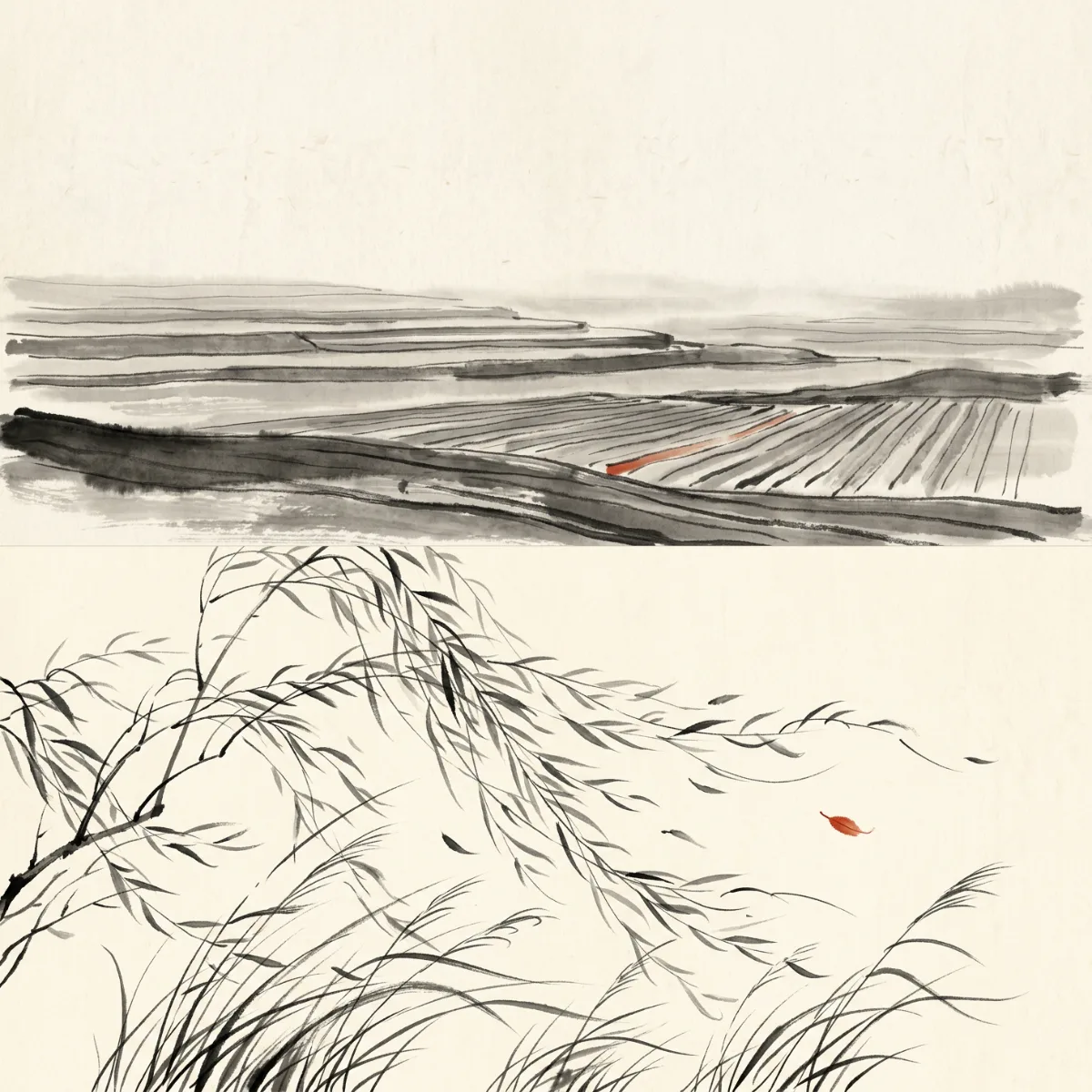 46. Ascending升 · ShēngAscent here is not made in leaps, but through steady, upward faithfulness.
Hexagram 46 (Ascending) often shows up around making steady progress, growing step by step or heading toward a promotion. At its core: Ascent here is not made in leaps, but through steady, upward faithfulness.
Where this hexagram often fits.
Situations
- making steady progress
- growing step by step
- heading toward a promotion
- climbing slowly
- patiently building up
- growing into a bigger role
- wanting to speed up without footing
- not underrating small progress
Questions people ask
- How do I keep going steadily without trying to leap?
- Why does slow progress feel like too little?
- Will this rise hold if I bring my base along?
- What does patient climbing ask of me?
What is often at play
- impatience to be at the top
- need for validation
- urge to rush it
- doubt that the steps count
What this asks for
- keep working steadily
- honor the lower rungs
- grow from your roots
- humility in the climb
Also searched as
- Pushing Upward
- Ascending
- Upward movement
- Steady growth
- Rising
- Promotion
- Advancement
Core image
This hexagram is about slow rising: growing upward and being taken into a higher order. The image is nothing spectacular. It is the gradual, unbroken lift that is favored here. What climbs does so because it is rooted, and lets itself be carried one step at a time.
Tension
The tension lies in the patience that climbing demands. One wants a result to point to, wants to be higher sooner, wants confirmation that the rise counts. But this hexagram does not honor the leap. It honors the steady ascent that is real from the ground up.
Distortion
Rising distorts when it turns into careerism, self-elevation, or hurried striving. Then one does climb, but without ground. What rises without root grows thin.
Stance
Work steadily, honor the lower rungs, and stay available to a lead that reaches higher than your own drive. Good climbing carries humility in it. Not because it thinks little of itself, but because it knows that height only holds when the base can come along.
Closing line
Whoever truly rises leaves no cut-away ground beneath them.
Plain-language entrances.
Plain-language entrances to this hexagram. They help with search and recognition, while the reading itself remains rooted in the text and your question.
Hexagram 46 - Ascending
Hexagram 46 - Ascending gives language to a recognisable I Ching pattern. Read the linked hexagram as the source, not as a separate interpretation.
Changing lines of hexagram 46
- Line 1. At the start the climb is still modest, but favored. There is no need to make light of small progress. It is here, exactly, that the tone is set for a rise that can last.
- Line 2. Here the ascent comes paired with sincerity in shape or devotion. That keeps the way upward from going empty or merely ambitious; it stays worthy. What is offered small can be granted wide passage.
- Line 3. At this point the rise opens unexpectedly easily. That is favored, but it also asks for restraint. Whoever swells now on the ease loses the rhythm that brought them up.
- Line 4. Here the climb takes on a more ritual, public weight. One is taken into something larger than one's own path. That asks for a fitting bearing, not for triumph.
- Line 5. This line shows the middle of steady rising. There is trust, direction, and no need to force. The ascent becomes load-bearing here precisely because it does not celebrate itself.
- Line 6. When climbing wants only height and no longer listens to measure, it tips toward strain. Yet even this line can stay favored if the persistence is bound to what is right. Without an inner compass, even rising becomes a fever.
The form beneath hexagram 46
Derived from the structure of the I Ching — not an interpretation, but the shape underneath it. The reading above remains the source.
- Balance. Hexagram 46 is predominantly yin — 4 yin lines and 2 yang lines.
- Line pattern. From bottom to top: yin, yang, yang, yin, yin, yin.
- Movement. 63 possible paths of change run from this image — every combination of moving lines leads to a different hexagram.
Built from
Hexagram 46 is built from two trigrams, the natural forces of the I Ching.
Related hexagrams
Sources & reading
Our text is our own, ratified reading of the canonical I Ching — source → human → pattern → fitting movement. It is not a reproduction of the translations above, and not prediction, psychology, or new-age. The reference translations serve to calibrate; protected prose is not taken over.
- Richard Wilhelm / Cary F. Baynes — The I Ching or Book of Changes. symbolic-philosophical, with the Ten Wings — the most influential Western edition.
- James Legge — The Yî King (Sacred Books of the East). scholarly-philological (public domain).
Read what is in motion in your situation.
A hexagram only takes on meaning in relation to your own question. Ask one and read what appears.