
A short history of the I Ching
The I Ching — the Book of Changes — is more than three thousand years old, and in that time it has been many things: a divination manual, a philosophical classic, a text for the imperial examinations, and in the West a symbol of Eastern wisdom. Below is the main line, always distinguishing what is traditionally handed down from what is historically established.
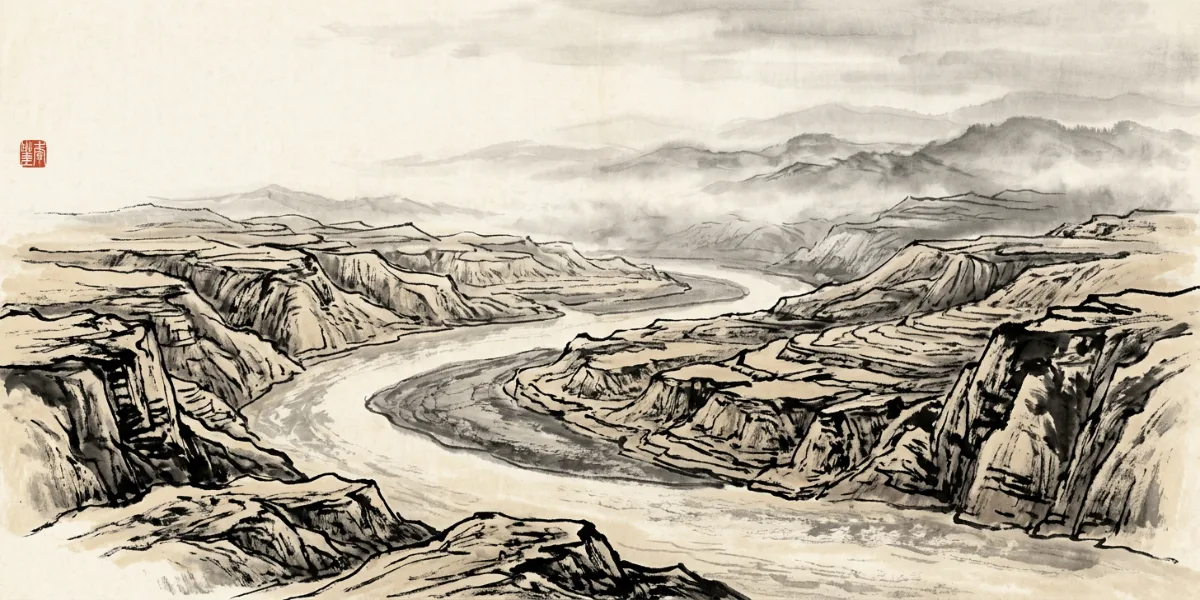
Before the book: divination in ancient China
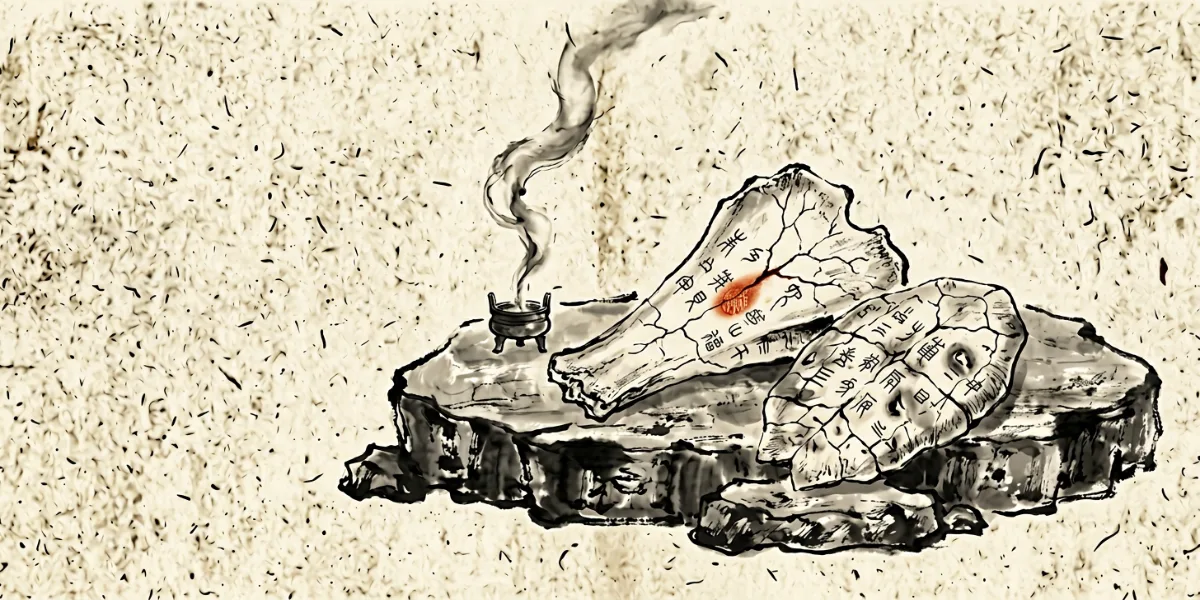
Long before the I Ching existed, divination was woven into Chinese court life. Under the Shang dynasty (c. 1600–1046 BCE) people heated turtle shells and ox bones until they cracked; from the cracks they read an answer. Those oracle bones carry the oldest known Chinese script.
The I Ching does not come directly out of those bones — it belongs to another, related tradition: the counting of yarrow stalks. But the oracle bones show that the I Ching did not arise from nothing: it stands in a long line of attempts to find direction in an uncertain world.
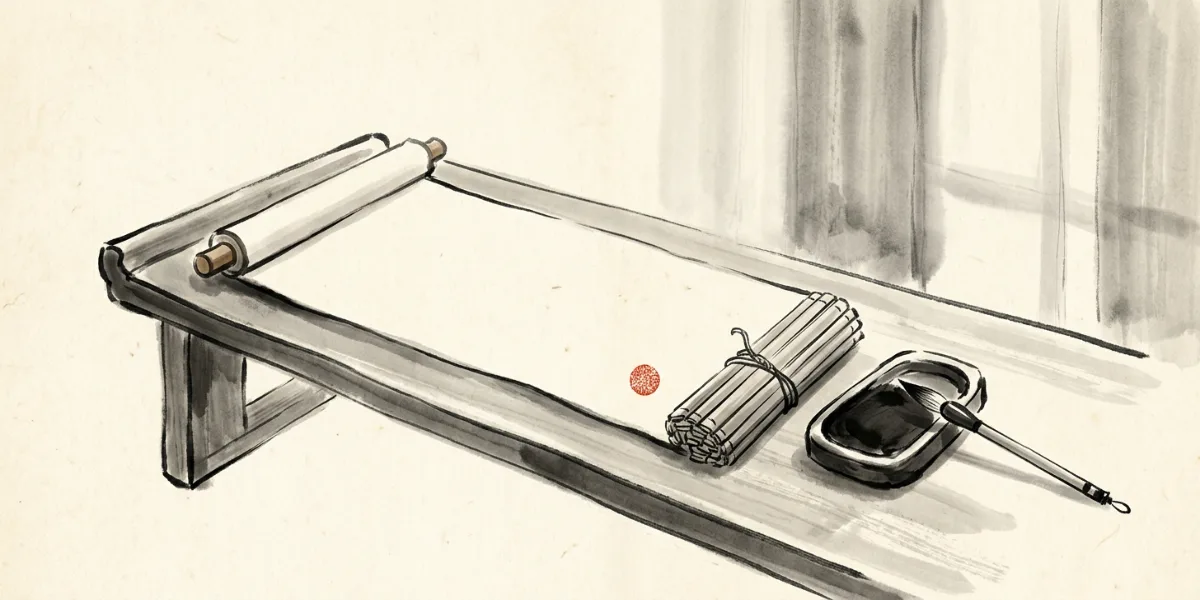
The core: the Zhou Yi
The oldest layer of the book is called the Zhou Yi, the “Changes of Zhou”. It arose in the Western Zhou period, roughly between 1000 and 750 BCE. This is the bare core: the 64 hexagrams, each with a short judgment, and at each line a saying.
In that oldest form the I Ching is a manual for divination — terse, sometimes riddling, close to the ritual. The philosophy we now read in it came later.
The core (Zhou Yi) is an oracle. The commentaries (the Ten Wings) make it a wisdom text. That distinction is the key to the whole history.
King Wen and the Duke of Zhou
Tradition attributes the hexagrams and their judgments to King Wen, who is said to have ordered them during his imprisonment, and the line texts to his son, the Duke of Zhou. It is a fine and venerable story.
But it is handed-down tradition, not proven authorship. Modern textual scholarship does not see the I Ching as the work of one hand at one moment, but as a text that grew over generations — collected, ordered, and passed on. The names mark an origin, not a signature.
The Ten Wings: from oracle to wisdom
The great shift comes with the Ten Wings (Shi Yi): a series of commentaries that grew around the core in the Warring States and Han periods (roughly the 4th to 2nd century BCE). Traditionally they are attributed to Confucius; most scholars date them later, after his death.
With the Ten Wings something essential changes. The same signs that once predicted an outcome are now read as images of change, direction, and stance. The oracle becomes a mirror for the person standing before it. This is the wisdom tradition this practice rests on — not the predictive oracle core, but the reading that asks: what does this ask of me?
A classic
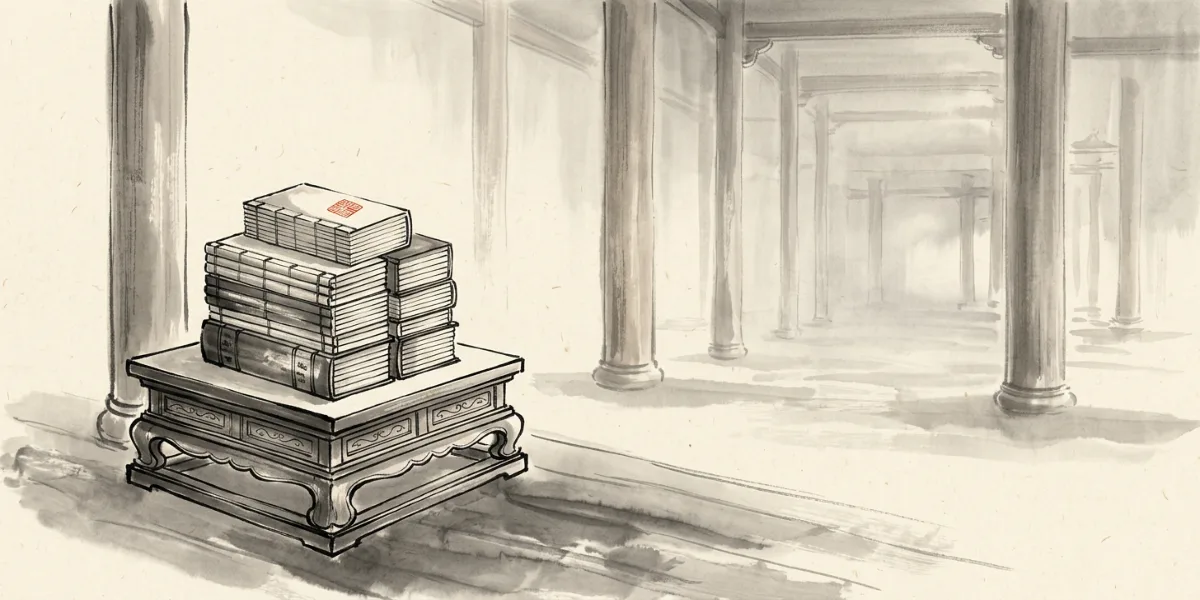
Once furnished with its commentaries, the I Ching became one of the Five Classics of Confucianism — required study for anyone who wanted to pass the imperial civil-service examination. At the same time Taoists read it as a book about the natural course, and later thinkers built whole cosmologies on it, around yin and yang and the five phases. In the 3rd century Wang Bi wrote an influential commentary that anchored the philosophical reading further; centuries later the neo-Confucian Zhu Xi did the same.
Through all those readings the text stayed the same, and what people saw in it changed. That is no weakness of the I Ching — it is exactly how it works.
The I Ching comes to the West
Through Jesuits in China the I Ching reached Europe. Famous is the correspondence in which Leibniz believed he saw, in the hexagram ordering, an echo of his binary system. The first major scholarly English translation came from James Legge (1882), sober and philological.
The edition that truly made the I Ching popular in the West was that of Richard Wilhelm (German, 1924), translated into English by Cary Baynes (1950), with a foreword by Carl Jung. Jung read the apt answers as synchronicity — a meaningful coincidence without a causal link.
We describe it; we do not adopt it as our working lens. See our position.
What archaeology changed
The twentieth century brought finds that adjusted the picture. In 1973, at Mawangdui, a Yijing written on silk came to light, with a different ordering of the hexagrams and its own commentaries. Later, bamboo strips from the Warring States period appeared. Together they showed that there was not one fixed original text, but several streams circulating side by side before the text took its classical form.
The research goes on. That is why this practice keeps history as a means, not an end in itself: it serves the understanding of the text, it does not replace it.
Sources & reading
Our text is our own, ratified reading of the canonical I Ching — source → human → pattern → fitting movement. It is not a reproduction of the translations above, and not prediction, psychology, or new-age. The reference translations serve to calibrate; protected prose is not taken over.
- Richard Wilhelm / Cary F. Baynes — The I Ching or Book of Changes. symbolic-philosophical, with the Ten Wings — the most influential Western edition.
- James Legge — The Yî King (Sacred Books of the East). scholarly-philological (public domain).
Based on the I Ching (Book of Changes). Traditional attributions are named as such; where the dating is uncertain, that is noted.
For a source-linked map of people, places and textual events, see the history field in the I Ching Atlas.
Frequently asked questions about the history of the I Ching
Who wrote the I Ching?
Traditionally the hexagrams and their judgments are attributed to King Wen and the line texts to the Duke of Zhou, and the commentaries to Confucius. That is handed-down tradition, not proven authorship: modern textual scholarship sees the I Ching as a text that grew over centuries.
How old is the I Ching?
The core — the Zhou Yi, the hexagrams with their judgment and line texts — dates from the Western Zhou period, roughly 1000–750 BCE. The philosophical commentaries (the Ten Wings) came centuries later, in the Warring States and Han periods.
Was the I Ching originally an oracle?
Yes. The oldest layer is a divination manual. The wisdom tradition of the Ten Wings later reads those same signs as direction and stance — that is the reading this practice rests on, not the predictive oracle core.
Where we stand toward this history.
Origin first, the interpretation open — and our own chosen lens named.