
47. Exhaustion
Exhaustion is hexagram 47 of the 64 in the I Ching, also known as the Book of Changes (in Chinese Kùn, 困).
Also known as: Oppression.
Exhaustion shows what remains when pressure can no longer be carried by show.
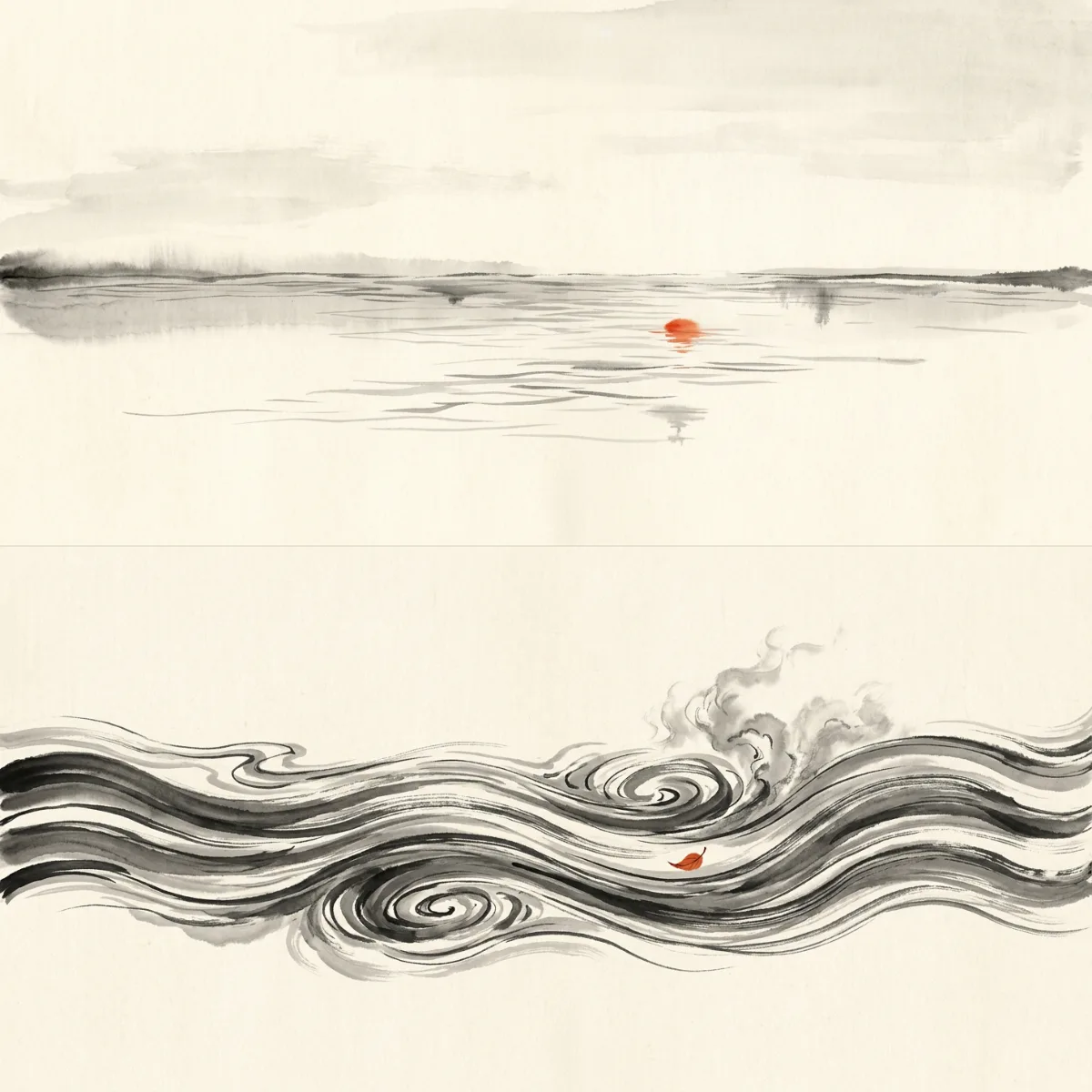 47. Exhaustion困 · KùnExhaustion shows what remains when pressure can no longer be carried by show.
Hexagram 47 (Exhaustion) often shows up around burnout, feeling trapped or hitting a wall. At its core: Exhaustion shows what remains when pressure can no longer be carried by show.
Where this hexagram often fits.
Situations
- burnout
- feeling trapped
- hitting a wall
- no way out
- drained
- under prolonged strain
- everything is an effort
- not being heard
Questions people ask
- How do I deal with prolonged pressure?
- Why can't I move forward right now?
- What does this period of exhaustion ask of me?
- What happens in this relationship when everything feels strained?
What is often at play
- pressure
- shame
- fatigue
- isolation
What this asks for
- inner steadiness
- honesty
- enduring soberly
- recovering meaning
Also searched as
- Oppression
- Exhaustion
- Confined
- Adversity
- Entangled
- Weariness
- Pressure
- Trapped
Core image
This hexagram is about being pressed thin: scarcity, confinement, a load that narrows what you can do. You are short of something — means, room, recognition, breath. But this is more than lack. The real question is what keeps its dignity when there is no longer slack to hide behind.
Tension
The tension breaks at the point where the usual reserves run out. You can no longer coast on bravado, routine, or support from outside. That is when it shows whether the inner line stays straight as the walls close in.
Distortion
Exhaustion goes wrong when it curdles into self-pity, bitter theater, or hard cynicism. Then the strain is no longer carried but smeared across everyone in reach. What was already tight turns murky too.
Stance
Keep the inner line straight, and spend no strength complaining that the room is small. Look for plainness, fidelity, and a way of speaking that does not beg for pity. Exhaustion is not glorified here — it is tested for dignity.
Closing line
When the room narrows, you find out whether your core can stand straight with nothing holding it up.
Plain-language entrances.
Plain-language entrances to this hexagram. They help with search and recognition, while the reading itself remains rooted in the text and your question.
Hexagram 47 - Exhaustion
Hexagram 47 - Exhaustion gives language to a recognisable I Ching pattern. Read the linked hexagram as the source, not as a separate interpretation.
Hexagram 47 - Exhaustion
Hexagram 47 - Exhaustion gives language to a recognisable I Ching pattern. Read the linked hexagram as the source, not as a separate interpretation.
Changing lines of hexagram 47
- Line 1. At the start the strain is still raw and felt in the body. The pressure is direct and there is little room to move. This is exactly when needless agitation has to be reined in.
- Line 2. Here some support exists, but not in the form or timing you would have chosen. That can feel demeaning. Still, the line asks for dignified acceptance, without bending on the inside.
- Line 3. At this point you jam yourself with clumsy movement in an already narrow place. The exhaustion only stiffens. Not every extra shove is real effort; sometimes it is only friction.
- Line 4. Here relief comes slow and incomplete. That asks for patience in an awkward in-between. You may feel the delay without letting it turn you bitter.
- Line 5. This line shows a center that does not fully collapse under pressure. There is limit, but no inner surrender to humiliation. So the exhaustion stays hard, yet does not break you apart.
- Line 6. When exhaustion hits its furthest edge, the pull is to read everything as a permanent cage. Then you see the opening too late. This line asks for one last shift in stance, so the confinement no longer holds as absolute.
The form beneath hexagram 47
Derived from the structure of the I Ching — not an interpretation, but the shape underneath it. The reading above remains the source.
- Balance. Hexagram 47 is in full balance — 3 yang lines and 3 yin lines.
- Line pattern. From bottom to top: yin, yang, yin, yang, yang, yin.
- Movement. 63 possible paths of change run from this image — every combination of moving lines leads to a different hexagram.
Built from
Hexagram 47 is built from two trigrams, the natural forces of the I Ching.
Related hexagrams
Sources & reading
Our text is our own, ratified reading of the canonical I Ching — source → human → pattern → fitting movement. It is not a reproduction of the translations above, and not prediction, psychology, or new-age. The reference translations serve to calibrate; protected prose is not taken over.
- Richard Wilhelm / Cary F. Baynes — The I Ching or Book of Changes. symbolic-philosophical, with the Ten Wings — the most influential Western edition.
- James Legge — The Yî King (Sacred Books of the East). scholarly-philological (public domain).
Read what is in motion in your situation.
A hexagram only takes on meaning in relation to your own question. Ask one and read what appears.