
25. Innocence
Innocence is hexagram 25 of the 64 in the I Ching, also known as the Book of Changes (in Chinese Wú Wàng, 無妄).
Where movement is not spoiled by calculation, the true gains room of its own accord.
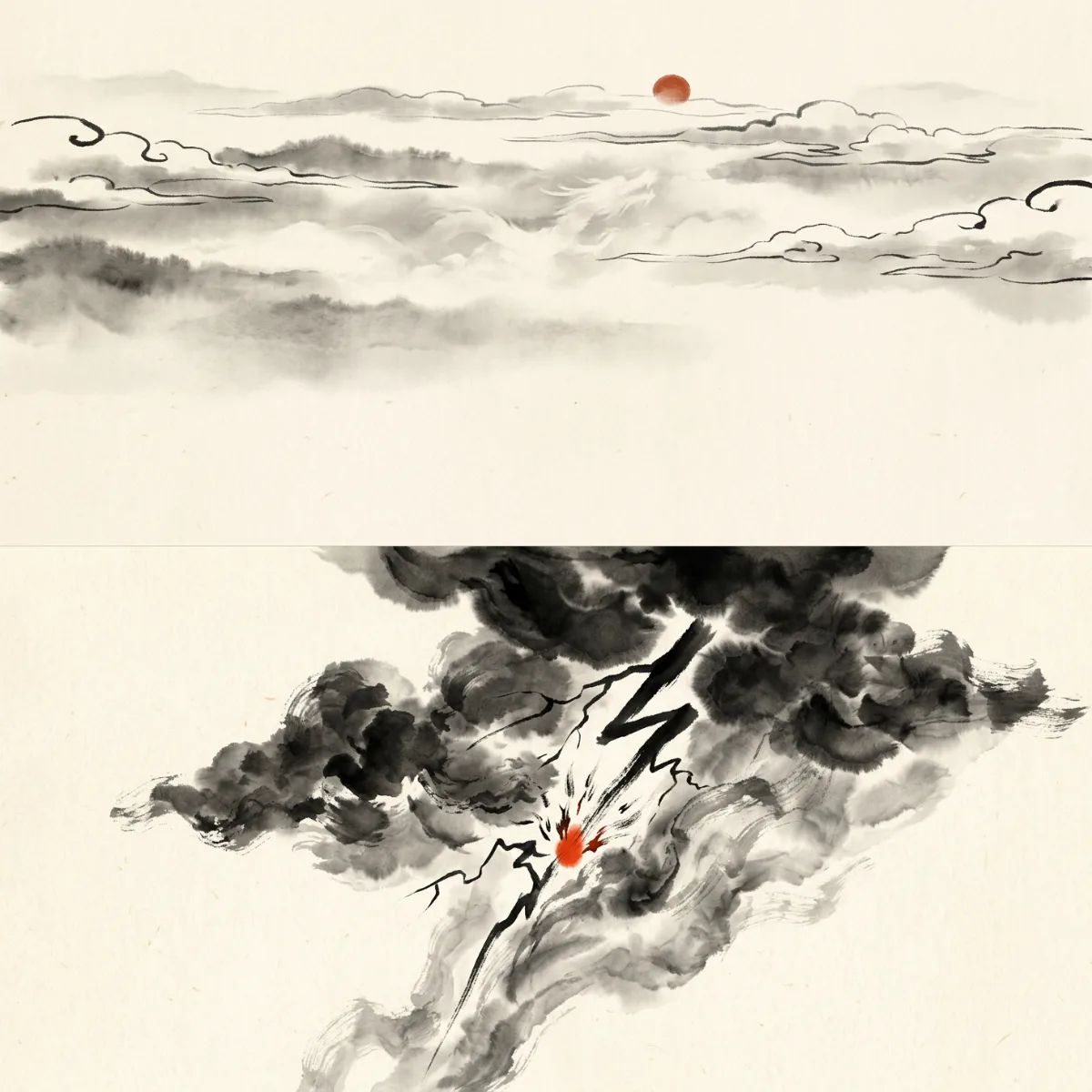 25. Innocence無妄 · Wú WàngWhere movement is not spoiled by calculation, the true gains room of its own accord.
Hexagram 25 (Innocence) often shows up around wanting to act without an agenda, trying to stay genuine or no hidden motives. At its core: Where movement is not spoiled by calculation, the true gains room of its own accord.
Where this hexagram often fits.
Situations
- wanting to act without an agenda
- trying to stay genuine
- no hidden motives
- acting on instinct
- wondering if I'm being too naive
- just want to be honest
- getting blamed for something I didn't cause
- am I too trusting
Questions people ask
- How do I stay honest without becoming naive?
- Am I acting from a clean motive or from calculation?
- Can I just respond spontaneously here?
- What does it take to stay genuine under pressure?
What is often at play
- sincerity
- openness
- guilelessness
- slight doubt
What this asks for
- stay true to your motive
- don't overthink it
- stay alert
- act cleanly
Also searched as
- Innocence
- The Unexpected
- Sincerity
- Naturalness
- Integrity
- Spontaneity
- Guilelessness
Core image
This hexagram is about innocence, though not in the childlike sense. It is about acting that has not yet been bent out of true by cleverness, manipulation, or a hidden interest. The force moves here without a double agenda. From that, something straight and open arises.
Tension
The tension sits in the difference between purity and naive blindness. Not everything that looks open-faced is also true. This hexagram asks not for blind trust, but for a heart that is not steered by an ulterior motive. The moment calculation enters, the movement loses its straightness.
Distortion
Innocence distorts when it is played, or confused with incompetence. Then purity becomes a pose, and simplicity an excuse not to see. Real innocence stays awake.
Stance
Stay straight in motive. Don't act clever where plain enough is already strong, but don't act dumb out of vanity about being pure either. Let the movement come from what is true, not from what seems convenient. Innocence here is no lack of intelligence, but the absence of crookedness.
Closing line
What needs no ulterior motive often carries further than the calculated.
Plain-language entrances.
Plain-language entrances to this hexagram. They help with search and recognition, while the reading itself remains rooted in the text and your question.
Hexagram 25 - Innocence
Hexagram 25 - Innocence gives language to a recognisable I Ching pattern. Read the linked hexagram as the source, not as a separate interpretation.
Changing lines of hexagram 25
- Line 1. At the start, the innocence is still fresh and without strain. That is a strong place. What comes here plainly out of the straight needs no correction yet.
- Line 2. This line works without already owning the harvest. There is effort without grasping at the result. That keeps the act clean.
- Line 3. At this point innocence can take damage from its surroundings. One is struck though the fault did not come from one's own crookedness. This line asks for the sober carrying of undeserved loss.
- Line 4. Here one can keep to the straight track without theatrical purity. That matters. Not everything has to be proven in order to stay pure.
- Line 5. This line shows an innocence that does not turn sickly from self-scrutiny. There is health of motive. So nothing need be forced in order to act well.
- Line 6. When one keeps going on blind trust while reality already asks for something else, innocence goes impure. Then purity tips over into the wrong kind of stubbornness. This line warns against a pure motive without a right reading of the situation.
The form beneath hexagram 25
Derived from the structure of the I Ching — not an interpretation, but the shape underneath it. The reading above remains the source.
- Balance. Hexagram 25 is predominantly yang — 4 yang lines and 2 yin lines.
- Line pattern. From bottom to top: yang, yin, yin, yang, yang, yang.
- Movement. 63 possible paths of change run from this image — every combination of moving lines leads to a different hexagram.
Built from
Hexagram 25 is built from two trigrams, the natural forces of the I Ching.
Related hexagrams
Sources & reading
Our text is our own, ratified reading of the canonical I Ching — source → human → pattern → fitting movement. It is not a reproduction of the translations above, and not prediction, psychology, or new-age. The reference translations serve to calibrate; protected prose is not taken over.
- Richard Wilhelm / Cary F. Baynes — The I Ching or Book of Changes. symbolic-philosophical, with the Ten Wings — the most influential Western edition.
- James Legge — The Yî King (Sacred Books of the East). scholarly-philological (public domain).
Read what is in motion in your situation.
A hexagram only takes on meaning in relation to your own question. Ask one and read what appears.