
22. Grace
Grace is hexagram 22 of the 64 in the I Ching, also known as the Book of Changes (in Chinese Bì, 賁).
Form can make a thing visible, but it must never pass itself off as substance.
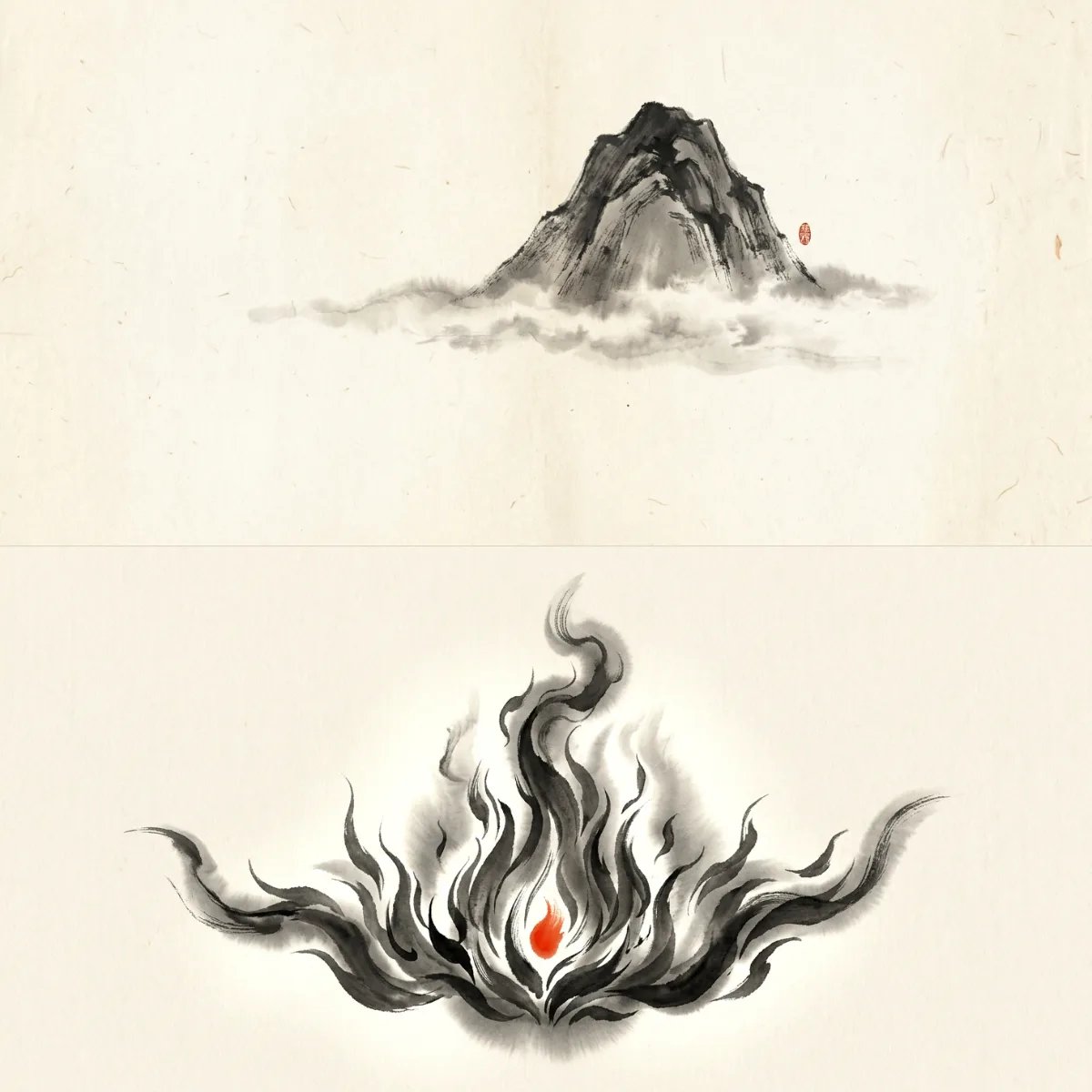 22. Grace賁 · BìForm can make a thing visible, but it must never pass itself off as substance.
Hexagram 22 (Grace) often shows up around paying attention to form and presentation, wanting to present something beautifully or doubting whether the surface matches the substance. At its core: Form can make a thing visible, but it must never pass itself off as substance.
Where this hexagram often fits.
Situations
- paying attention to form and presentation
- wanting to present something beautifully
- doubting whether the surface matches the substance
- making a first impression
- style over substance
- polishing or dressing something up
- too caught up in appearances
- plainness versus ornament
Questions people ask
- Does the surface still match what's inside?
- How do I present something beautifully without it ringing hollow?
- Am I making form more important than substance?
- When is dressing something up enough and when is it too much?
What is often at play
- vanity
- urge to impress
- insecurity about the core
- aesthetic pleasure
What this asks for
- let form serve, not lead
- dare to be plain
- clarify without concealing
- keep beauty in its place
Also searched as
- Grace
- Adornment
- Form
- Aesthetics
- Refinement
- Presentation
- Beauty
Core image
This hexagram is about adornment, shine, style, and the ordering of the visible. It acknowledges that form matters. Not everything has to be raw and bare to be true. But the beauty here is kept small: it lights, outlines, and tunes, without replacing the ground.
Tension
The tension lies in the temptation to make the beautiful larger than what bears it. One can lose oneself in radiance, aesthetics, presentation, and the fineness of finish. Then the outside grows too heavy for what it was meant to serve. This hexagram honors form, but guards its place.
Distortion
Grace distorts when shine starts to play at truth. Then décor matters more than content. One polishes the visible while the core stays thin.
Stance
Use form to clarify, not to mislead. Let the small be beautiful, but do not make the beautiful the main thing. A right outline can let truth appear better; excess smothers it. Here taste is only good when it lets itself be bounded.
Closing line
Beauty that forgets its place soon becomes a veil.
Plain-language entrances.
Plain-language entrances to this hexagram. They help with search and recognition, while the reading itself remains rooted in the text and your question.
Hexagram 22 - Grace
Hexagram 22 - Grace gives language to a recognisable I Ching pattern. Read the linked hexagram as the source, not as a separate interpretation.
Changing lines of hexagram 22
- Line 1. At the start the form is still simple and sober. That is good. Whoever adds too much here loses the freshness of the beginning.
- Line 2. This line shows how little is sometimes needed to make something fitting. A light tending can be enough. The beauty here lies in measure, not in splendor.
- Line 3. At this point shine grows dangerously seductive. One wants to keep bathing in radiance. Then form comes loose from ground and begins to eat itself.
- Line 4. Here there is tension between bareness and adornment. Both pull. This line asks for a form that does not hide, but lights just enough.
- Line 5. This line keeps grace small and therefore exactly credible. No excess is needed. The sober can carry more dignity here than the rich.
- Line 6. When the form is at its best, it grows almost white and plain. Then only what truly serves remains. This line shows the completion of beauty in restraint.
The form beneath hexagram 22
Derived from the structure of the I Ching — not an interpretation, but the shape underneath it. The reading above remains the source.
- Balance. Hexagram 22 is in full balance — 3 yang lines and 3 yin lines.
- Line pattern. From bottom to top: yang, yin, yang, yin, yin, yang.
- Movement. 63 possible paths of change run from this image — every combination of moving lines leads to a different hexagram.
Built from
Hexagram 22 is built from two trigrams, the natural forces of the I Ching.
Related hexagrams
Sources & reading
Our text is our own, ratified reading of the canonical I Ching — source → human → pattern → fitting movement. It is not a reproduction of the translations above, and not prediction, psychology, or new-age. The reference translations serve to calibrate; protected prose is not taken over.
- Richard Wilhelm / Cary F. Baynes — The I Ching or Book of Changes. symbolic-philosophical, with the Ten Wings — the most influential Western edition.
- James Legge — The Yî King (Sacred Books of the East). scholarly-philological (public domain).
Read what is in motion in your situation.
A hexagram only takes on meaning in relation to your own question. Ask one and read what appears.