
23. Crumbling
Crumbling is hexagram 23 of the 64 in the I Ching, also known as the Book of Changes (in Chinese Bō, 剝).
Also known as: Splitting Apart.
What has lost its base falls apart not through enmity, but through the loss of what held it up.
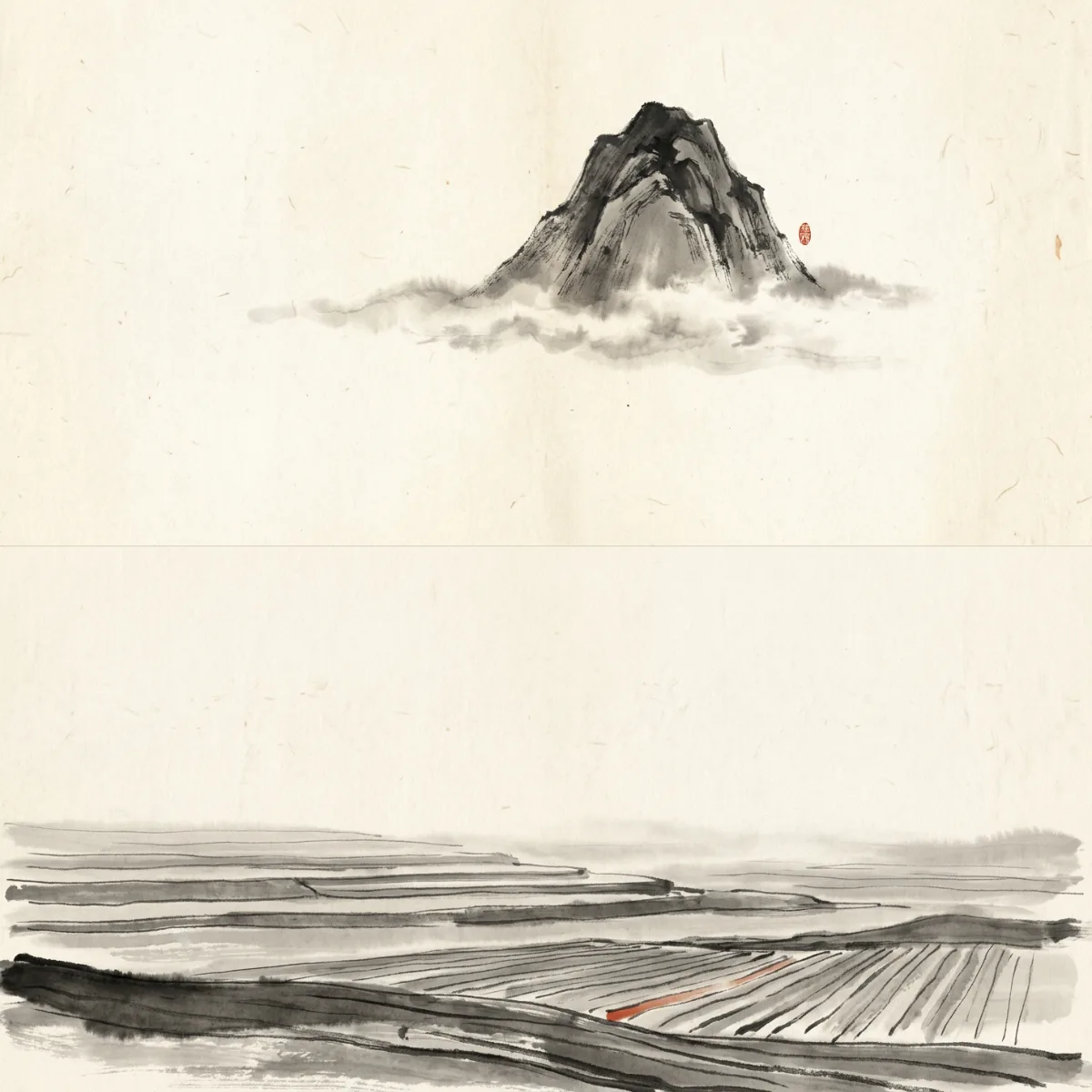 23. Crumbling剝 · BōWhat has lost its base falls apart not through enmity, but through the loss of what held it up.
Hexagram 23 (Crumbling) often shows up around something is slowly falling apart, the ground under something is giving way or a relationship or project winding down. At its core: What has lost its base falls apart not through enmity, but through the loss of what held it up.
Where this hexagram often fits.
Situations
- something is slowly falling apart
- the ground under something is giving way
- a relationship or project winding down
- decay you can't stop
- letting go of what no longer holds
- a facade that can't be saved
- stripping things down to the core
- carrying a decline with dignity
Questions people ask
- How do I deal with something slowly crumbling?
- Should I still try to save this or let it go?
- What here is still worth protecting?
- How do I lose something with dignity?
What is often at play
- powerlessness
- loss
- urge to hold on
- acceptance
What this asks for
- don't force it
- let go of what has no foundation left
- protect the core
- accept decline with dignity
Also searched as
- Splitting apart
- Falling apart
- Disintegration
- Decay
- Collapse
- Stripping
- Peeling away
Core image
This hexagram shows crumbling from below. The form still stands a while, but the bearing layers come loose. What is visible above is no longer fed by what should hold below. This is no sudden disaster, but a process of removal, peeling away, falling apart.
Tension
The tension lies in the urge to keep saving the outside while the ground is already gone. One wants to keep the visible, straighten the façade, paint over the break. But this hexagram does not ask for heroic repair. It asks that one see what has lost its support.
Distortion
Crumbling distorts when one pulls harder still at the upper structure. Then the collapse only grows rougher. What falls away need not always be kept just because it once had shape.
Stance
Hold yourself still enough not to worsen the breakdown with panic. Protect what is still essential, but do not save everything. When the underground is gone, dignity sometimes lies precisely in not forcing. Accept loss as a form of truth.
Closing line
Not every fall is a fault; some things finally fall away from their lie.
Plain-language entrances.
Plain-language entrances to this hexagram. They help with search and recognition, while the reading itself remains rooted in the text and your question.
Hexagram 23 - Crumbling
Hexagram 23 - Crumbling gives language to a recognisable I Ching pattern. Read the linked hexagram as the source, not as a separate interpretation.
Changing lines of hexagram 23
- Line 1. At the start the ground still crumbles quietly. The signs are small, but not innocent. What is ignored now stands larger on the account later.
- Line 2. Here the breakdown already eats closer at what you carry. The loss is no longer only structural, but palpable. For that very reason discrimination must be kept.
- Line 3. This line shows that not everything has to collapse at once. Someone can still loosen themselves from the breakdown. That spares the core.
- Line 4. At this point the damage has come close under the visible layer. The pain turns concrete. What one still held high begins to give way.
- Line 5. Here a dignified ordering still appears in the middle of the breakdown. Because of that, loss can pass less humiliatingly. Not everything can still be saved, but the way something ends can.
- Line 6. When the falling-apart is complete, a bare remnant is left that no longer has to carry appearance. That is hard, but also clean. This line marks the end of a form.
The form beneath hexagram 23
Derived from the structure of the I Ching — not an interpretation, but the shape underneath it. The reading above remains the source.
- Balance. Hexagram 23 is predominantly yin — 5 yin lines and 1 yang lines.
- Line pattern. From bottom to top: yin, yin, yin, yin, yin, yang.
- Movement. 63 possible paths of change run from this image — every combination of moving lines leads to a different hexagram.
Built from
Hexagram 23 is built from two trigrams, the natural forces of the I Ching.
Related hexagrams
Sources & reading
Our text is our own, ratified reading of the canonical I Ching — source → human → pattern → fitting movement. It is not a reproduction of the translations above, and not prediction, psychology, or new-age. The reference translations serve to calibrate; protected prose is not taken over.
- Richard Wilhelm / Cary F. Baynes — The I Ching or Book of Changes. symbolic-philosophical, with the Ten Wings — the most influential Western edition.
- James Legge — The Yî King (Sacred Books of the East). scholarly-philological (public domain).
Read what is in motion in your situation.
A hexagram only takes on meaning in relation to your own question. Ask one and read what appears.