
7. The Army
The Army is hexagram 7 of the 64 in the I Ching, also known as the Book of Changes (in Chinese Shī, 師).
When force scatters, the moment calls for an order that people can carry.
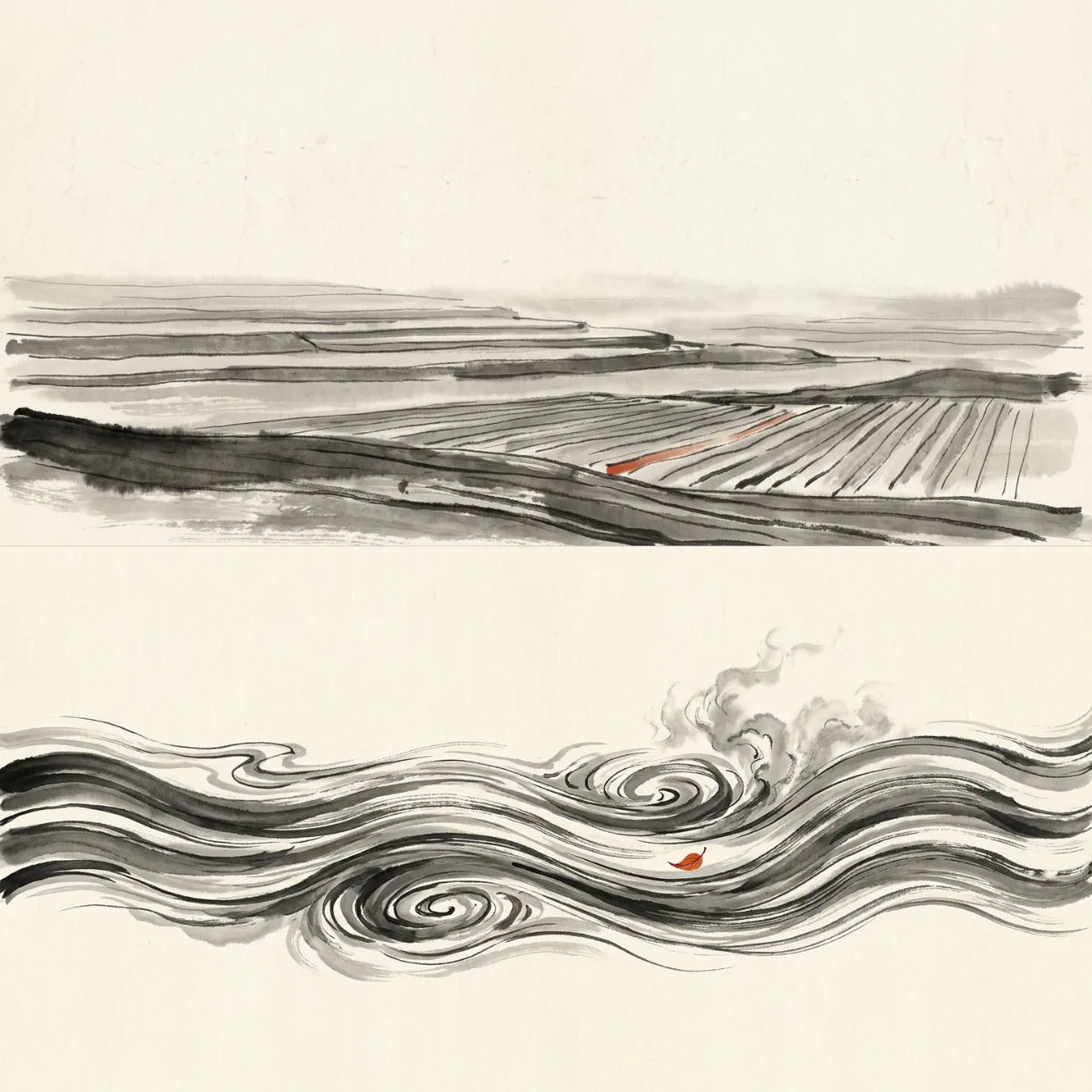 7. The Army師 · ShīWhen force scatters, the moment calls for an order that people can carry.
Hexagram 7 (The Army) often shows up around leading a team, organizing a big operation or bringing in discipline. At its core: When force scatters, the moment calls for an order that people can carry.
Where this hexagram often fits.
Situations
- leading a team
- organizing a big operation
- bringing in discipline
- rallying people toward a goal
- having to lead under pressure
- structure is missing
- a collective effort
- pulling scattered forces together
Questions people ask
- How do I lead a team without dominating it?
- Is my authority here actually justified?
- How do I bring order without becoming mechanical?
- What do I carry myself before asking it of others?
What is often at play
- responsibility
- pressure to stay in control
- tension between authority and buy-in
- fatigue from the load
What this asks for
- leading plainly and clearly
- staying load-bearing yourself
- serving the order, not yourself
- letting power go once the work is done
Also searched as
- The Army
- Discipline
- Organization
- Team
- Strategy
- Mobilization
- Command
Core image
This hexagram is about organized effort. Not the lone hero stands at the center, but a gathered force that needs direction. The image is plain: discipline, obedience, formation, task. What counts here is not who burns hottest, but what stays in shape under authority.
Tension
The tension lies in the relation between power and leadership. An army without order falls apart; an army without justification rots from within. So this hexagram is stricter than it first appears. Not every mobilization is grounded, and not every leader carries the weight he claims.
Distortion
The army distorts when the organization comes to love itself. Then discipline turns mechanical and authority complacent. What was once gathered for a necessary task begins to exist for its own upkeep.
Stance
Gather what is scattered, but not lightly. Lead plainly, clearly, and without display. Whoever gives direction here must first be able to bear weight themselves. Order holds only when it rests on something more than power.
Closing line
Authority that spares itself sooner or later loses the right to command.
Plain-language entrances.
Plain-language entrances to this hexagram. They help with search and recognition, while the reading itself remains rooted in the text and your question.
Hexagram 7 - The Army
Hexagram 7 - The Army gives language to a recognisable I Ching pattern. Read the linked hexagram as the source, not as a separate interpretation.
Changing lines of hexagram 7
- Line 1. At the start, order must be visible and simple. If the first formation is already loose, later discipline barely works. The basis of acting together lies in a clear start.
- Line 2. Here is the right center of leadership. Not lofty, not indulgent, but present in the burden. This line carries authority because it stays closer to the task than to decorum.
- Line 3. At this point confusion enters the chain of command. Too many voices want to give direction at once. Where command splinters, force does move — but not toward its aim.
- Line 4. This line knows the wisdom of holding back. Not every formation must be pushed to the bitter end. Sometimes it is the retreat that saves the core of the order.
- Line 5. Here leadership becomes legitimate because it truly carries the situation. There is discrimination, measure, and timing. Force is sent out now not for its own sake, but for what is necessary.
- Line 6. After the effort, power must be bound back again. What was needed in the struggle should not go on ruling without limit. This line warns of the after-effects of hard authority in a time of peace.
The form beneath hexagram 7
Derived from the structure of the I Ching — not an interpretation, but the shape underneath it. The reading above remains the source.
- Balance. Hexagram 7 is predominantly yin — 5 yin lines and 1 yang lines.
- Line pattern. From bottom to top: yin, yang, yin, yin, yin, yin.
- Movement. 63 possible paths of change run from this image — every combination of moving lines leads to a different hexagram.
Built from
Hexagram 7 is built from two trigrams, the natural forces of the I Ching.
Related hexagrams
Sources & reading
Our text is our own, ratified reading of the canonical I Ching — source → human → pattern → fitting movement. It is not a reproduction of the translations above, and not prediction, psychology, or new-age. The reference translations serve to calibrate; protected prose is not taken over.
- Richard Wilhelm / Cary F. Baynes — The I Ching or Book of Changes. symbolic-philosophical, with the Ten Wings — the most influential Western edition.
- James Legge — The Yî King (Sacred Books of the East). scholarly-philological (public domain).
Read what is in motion in your situation.
A hexagram only takes on meaning in relation to your own question. Ask one and read what appears.