
13. Community
Community is hexagram 13 of the 64 in the I Ching, also known as the Book of Changes (in Chinese Tóng Rén, 同人).
Also known as: Fellowship.
Community begins where your own circle stops being the measure of everything.
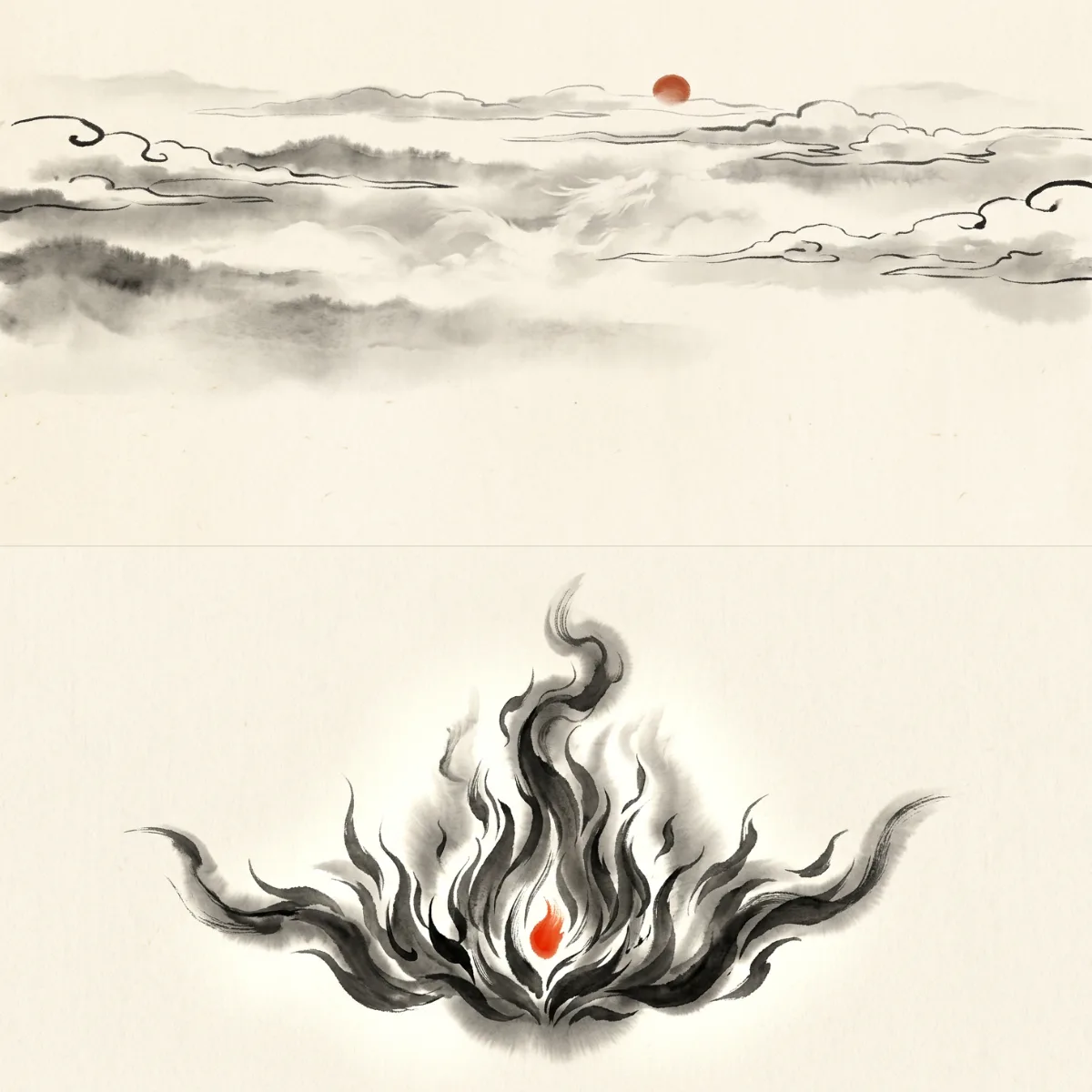 13. Community同人 · Tóng RénCommunity begins where your own circle stops being the measure of everything.
Hexagram 13 (Community) often shows up around working toward a shared goal, forming an alliance or rallying people behind a cause. At its core: Community begins where your own circle stops being the measure of everything.
Where this hexagram often fits.
Situations
- working toward a shared goal
- forming an alliance
- rallying people behind a cause
- building an open team
- seeking connection on a larger scale
- avoiding clique-forming
- standing for something together
- finding a common direction
Questions people ask
- How do I build real cooperation instead of a clique?
- What truly brings these people together?
- How do I keep an alliance open and clean?
- What do we stand for together, even in plain sight?
What is often at play
- belonging
- loyalty
- openness
- longing for togetherness
What this asks for
- openness over coziness
- putting the shared goal first
- staying transparent
- excluding no one
Also searched as
- Fellowship
- Fellowship with men
- Community
- Cooperation
- Alliance
- Solidarity
- Common cause
Core image
This hexagram shows people who find each other in open field, not in a closed circle. The community here is not intimacy, but orientation toward something larger than preference or blood tie. One comes together in plain sight. That makes the bond stronger, but also more vulnerable to impurity.
Tension
The tension lies in the difference between true community and camp-forming. Many groups look bonded as long as they can stand against something or someone. But this hexagram asks for a more open ground. What truly brings people together must also hold outside the protection of one's own nest.
Distortion
Community distorts the moment it becomes selective, secretive, or self-confirming. Then connection turns into clique, and shared purpose into shared self-regard. The common grows narrower the warmer it feels.
Stance
Go to open field. Look for what can be shared without a back room or a closed circle. Do not let the bond rest on preference alone, but on something that holds up in full light too. True community asks for more openness than good company.
Closing line
Where only your own circle breathes, no great bond has yet been born.
Plain-language entrances.
Plain-language entrances to this hexagram. They help with search and recognition, while the reading itself remains rooted in the text and your question.
Hexagram 13 - Community
Hexagram 13 - Community gives language to a recognisable I Ching pattern. Read the linked hexagram as the source, not as a separate interpretation.
Changing lines of hexagram 13
- Line 1. At the start, community still stays close to the door. That is understandable, but limited. As long as one admits only the near, the space of this hexagram is not yet reached.
- Line 2. Here community is narrowed to one's own kind. That gives warmth, but no open field. This line warns of a bond that stays too small for its own name.
- Line 3. At this point mistrust creeps into the community. One guards, observes, waits for the wrong moment. Where openness vanishes, the common soon becomes a disguised battlefield.
- Line 4. This line shows restraint at the edge of strife. One sees the possibility of collision, but does not step fully into it. That spares the community a harder break.
- Line 5. Here community is hard-fought, but in the end real. Tears and trouble belong to it because the bond is not cheap. What holds here has had to pass through fire.
- Line 6. When community is possible only at the edge, it stays lean but not false. That is less than the full picture, but more than mock-fellowship. Sometimes a narrow real bond is better than a broad lie.
The form beneath hexagram 13
Derived from the structure of the I Ching — not an interpretation, but the shape underneath it. The reading above remains the source.
- Balance. Hexagram 13 is predominantly yang — 5 yang lines and 1 yin lines.
- Line pattern. From bottom to top: yang, yin, yang, yang, yang, yang.
- Movement. 63 possible paths of change run from this image — every combination of moving lines leads to a different hexagram.
Built from
Hexagram 13 is built from two trigrams, the natural forces of the I Ching.
Related hexagrams
Sources & reading
Our text is our own, ratified reading of the canonical I Ching — source → human → pattern → fitting movement. It is not a reproduction of the translations above, and not prediction, psychology, or new-age. The reference translations serve to calibrate; protected prose is not taken over.
- Richard Wilhelm / Cary F. Baynes — The I Ching or Book of Changes. symbolic-philosophical, with the Ten Wings — the most influential Western edition.
- James Legge — The Yî King (Sacred Books of the East). scholarly-philological (public domain).
Read what is in motion in your situation.
A hexagram only takes on meaning in relation to your own question. Ask one and read what appears.