
48. The Well
The Well is hexagram 48 of the 64 in the I Ching, also known as the Book of Changes (in Chinese Jǐng, 井).
The well asks not for spectacle, but for care of what lies deeper than the moment.
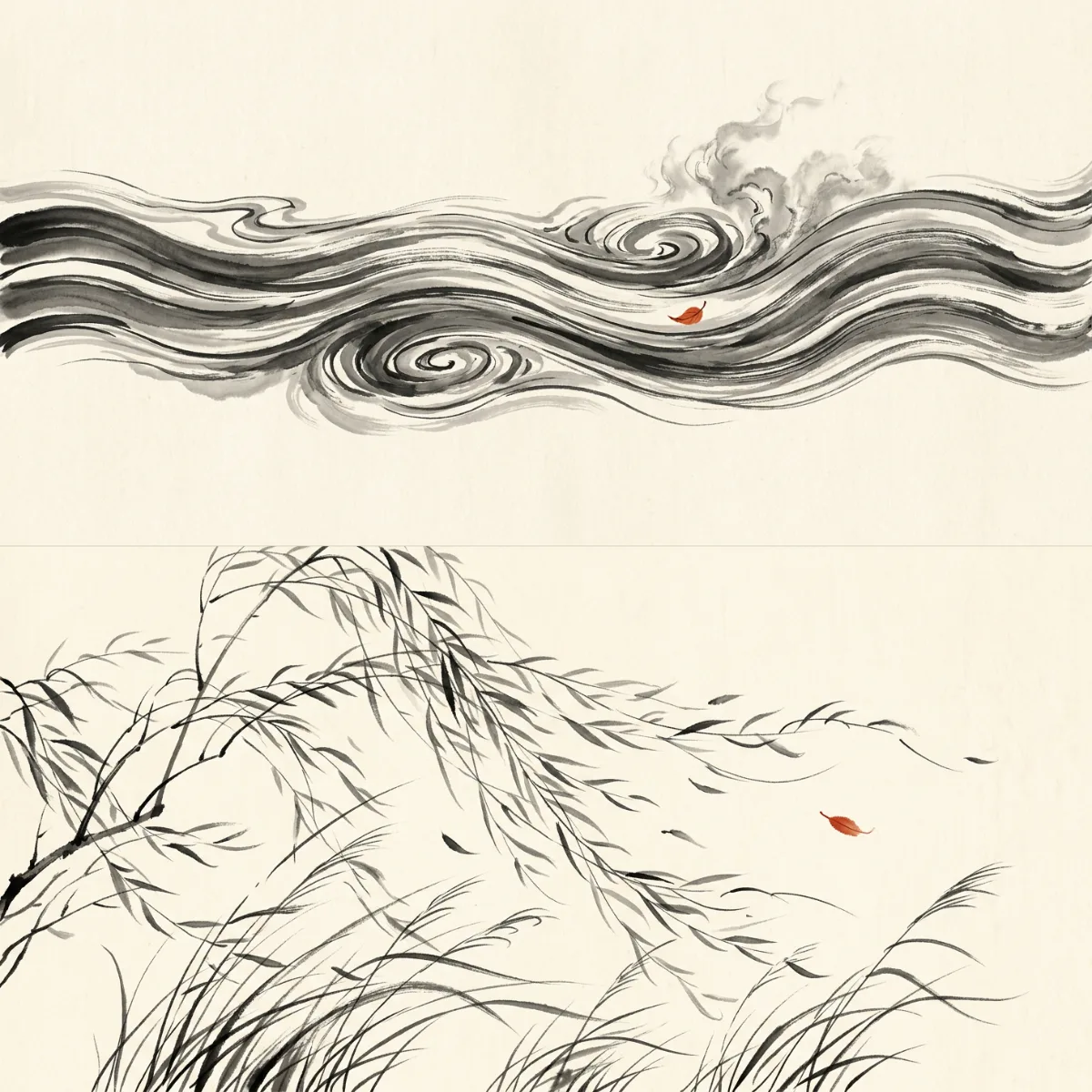 48. The Well井 · JǐngThe well asks not for spectacle, but for care of what lies deeper than the moment.
Hexagram 48 (The Well) often shows up around going back to the source, neglecting maintenance or value no one can reach. At its core: The well asks not for spectacle, but for care of what lies deeper than the moment.
Where this hexagram often fits.
Situations
- going back to the source
- neglecting maintenance
- value no one can reach
- making something good usable again
- getting back to basics
- restoring a foundation
- drawing on what's already there
- the access has gotten clogged
Questions people ask
- What truly nourishes me that I've let get blocked off?
- How do I make something of real value reachable again?
- Why does this source no longer reach anyone?
- What needs upkeep instead of chasing something new?
What is often at play
- sense that something sits unused
- weariness of neglect
- longing for what truly nourishes
- frustration that the value isn't getting through
What this asks for
- restore the access
- stay loyal to what lastingly nourishes
- maintain the form
- share generously
Also searched as
- The Well
- The Source
- Source value
- Getting back to basics
- Foundation
- Sustenance
- Infrastructure
Core image
This hexagram is a well: a lasting source that people can draw from. The image is old and plain — the well does not change every time the surface life above it changes, but it does have to stay reachable. The water is there; only the access can fall into neglect. So this is less about owning a source than about tending it.
Tension
The strain sits in the gap between what is present and what is usable. A thing can hold great worth and still feed no one — because the bucket is missing, the rope has worn through, or the care simply lapsed. Then people boast about the depth while no one is drinking.
Distortion
The well goes wrong when one romanticizes the depth but lets the form rot. Then what is essential becomes a stage prop. What should have nourished stays untouched beneath fine words.
Stance
Tend the way in to what truly feeds. Mend the form, keep the path open, make usable what has held its worth all along. The point here is not to discover something new, but to stay faithful to a source that need not be fashionable to remain indispensable.
Closing line
A real source proves itself not by mystery, but by the fact that you can drink from it.
Plain-language entrances.
Plain-language entrances to this hexagram. They help with search and recognition, while the reading itself remains rooted in the text and your question.
Hexagram 48 - The Well
Hexagram 48 - The Well gives language to a recognisable I Ching pattern. Read the linked hexagram as the source, not as a separate interpretation.
Changing lines of hexagram 48
- Line 1. At the start the well is still neglected, silted up. The worth is there, but no one can reach it. The mud has to be seen before anything can flow again.
- Line 2. Here the well is not empty, but used wrongly, approached without respect. So its reach drains away into small-mindedness. The line asks you to value again what is more than a passing gain.
- Line 3. At this point the well is usable and yet stays unused. That stings, because the lack is not in the depth but in human neglect. This line cuts into possibility left to waste.
- Line 4. Here the well is repaired with solid work. There is no great use of it yet, but the form comes right again. That is quieter than success, and more essential.
- Line 5. This line shows clear water that truly comes within reach. The well feeds without adornment. What is shared here carries precisely because it is plain and reliable.
- Line 6. When the well stands open and tended, do not wall it off again out of a wish to own it. What nourishes does not want to be locked away. This line asks for open-handed keeping.
The form beneath hexagram 48
Derived from the structure of the I Ching — not an interpretation, but the shape underneath it. The reading above remains the source.
- Balance. Hexagram 48 is in full balance — 3 yang lines and 3 yin lines.
- Line pattern. From bottom to top: yin, yang, yang, yin, yang, yin.
- Movement. 63 possible paths of change run from this image — every combination of moving lines leads to a different hexagram.
Built from
Hexagram 48 is built from two trigrams, the natural forces of the I Ching.
Related hexagrams
Sources & reading
Our text is our own, ratified reading of the canonical I Ching — source → human → pattern → fitting movement. It is not a reproduction of the translations above, and not prediction, psychology, or new-age. The reference translations serve to calibrate; protected prose is not taken over.
- Richard Wilhelm / Cary F. Baynes — The I Ching or Book of Changes. symbolic-philosophical, with the Ten Wings — the most influential Western edition.
- James Legge — The Yî King (Sacred Books of the East). scholarly-philological (public domain).
Read what is in motion in your situation.
A hexagram only takes on meaning in relation to your own question. Ask one and read what appears.