
16. Enthusiasm
Enthusiasm is hexagram 16 of the 64 in the I Ching, also known as the Book of Changes (in Chinese Yù, 豫).
When energy gathers around a rhythm, movement becomes contagious.
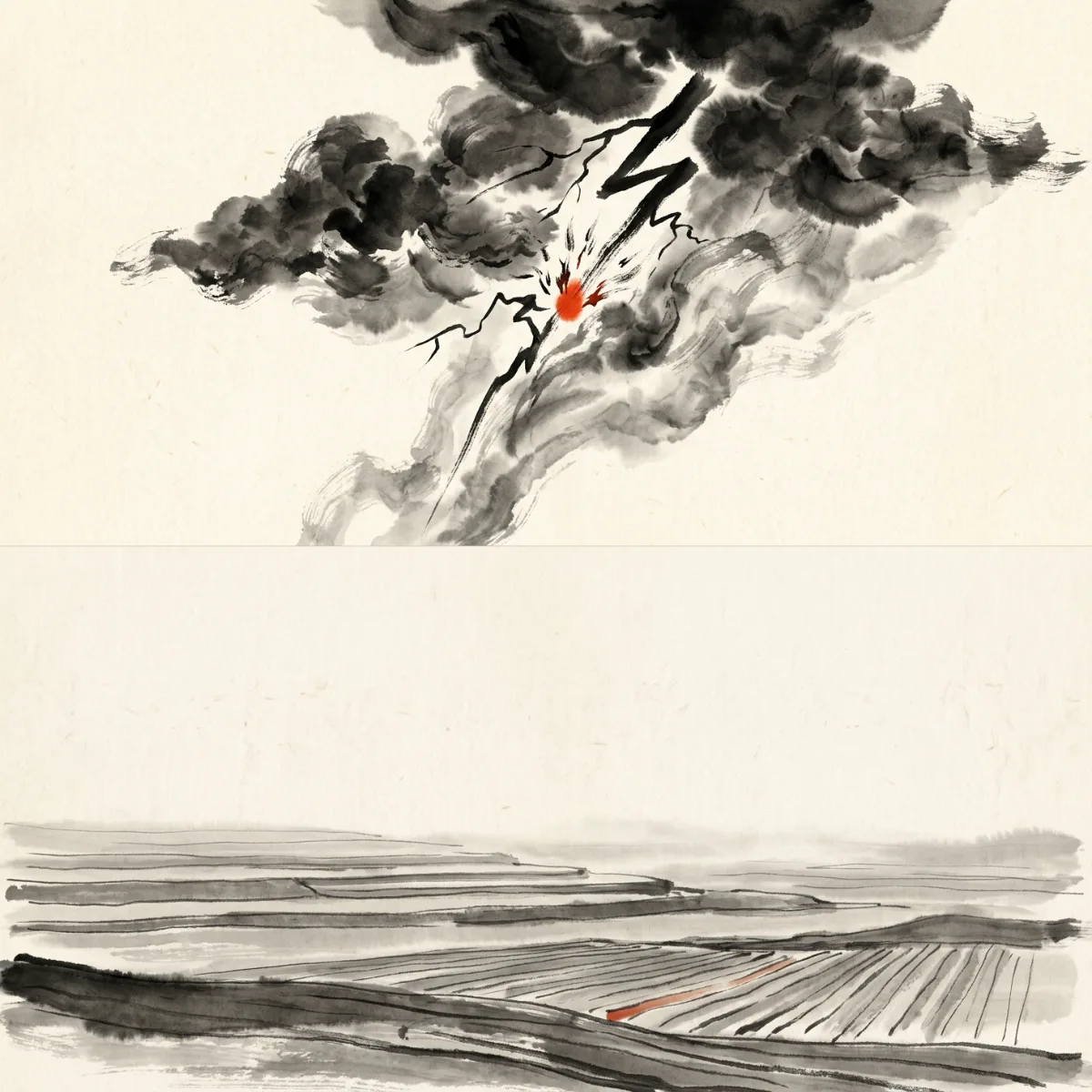 16. Enthusiasm豫 · YùWhen energy gathers around a rhythm, movement becomes contagious.
Hexagram 16 (Enthusiasm) often shows up around enthusiasm rising, getting people on board or building momentum. At its core: When energy gathers around a rhythm, movement becomes contagious.
Where this hexagram often fits.
Situations
- enthusiasm rising
- getting people on board
- building momentum
- kicking off a movement
- excitement that could spread
- announcing or launching something
- energy looking for direction
- keeping it from becoming just noise
Questions people ask
- How do I give enthusiasm a direction that lasts?
- How do I genuinely get others on board?
- What keeps excitement clean instead of loud?
- How do I build momentum without burning out?
What is often at play
- enthusiasm
- excitement
- anticipation
- the urge to sweep others along
What this asks for
- attuning
- giving rhythm and measure
- binding it to a real direction
- guarding a clean source
Also searched as
- Enthusiasm
- Zeal
- Mobilization
- Momentum
- Inspiration
- Getting things moving
- Contagious energy
Core image
This hexagram shows rising enthusiasm: a charged field in which people or forces want to move in the same direction. There is vibration, expectation, mobilization. The image has something of drum, announcement, founding. What grows here does not only want to live, but to carry others along.
Tension
Enthusiasm is powerful, but rarely neutral. It can gather genuinely, but also intoxicate. So this hexagram asks for a pure source. What looks like excitement without ground soon runs out into noise, herd behavior, or exhausted drive.
Distortion
Enthusiasm distorts when it comes to value itself more than the direction that called it. Then excitement becomes an end in itself. One moves a great deal, but no longer toward anything that truly bears.
Stance
Give the movement shape, rhythm, and measure. Do not let enthusiasm shoot loose through the room, but bind it to something that can last. A well-tuned enthusiasm wakes people; a loose enthusiasm only makes them loud. Here attunement matters more than volume.
Closing line
Not every vibration is a direction.
Plain-language entrances.
Plain-language entrances to this hexagram. They help with search and recognition, while the reading itself remains rooted in the text and your question.
Hexagram 16 - Enthusiasm
Hexagram 16 - Enthusiasm gives language to a recognisable I Ching pattern. Read the linked hexagram as the source, not as a separate interpretation.
Changing lines of hexagram 16
- Line 1. At the start, enthusiasm makes itself heard quickly. That can open something, but also promise too much too early. What is proclaimed now must later be able to be carried too.
- Line 2. This line stays firm while the movement rises around it. That gives reliability. Not whoever goes along loudest, but whoever stays well-grounded, keeps the tone pure.
- Line 3. At this point the gaze turns up toward the wrong shine. One lets oneself be swept along by appearance instead of substance. Then enthusiasm becomes dependent on décor.
- Line 4. Here enthusiasm can truly gather. The occasion is pure enough to carry people along without using them. That makes this line strong.
- Line 5. This line is caught in a position of tension: there is movement, but not full freedom. That makes it palpable whether the enthusiasm truly comes from within, or only leans on the situation. Only the first holds.
- Line 6. When enthusiasm goes on too long, it turns into intoxication. Then one wakes inside something already past its peak. This line asks for a sober return before the movement grows hollow.
The form beneath hexagram 16
Derived from the structure of the I Ching — not an interpretation, but the shape underneath it. The reading above remains the source.
- Balance. Hexagram 16 is predominantly yin — 5 yin lines and 1 yang lines.
- Line pattern. From bottom to top: yin, yin, yin, yang, yin, yin.
- Movement. 63 possible paths of change run from this image — every combination of moving lines leads to a different hexagram.
Built from
Hexagram 16 is built from two trigrams, the natural forces of the I Ching.
Related hexagrams
Sources & reading
Our text is our own, ratified reading of the canonical I Ching — source → human → pattern → fitting movement. It is not a reproduction of the translations above, and not prediction, psychology, or new-age. The reference translations serve to calibrate; protected prose is not taken over.
- Richard Wilhelm / Cary F. Baynes — The I Ching or Book of Changes. symbolic-philosophical, with the Ten Wings — the most influential Western edition.
- James Legge — The Yî King (Sacred Books of the East). scholarly-philological (public domain).
Read what is in motion in your situation.
A hexagram only takes on meaning in relation to your own question. Ask one and read what appears.