
17. Following
Following is hexagram 17 of the 64 in the I Ching, also known as the Book of Changes (in Chinese Suí, 隨).
To follow without testing is to wear another's direction as your own fate.
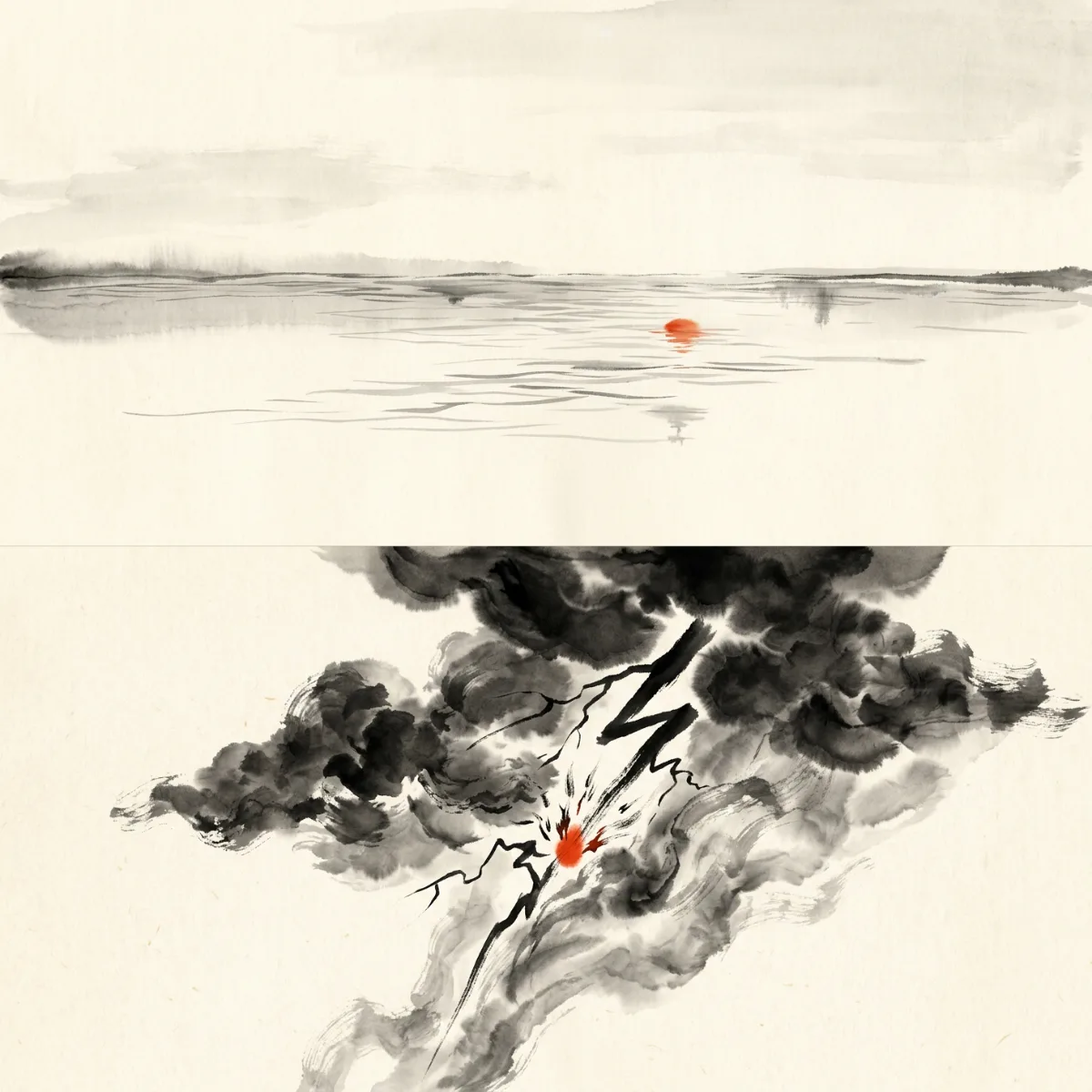 17. Following隨 · SuíTo follow without testing is to wear another's direction as your own fate.
Hexagram 17 (Following) often shows up around going along with the group, wondering whether to follow someone or adapting to fit in. At its core: To follow without testing is to wear another's direction as your own fate.
Where this hexagram often fits.
Situations
- going along with the group
- wondering whether to follow someone
- adapting to fit in
- following a new leader or direction
- moving with what's already in motion
- afraid to go against the flow
- blindly following someone
- deciding who to trust
Questions people ask
- Should I go along with this or not?
- How do I know I'm following the right person?
- Will I lose myself if I adapt?
- When is following wisdom and when is it just the easy way out?
What is often at play
- compliance
- doubt
- need to belong
- loyalty
What this asks for
- test before you commit
- stay flexible without going soft
- keep your own center
- consciously choose who you follow
Also searched as
- Following
- Going along
- Adapting
- Falling in line
- Compliance
- Allegiance
- Resonance
Core image
This hexagram is about following, joining, going along with something that is already in motion. That can be good and necessary. Not everyone has to lead all the time. But following here is no automatic virtue. The question is always: what receives your assent, and why?
Tension
The tension lies in the relation between suppleness and judgment. Whoever can never follow stays caught in themselves. Whoever follows too quickly loses their axis. This hexagram seeks no stubborn autonomy, but an obedience that is worthy of its object.
Distortion
Following distorts when one would rather move along than examine. Then adapting becomes a kind of laziness. One lets oneself be led by nearness, mood, or advantage, and then calls that openness.
Stance
Follow only what still gives direction after examination. Let yourself be made supple, but not soft. Good following guards your inside better than bad leadership ever can. Whoever follows rightly need not lose themselves.
Closing line
Sometimes only later does it show whether you walked with a direction or with a weight.
Plain-language entrances.
Plain-language entrances to this hexagram. They help with search and recognition, while the reading itself remains rooted in the text and your question.
Hexagram 17 - Following
Hexagram 17 - Following gives language to a recognisable I Ching pattern. Read the linked hexagram as the source, not as a separate interpretation.
Changing lines of hexagram 17
- Line 1. At the start the choice is still open. What you follow now sets the tone for what is later hard to undo. So do not begin your assent lightly.
- Line 2. This line shows a following that is too small. One lets oneself be led by what is near, pleasant, or directly available. The larger track is lost from sight as a result.
- Line 3. Here a better following can be found, but only if the lesser is let go. You cannot take everything with you. Sometimes a truer track asks for a clear break.
- Line 4. At this point influence grows large, and with it the danger. Whoever is followed must test all the harder what they themselves follow. Otherwise authority grows on an empty core.
- Line 5. Here following coincides with trust in something truly good. That makes this line clear. No fawning is needed where the direction already proves itself.
- Line 6. When following becomes complete, it takes on something of binding. That can be strong, but also heavy. This line asks for loyalty that stays free, not for a tie that smothers.
The form beneath hexagram 17
Derived from the structure of the I Ching — not an interpretation, but the shape underneath it. The reading above remains the source.
- Balance. Hexagram 17 is in full balance — 3 yang lines and 3 yin lines.
- Line pattern. From bottom to top: yang, yin, yin, yang, yang, yin.
- Movement. 63 possible paths of change run from this image — every combination of moving lines leads to a different hexagram.
Built from
Hexagram 17 is built from two trigrams, the natural forces of the I Ching.
Related hexagrams
Sources & reading
Our text is our own, ratified reading of the canonical I Ching — source → human → pattern → fitting movement. It is not a reproduction of the translations above, and not prediction, psychology, or new-age. The reference translations serve to calibrate; protected prose is not taken over.
- Richard Wilhelm / Cary F. Baynes — The I Ching or Book of Changes. symbolic-philosophical, with the Ten Wings — the most influential Western edition.
- James Legge — The Yî King (Sacred Books of the East). scholarly-philological (public domain).
Read what is in motion in your situation.
A hexagram only takes on meaning in relation to your own question. Ask one and read what appears.