
Hexagram 64 - Before Completion
A source-linked hexagram entry in the I Ching Atlas.
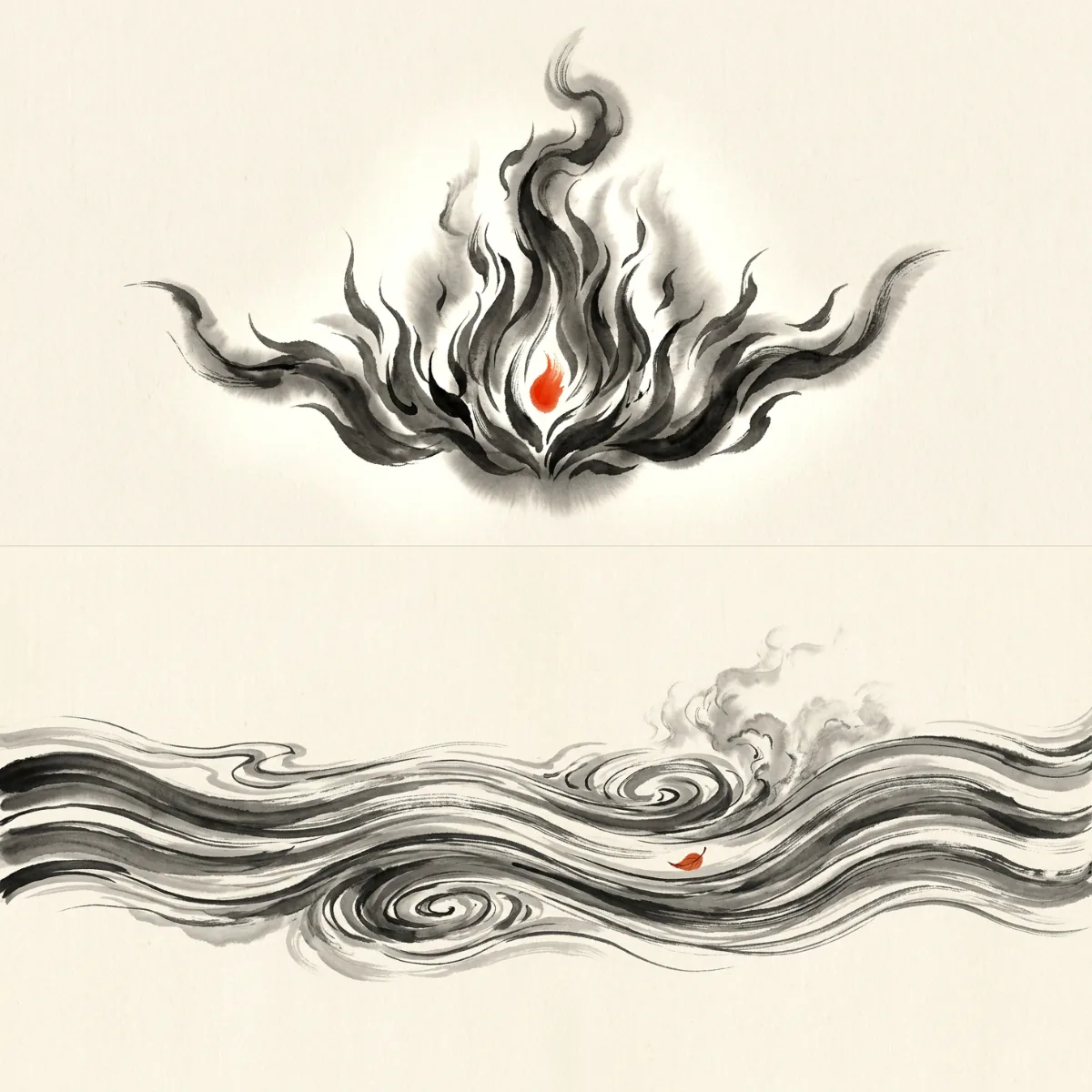
How to read this entry
Read as a source-linked field of change, not as a prediction.
This Atlas page helps orientation. The real reading still begins with the text and your own question.
Source reading and stance
Core image
This hexagram is the crossing almost made but not yet safe to close. A fox is nearly across the water and, at the last stretch, gets its tail wet. So this is the critical stage where much is already in motion, yet the shape cannot be sealed. Almost over is not the same as over.
Tension
The tension sits in the nearness of the end. Because completion looks close, the pull grows to round things off too fast, to speak as if it were already done, to let the last care slip. This hexagram asks for an attention that stays awake right to the edge.
Distortion
It goes wrong when the unfinished gets mistaken for failure, or when the almost-done is celebrated as done. Then the final crossing becomes the place of loss. The trouble is not in the process, but in impatience at the threshold.
Stance
Stay in the movement, but close nothing before its time. Order what is still unordered, and respect how fragile the last crossing is. Good nearness to completion has something humble in it: you know that almost is not yet finished.
Closing line
Whoever doesn't force the last step often helps the unfinished best toward shape.
Where this hexagram often appears.
These fields are addresses toward the source reading, not separate meanings.
Situations
- almost done but not quite there
- the temptation to wrap up too early
- being in a transition phase
- the final stretch that weighs the heaviest
- impatience right before the finish
- celebrating before it's truly finished
- mistaking the unfinished for failure
- not wanting to force the last step
Questions
- How do I keep going now that it's almost done?
- Why do I just miss the finish line?
- How do I avoid celebrating too soon?
- What does this last transition ask of me?
What often plays here
- impatience
- tension at the threshold
- temptation to celebrate
- uncertainty about finishing
What this asks
- staying attentive to the last
- closing nothing prematurely
- respecting the final fragility
- not mistaking almost for done
Plain-language entrances.
Hexagram 64 - Before Completion
Hexagram 64 - Before Completion gives language to a recognisable I Ching pattern. Read the linked hexagram as the source, not as a separate interpretation.
Changing lines of hexagram 64
- Line 1. At the start the movement is still unsteady, and rushing does immediate harm. You want to claim the far bank while your foot is still sliding. Hold to the modesty that beginnings ask for.
- Line 2. Here you hold yourself together by not answering every impulse. Progress is possible, but only under restrained steering. What counts is the power not to break loose too early.
- Line 3. At this point the crossing is too unripe for a brute push through. Yet some aimed movement may already be needed. The line asks you to tell courage apart from haste.
- Line 4. Here the strength for the last passage gathers, if old hesitation is left behind without tipping into frenzy. The movement takes firmer shape, and the almost-stage grows more reliable.
- Line 5. This line shows a quiet clarity just before completion. You no longer have to prove it will work. That undramatic concentration is exactly what makes the crossing strong.
- Line 6. When you get drunk at the end on the nearness of success and lose the last measure, it turns over. Even so, the unfinished need not be lost if you come sober again. This line is severe on rapture at the threshold.
Canonical relations
Related doors
Related context
From context to practice
This Atlas page helps orientation. Place this field beside your own question or saved readings when you want to see what it does in your situation.
Source status
This entry is Atlas context. It points back to the source instead of becoming a separate teaching.
View source anchor
Source: corpus:hexagram/64
Claim: derived - Review: validated - Policy: derived-atlas-projection