
Hexagram 49 - Revolution
A source-linked hexagram entry in the I Ching Atlas.
How to read this entry
Read as a source-linked field of change, not as a prediction.
This Atlas page helps orientation. The real reading still begins with the text and your own question.
Source reading and stance
Core image
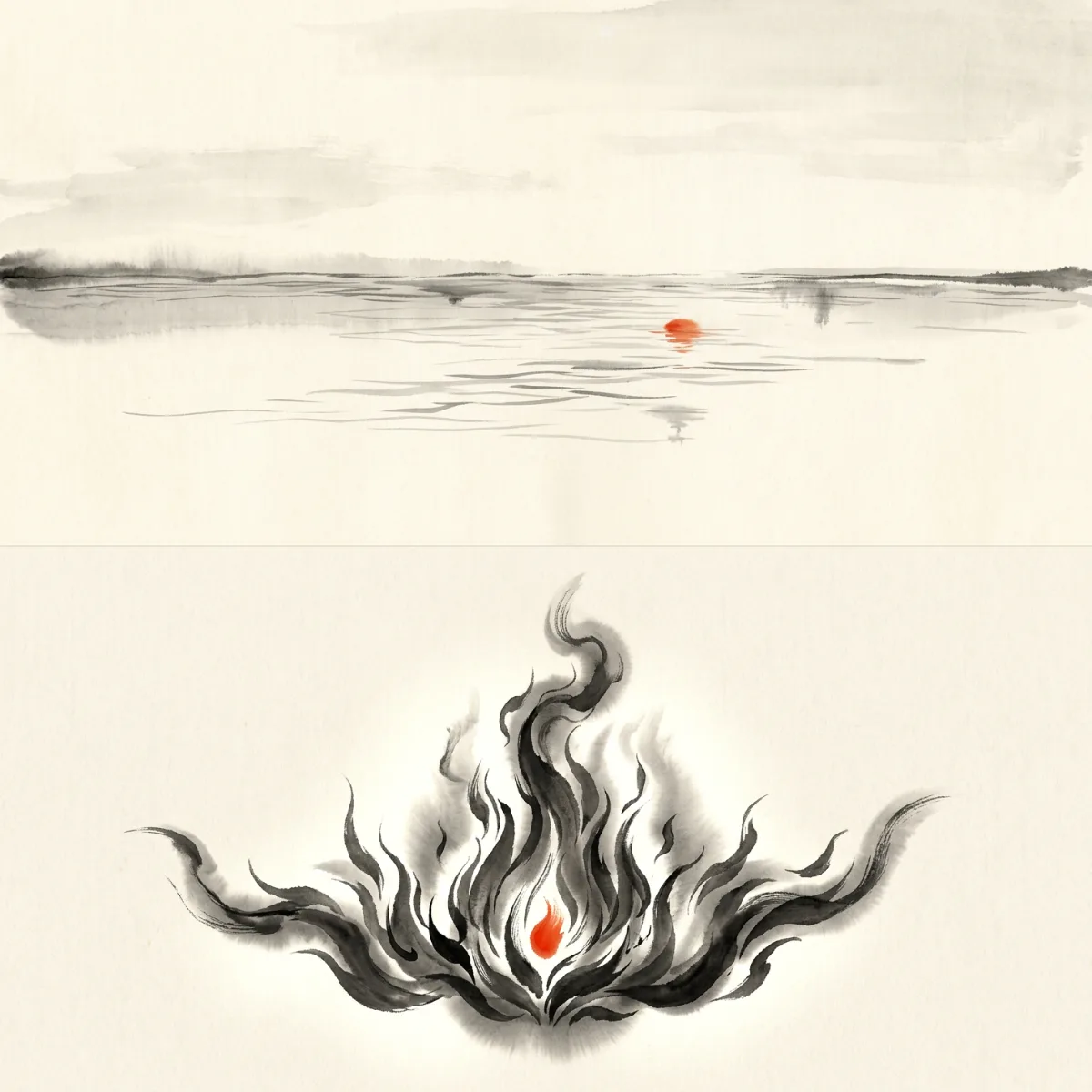
This hexagram is about change that can no longer stay cosmetic. An old form has had its time and must genuinely be shed. That charges the situation: you stand between a known skin and a renewal you cannot avoid. The turn carries weight only when it comes at the right moment and wears its legitimacy in the open.
Tension
The tension sits in timing and trust. Move too early and you change out of impatience. Move too late and you change only after the rot has already worked its way deeper. So this hexagram asks not only for the courage to renew, but for a sharp sense of when a thing is ripe.
Distortion
Revolution distorts when it becomes a craving for the new, rebellion for its own sake, or plain settling of scores. Then you change the skin but not the nature. What looks new stays old underneath.
Stance
Change only what has truly had its time, and do it openly enough not to feed suspicion. Let the turn come from necessity, not from taste. Good renewal carries something stricter than enthusiasm.
Closing line
Where the old form no longer protects, holding on becomes the risk itself.
Where this hexagram often appears.
These fields are addresses toward the source reading, not separate meanings.
Situations
- overhauling everything
- making a radical change
- an old form that no longer fits
- repositioning a brand or organization
- breaking with how it's always been done
- a course change that genuinely has to happen
- shedding an old skin
- wondering if it's really time to change
Questions
- Is it really time for a radical change?
- How do I change without acting out of impatience?
- How do I make a turnaround earn trust instead of suspicion?
- What do I truly need to let go of and what do I keep?
What often plays here
- restlessness
- resolve
- distrust
- impatience
What this asks
- waiting for the right moment
- changing openly and visibly
- only changing what has truly had its time
- pairing courage with discipline
Plain-language entrances.
Hexagram 49 - Revolution
Hexagram 49 - Revolution gives language to a recognisable I Ching pattern. Read the linked hexagram as the source, not as a separate interpretation.
Changing lines of hexagram 49
- Line 1. At the start the pull toward change is already felt, but the moment is not yet ripe. To tear loose too early only leaves the situation weaker. First the recognition has to be carried deeper.
- Line 2. Here the right moment draws closer, and change can be set in motion on firmer ground. The line asks for clear preparation. What needs to turn gains force from inner steadiness.
- Line 3. At this point the turn becomes a matter of debate, doubt, and back-and-forth. That belongs to the strain of a real crossing. Still, take care not to stall in endless deliberation.
- Line 4. Here the change can truly be carried through, because it no longer comes from heat. Guilt and old distrust begin to loosen. The turn gains more weight and less smoke.
- Line 5. This line shows the ripe turn: visible, convincing, and load-bearing. You need not shout that things are changing; it shows in the form itself. That is what gives the change its authority.
- Line 6. Once the turn is complete, do not work every last detail to death or keep revolting. Then renewal curdles into unrest. This line asks for rest in the new skin.
Canonical relations
Related doors
Related context
From context to practice
This Atlas page helps orientation. Place this field beside your own question or saved readings when you want to see what it does in your situation.
Source status
This entry is Atlas context. It points back to the source instead of becoming a separate teaching.
View source anchor
Source: corpus:hexagram/49
Claim: derived - Review: validated - Policy: derived-atlas-projection