
Hexagram 40 - Release
A source-linked hexagram entry in the I Ching Atlas.
How to read this entry
Read as a source-linked field of change, not as a prediction.
This Atlas page helps orientation. The real reading still begins with the text and your own question.
Source reading and stance
Core image
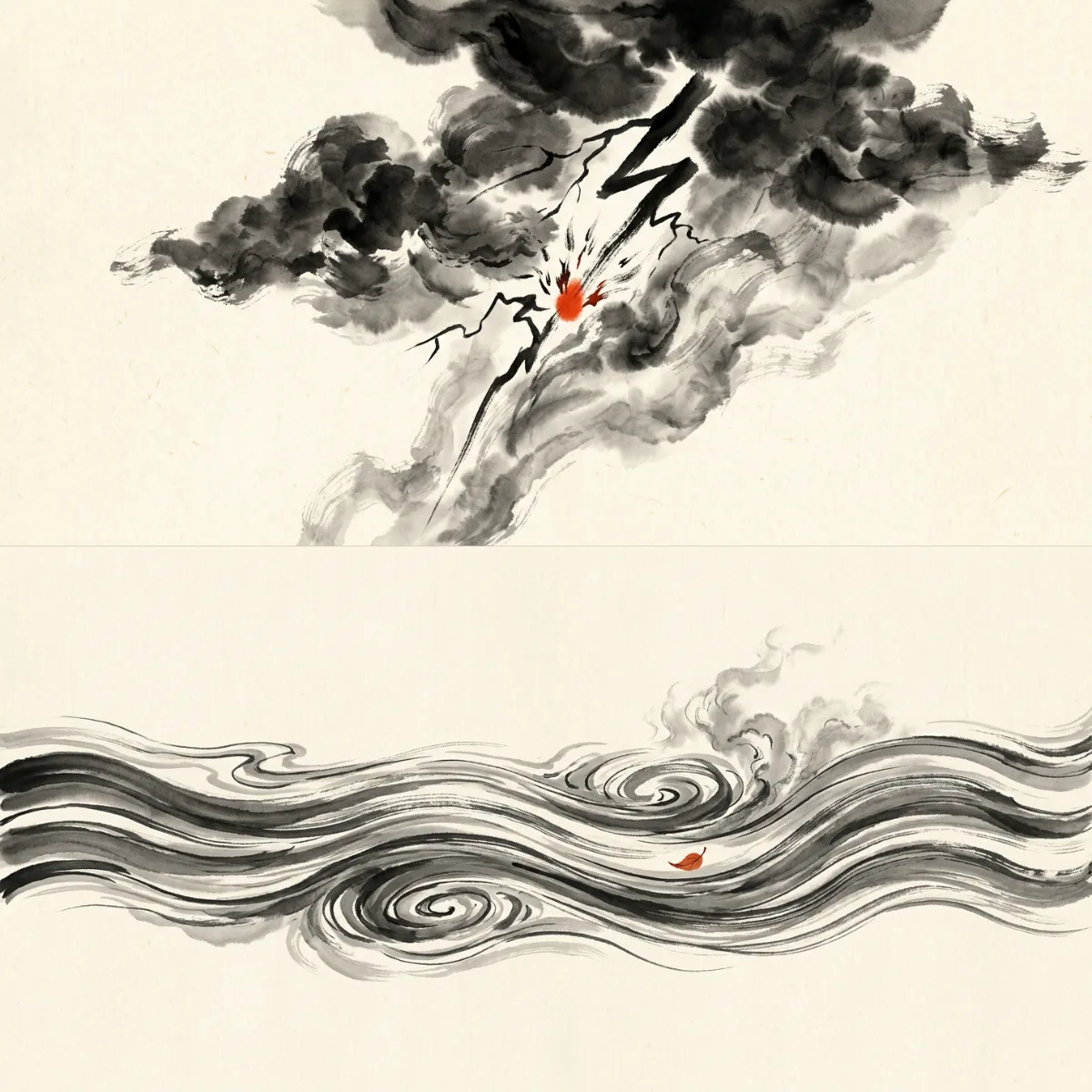
This hexagram arrives as tension, threat, or entanglement begins to come undone. The storm breaks open above the water, and what was stuck starts to move again. It doesn't mean the danger is past. It means the knot no longer has to stay clenched.
Tension
The strain lives in the aftermath. After pressure, conflict, or blockage, people want to rush ahead, as if release should bring instant relief or reward. But this hexagram asks first for unburdening, for order, for the return of proportion. Coming free is not the same as speeding up.
Distortion
Release goes wrong when it gets mistaken for venting. The loosening of pressure becomes an outburst that ties new knots. What truly frees does not slash blindly at everything around it.
Stance
Loosen what is actually stuck, and do it without drama. Repair what can still be mended, clear away what was left behind, and keep the movement plain. Not everything has to be fought for again. Sometimes it is enough that something finally stops pinching.
Closing line
Where the grip goes slack, life can often carry on by itself.
Where this hexagram often appears.
These fields are addresses toward the source reading, not separate meanings.
Situations
- finally getting free of something that gripped me
- the tension lifts
- a knot that comes undone
- being able to breathe again after a hard time
- a conflict that resolves
- letting go of something that held me
- clearing up what got left behind
- release after long pressure
Questions
- How do I truly get free without letting the tension explode?
- What should I clear up before I speed up again?
- Where am I still fighting something that's already over?
- What still holds me now that it's actually loosening?
What often plays here
- relief
- lingering tension
- urge to vent
- impatience to move on
What this asks
- recovering calmly
- tidying up without drama
- letting go without fighting on
- keeping it simple
Plain-language entrances.
Hexagram 40 - Release
Hexagram 40 - Release gives language to a recognisable I Ching pattern. Read the linked hexagram as the source, not as a separate interpretation.
Changing lines of hexagram 40
- Line 1. At the start the release is still small, but real. There is no need to keep proving how hard it was. Let the first easing simply be true.
- Line 2. Here a disruptive element is removed on purpose, and clarity comes back with it. Not every problem calls for wide analysis; sometimes a thing just has to be cleared out of the way.
- Line 3. Here release risks being put on display. Wanting to show that you're free now ties you back into the old game, dependent on it again. This line asks for a sober eye.
- Line 4. Here an unhealthy tie is genuinely let go, and that opens room for truer contact. As long as the old thing lingers, the new cannot draw close.
- Line 5. This line frees not only itself but makes room for others. It happens through no grand words, but because the center stops clenching. The easing carries authority for that reason.
- Line 6. When the time of tension is over, don't keep firing at an enemy already leaving. Let the conflict actually end. Otherwise release becomes an addiction to the fight that follows the fight.
Canonical relations
Related doors
Related context
From context to practice
This Atlas page helps orientation. Place this field beside your own question or saved readings when you want to see what it does in your situation.
Source status
This entry is Atlas context. It points back to the source instead of becoming a separate teaching.
View source anchor
Source: corpus:hexagram/40
Claim: derived - Review: validated - Policy: derived-atlas-projection