
8. Union
Union is hexagram 8 of the 64 in the I Ching, also known as the Book of Changes (in Chinese Bǐ, 比).
Also known as: Holding Together.
What truly wants to join must first know what it is faithful to.
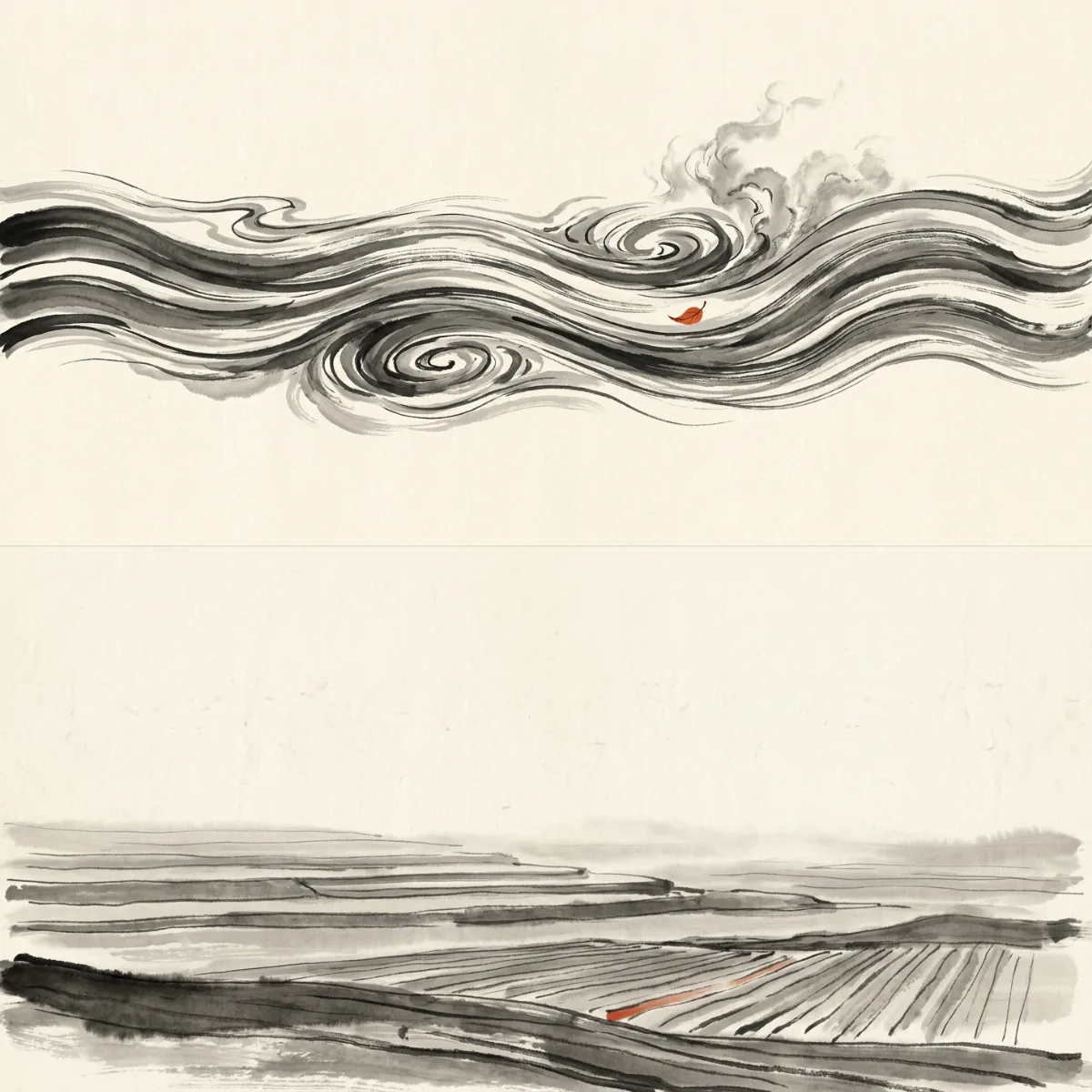 8. Union比 · BǐWhat truly wants to join must first know what it is faithful to.
Hexagram 8 (Union) often shows up around choosing allies, wanting to belong or entering a partnership. At its core: What truly wants to join must first know what it is faithful to.
Where this hexagram often fits.
Situations
- choosing allies
- wanting to belong
- entering a partnership
- loyalty being tested
- joining out of fear of being alone
- forming a group or coalition
- trusting who you let close
- doubting a bond
Questions people ask
- What or whom am I really binding myself to?
- Am I joining out of conviction or fear of being alone?
- Does this bond truly hold, or does it only attract?
- Who deserves my loyalty?
What is often at play
- need for something to hold onto
- fear of standing alone
- doubt over whom to trust
- longing to belong
What this asks for
- testing the center first
- bonding without haste
- loyalty that can stand scrutiny
- choosing from freedom, not need
Also searched as
- Holding Together
- Union
- Connection
- Loyalty
- Belonging
- Alliance
- Cohesion
Core image
This hexagram is about a coherence that is not accidental. People, forces, or interests move toward a center. The image is not romantic but orderly: coming together, joining, attaching, becoming faithful to something that truly holds. Coherence arises here not from good company, but from the recognition of a center that bears.
Tension
The tension lies in whether the bond is pure, or sought out of need, fear, or advantage. Not every union is a good sign. Sometimes one reaches for a hold because one no longer feels any ground of one's own. Then joining becomes dependence, and loyalty a way of not having to stand alone.
Distortion
Union distorts when one binds without testing to what. Then nearness matters more than truth. Wanting to belong somewhere, one quietly gives up one's own measure.
Stance
Test the center before you bind yourself to it. What gathers here must be able to bear, not only to attract. Do not join out of haste, or out of fear of being apart. Real coherence can withstand examination.
Closing line
Attach yourself too quickly, and you often notice only later what you gave yourself over to.
Plain-language entrances.
Plain-language entrances to this hexagram. They help with search and recognition, while the reading itself remains rooted in the text and your question.
Hexagram 8 - Union
Hexagram 8 - Union gives language to a recognisable I Ching pattern. Read the linked hexagram as the source, not as a separate interpretation.
Changing lines of hexagram 8
- Line 1. At the start, the bond is still simple and honest. What joins here does so openly. For that reason the first loyalty weighs heavily.
- Line 2. This line shows a nearness that grows from inner agreement. It needs little display. What is right within does not have to prove itself loudly.
- Line 3. At this point there is a risk of binding to the wrong center — reaching for a hold where there is no dignity. This line warns against a union that betrays itself already at the source.
- Line 4. Here one can bind rightly and in the open. The tie is neither secret nor calculating. What you acknowledge now may also be seen.
- Line 5. This is the strong center around which coherence orders itself. Not everything is gripped tight; that is exactly why the bond stays alive. Whoever can truly hold need not close everything off.
- Line 6. When union comes too late, or stays without a core, it becomes loose clumping. There is nearness, but no loyalty. This line shows that not every ending can still be healed by attaching after all.
The form beneath hexagram 8
Derived from the structure of the I Ching — not an interpretation, but the shape underneath it. The reading above remains the source.
- Balance. Hexagram 8 is predominantly yin — 5 yin lines and 1 yang lines.
- Line pattern. From bottom to top: yin, yin, yin, yin, yang, yin.
- Movement. 63 possible paths of change run from this image — every combination of moving lines leads to a different hexagram.
Built from
Hexagram 8 is built from two trigrams, the natural forces of the I Ching.
Related hexagrams
Sources & reading
Our text is our own, ratified reading of the canonical I Ching — source → human → pattern → fitting movement. It is not a reproduction of the translations above, and not prediction, psychology, or new-age. The reference translations serve to calibrate; protected prose is not taken over.
- Richard Wilhelm / Cary F. Baynes — The I Ching or Book of Changes. symbolic-philosophical, with the Ten Wings — the most influential Western edition.
- James Legge — The Yî King (Sacred Books of the East). scholarly-philological (public domain).
Read what is in motion in your situation.
A hexagram only takes on meaning in relation to your own question. Ask one and read what appears.