
63. After Completion
After Completion is hexagram 63 of the 64 in the I Ching, also known as the Book of Changes (in Chinese Jì Jì, 既濟).
Just when everything seems to stand, the hardest task begins: holding what is right without freezing it.
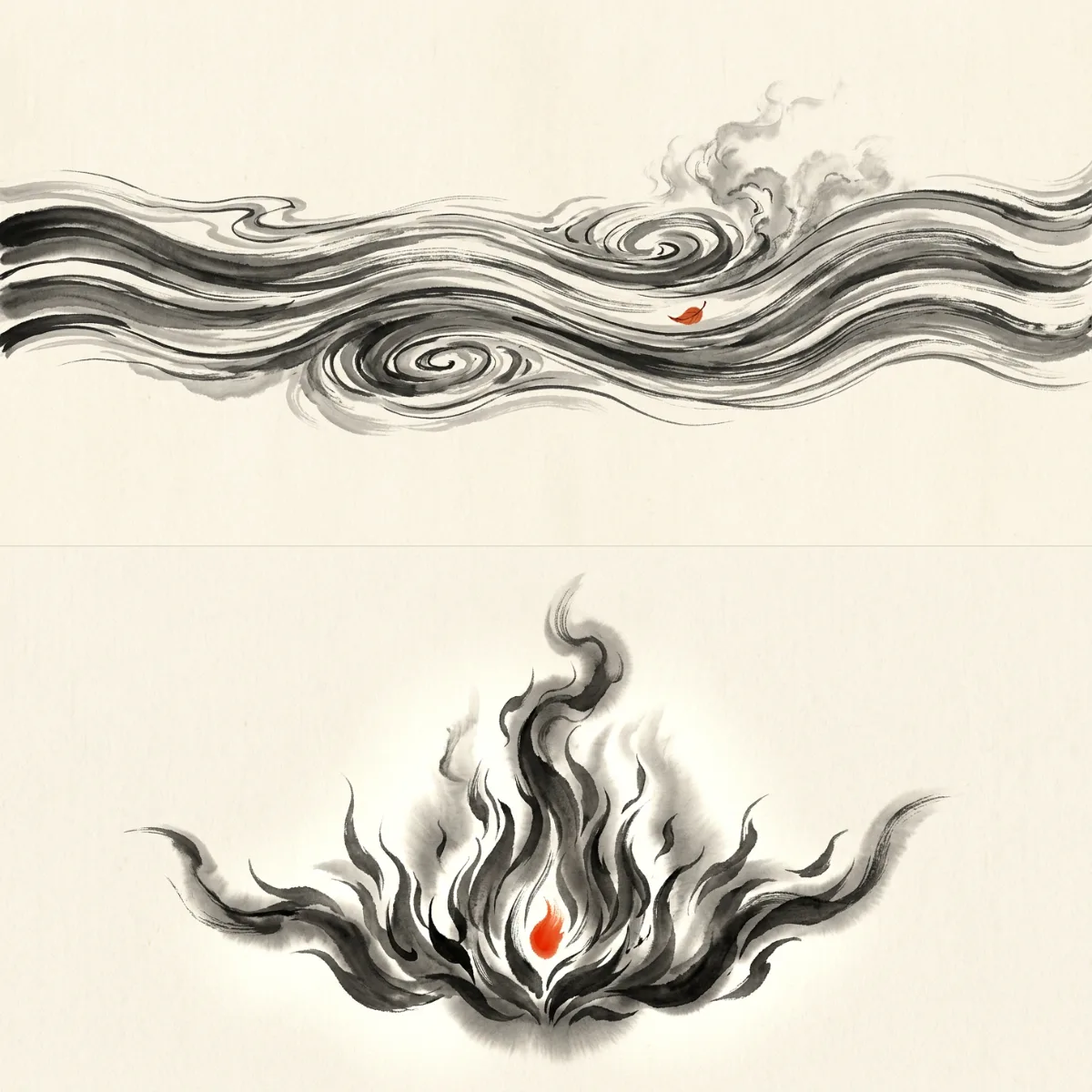 63. After Completion既濟 · Jì JìJust when everything seems to stand, the hardest task begins: holding what is right without freezing it.
Hexagram 63 (After Completion) often shows up around having just finished something and wanting to ease off, noticing that success needs upkeep or everything is in place but feels fragile. At its core: Just when everything seems to stand, the hardest task begins: holding what is right without freezing it.
Where this hexagram often fits.
Situations
- having just finished something and wanting to ease off
- noticing that success needs upkeep
- everything is in place but feels fragile
- staying alert after an achievement
- at risk of getting complacent
- holding what you've reached without rigidifying
- small shifts that carry big consequences
- hitting a goal and then sliding
Questions people ask
- How do I hold onto what I've achieved?
- Why does this feel done yet still fragile?
- How do I stay alert now that it seems to be working?
- What upkeep does what I built require?
What is often at play
- relief
- complacency
- easing off
- quiet unease
What this asks for
- staying awake after succeeding
- staying precise in the small things
- continuing soberly
- not reading success as an endpoint
Also searched as
- After Completion
- Completion
- Stabilizing
- Maintenance
- Consolidation
- Upkeep
- Staying alert
Core image
This hexagram is a thing that has come together. The parts have found their places; there is finish, shape, and fit. But finish is not the same as rest. What is whole is also exposed, because from here a small slip carries weight it would not have carried before.
Tension
The tension sits between two ways of failing. One goes slack once the work looks done; the other clutches at everything in fear of losing it. Both lose it. What's asked here is wakeful keeping — not alarm, but the plain knowledge that order, once made, has to be held.
Distortion
It goes wrong when finish is read as a final state. Then one drifts into carelessness or into being pleased with oneself, and what stood right begins, unnoticed, to slide.
Stance
Stay exact in the small things, and distrust the idea that the work now holds itself. Completion here asks for no triumph, only steady attention. The best guard over what you've reached is to carry it on plainly.
Closing line
What is finished stays whole only while you stay awake after the success.
Plain-language entrances.
Plain-language entrances to this hexagram. They help with search and recognition, while the reading itself remains rooted in the text and your question.
Hexagram 63 - After Completion
Hexagram 63 - After Completion gives language to a recognisable I Ching pattern. Read the linked hexagram as the source, not as a separate interpretation.
Changing lines of hexagram 63
- Line 1. Just past the finish, there's still risk of small damage — a wet foot, a minor leak. It needn't be fatal, but it asks to be set right at once. The small breach is exactly what must be taken seriously here.
- Line 2. Something slight goes out of shape or goes missing, but it can be recovered without real upheaval. The line asks for patience, not for panicked overcorrection. What's briefly lost can come back.
- Line 3. Here it shows that the finish still wants holding work and is not safe to lean back on. Something must be made to last against decay. This line warns against resting too soon.
- Line 4. In a state that looks ordered, doubt, wear, or seeping risk appears. Don't wait until the damage is plainly large. Timely care is what keeps the order whole.
- Line 5. This line shows a completion that no longer needs outward display to confirm it. Modest keeping carries further than great ceremony. Plainness itself is what keeps what's reached clean.
- Line 6. When one turns reckless or sure of oneself after the finish, the whole thing can still be put at risk. The end was never a free pass. This line is severe about late loss bought by early ease.
The form beneath hexagram 63
Derived from the structure of the I Ching — not an interpretation, but the shape underneath it. The reading above remains the source.
- Balance. Hexagram 63 is in full balance — 3 yang lines and 3 yin lines.
- Line pattern. From bottom to top: yang, yin, yang, yin, yang, yin.
- Movement. 63 possible paths of change run from this image — every combination of moving lines leads to a different hexagram.
Built from
Hexagram 63 is built from two trigrams, the natural forces of the I Ching.
Related hexagrams
Sources & reading
Our text is our own, ratified reading of the canonical I Ching — source → human → pattern → fitting movement. It is not a reproduction of the translations above, and not prediction, psychology, or new-age. The reference translations serve to calibrate; protected prose is not taken over.
- Richard Wilhelm / Cary F. Baynes — The I Ching or Book of Changes. symbolic-philosophical, with the Ten Wings — the most influential Western edition.
- James Legge — The Yî King (Sacred Books of the East). scholarly-philological (public domain).
Read what is in motion in your situation.
A hexagram only takes on meaning in relation to your own question. Ask one and read what appears.