
62. Small Excess
Small Excess is hexagram 62 of the 64 in the I Ching, also known as the Book of Changes (in Chinese Xiǎo Guò, 小過).
Also known as: Preponderance of the Small, Refinement.
When the small holds sway here, the way is not the grand gesture but the right fineness.
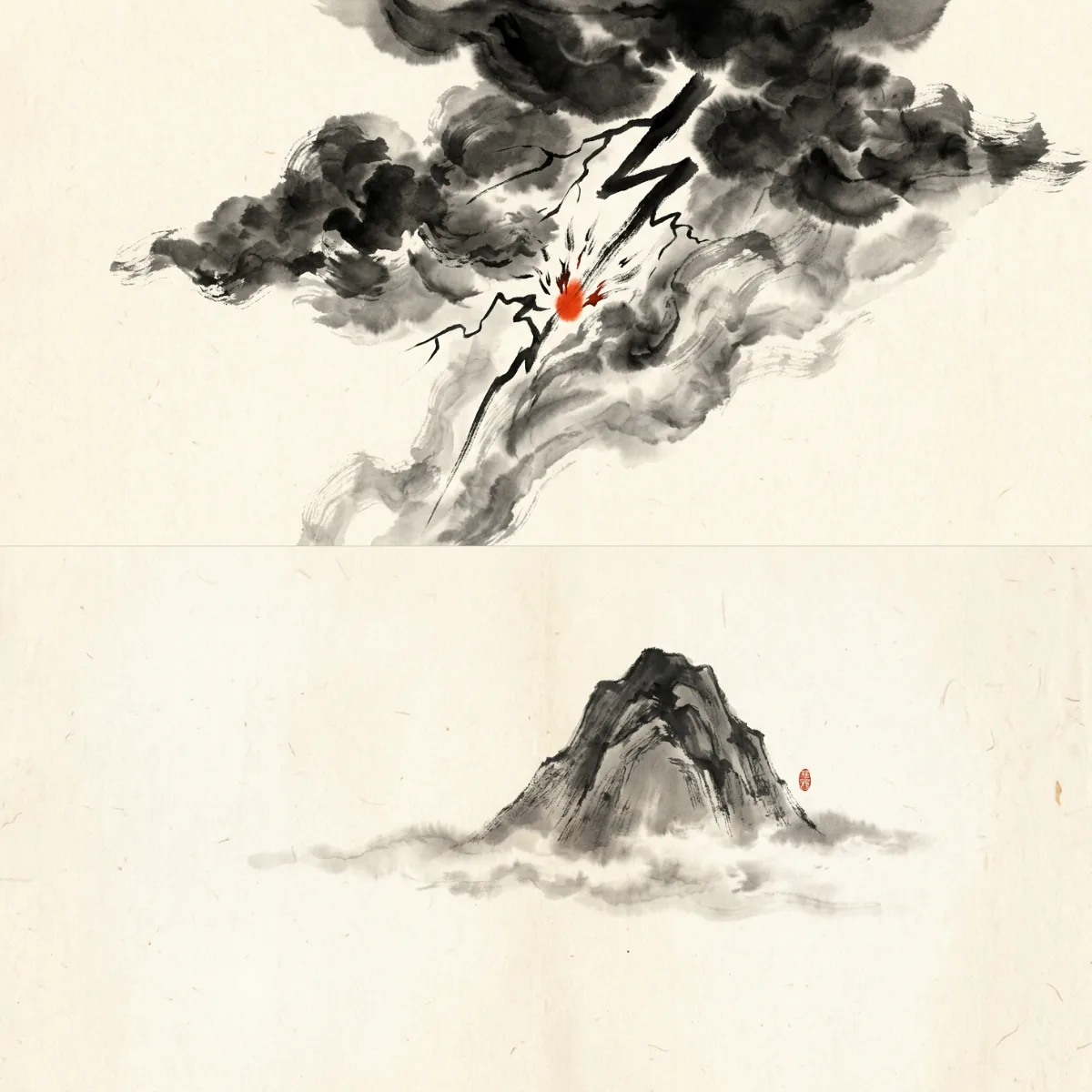 62. Small Excess小過 · Xiǎo GuòWhen the small holds sway here, the way is not the grand gesture but the right fineness.
Hexagram 62 (Small Excess) often shows up around taking small steps instead of big leaps, sensing this isn't the moment for grand moves or needing attention to detail. At its core: When the small holds sway here, the way is not the grand gesture but the right fineness.
Where this hexagram often fits.
Situations
- taking small steps instead of big leaps
- sensing this isn't the moment for grand moves
- needing attention to detail
- staying modest while you want more
- precise work that tolerates no flair
- reaching too high and missing because of it
- doing the small thing well before it grows
- acting carefully and precisely
Questions people ask
- Is this a moment for big or for small?
- How do I do the small thing well without getting petty?
- Why do my big leaps fail right now?
- What precision does this situation ask of me?
What is often at play
- impatience
- urge for more
- frustration with limited reach
- need for care
What this asks for
- staying low and precise
- working at the scale of what you can carry
- not mistaking small for petty
- not forcing big leaps
Also searched as
- Preponderance of the Small
- Refinement
- Small steps
- Detail
- Precision
- Modest action
- Care
Core image
This hexagram is about a time when large movement weighs too much and the small turns decisive. The picture is of something that must stay low, be carried out exactly, and not reach too high. So it asks for attention to detail, for small steps, for a modest correctness that does the work.
Tension
The tension sits in the affront of a narrow reach. One wants to do more, reach higher, decide faster. But the situation isn't built for that now. The small here is not lesser; it is the only scale on which getting it right stays possible.
Distortion
Fineness goes wrong when the small is mistaken for the petty, or when the big leap is attempted anyway. Then the matter turns either small-minded or reckless. Both miss the right measure.
Stance
Stay low enough, exact enough, and respect what must be done well in small shape. Work to the scale of what can bear weight, not the scale of ambition. The strength here lives in delicate correctness.
Closing line
What comes right now in the small often spares you damage later in the large.
Plain-language entrances.
Plain-language entrances to this hexagram. They help with search and recognition, while the reading itself remains rooted in the text and your question.
Hexagram 62 - Small Excess
Hexagram 62 - Small Excess gives language to a recognisable I Ching pattern. Read the linked hexagram as the source, not as a separate interpretation.
Changing lines of hexagram 62
- Line 1. At the start the pull to fly too high is strong. It doesn't fit the time. A leap this big from a base this small overreaches before it begins.
- Line 2. Here one stays under the limit and, for that very reason, finds the fitting passage. The small turns favorable because it does not pose as large. That gives a quiet correctness.
- Line 3. At this point caution runs thin. One wants to push on by sheer force and underrates the fineness the moment needs. Coarse movement in a delicate situation is the danger here.
- Line 4. Here one can move well as long as it isn't overdone. The passage is narrow but real. Wanting too much spoils it.
- Line 5. From above comes little real help or clarity, so the work must go all the more into what is near and small. Modest action carries further now than aiming high.
- Line 6. When the great flight is tried anyway, one passes beyond measure and beyond cover. The small time is then broken brutally. This line is a clean limit against overreach.
The form beneath hexagram 62
Derived from the structure of the I Ching — not an interpretation, but the shape underneath it. The reading above remains the source.
- Balance. Hexagram 62 is predominantly yin — 4 yin lines and 2 yang lines.
- Line pattern. From bottom to top: yin, yin, yang, yang, yin, yin.
- Movement. 63 possible paths of change run from this image — every combination of moving lines leads to a different hexagram.
Built from
Hexagram 62 is built from two trigrams, the natural forces of the I Ching.
Related hexagrams
Sources & reading
Our text is our own, ratified reading of the canonical I Ching — source → human → pattern → fitting movement. It is not a reproduction of the translations above, and not prediction, psychology, or new-age. The reference translations serve to calibrate; protected prose is not taken over.
- Richard Wilhelm / Cary F. Baynes — The I Ching or Book of Changes. symbolic-philosophical, with the Ten Wings — the most influential Western edition.
- James Legge — The Yî King (Sacred Books of the East). scholarly-philological (public domain).
Read what is in motion in your situation.
A hexagram only takes on meaning in relation to your own question. Ask one and read what appears.