
6. Conflict
Conflict is hexagram 6 of the 64 in the I Ching, also known as the Book of Changes (in Chinese Sòng, 訟).
Not every conflict asks to be won; sometimes it is gain enough that the tear does not widen.
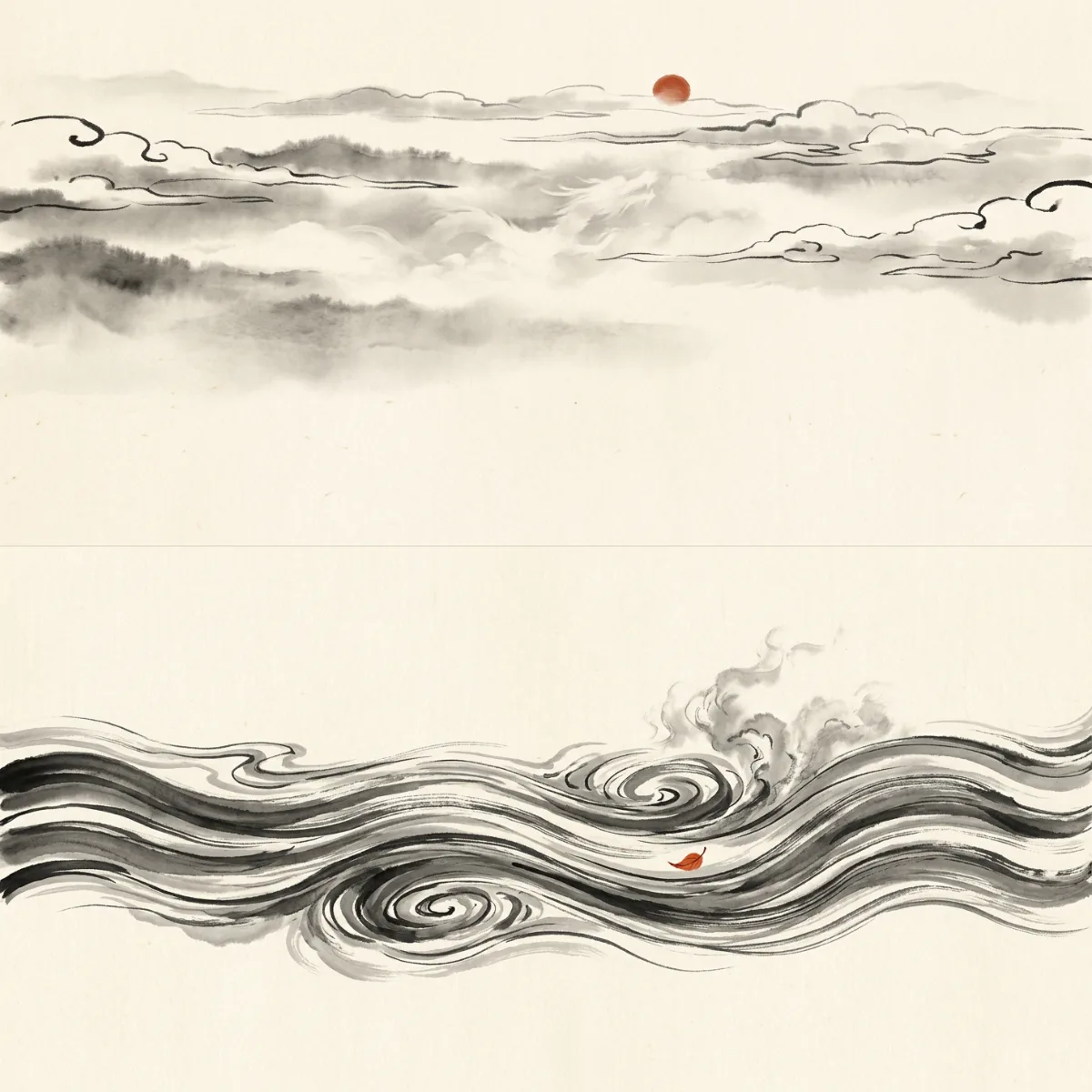 6. Conflict訟 · SòngNot every conflict asks to be won; sometimes it is gain enough that the tear does not widen.
Hexagram 6 (Conflict) often shows up around being in a conflict, an argument escalating or a clash at work. At its core: Not every conflict asks to be won; sometimes it is gain enough that the tear does not widen.
Where this hexagram often fits.
Situations
- being in a conflict
- an argument escalating
- a clash at work
- a dispute getting bigger
- facing off against someone
- wanting to be proven right
- a legal dispute
- clashing interests
Questions people ask
- Is this conflict really worth pursuing?
- Do I want to be right or to keep the relationship?
- Where exactly is the rift, and how big is it really?
- How do I contain this before it escalates?
What is often at play
- hardening
- pride
- heat
- drive to win
What this asks for
- staying sharp but not heated
- containing the rift early
- relationship over being right
- knowing when to back off
Also searched as
- Conflict
- Clash
- Disagreement
- Dispute
- Lawsuit
- Strife
- Friction
Core image
This hexagram shows a situation where two lines no longer meet on their own. There is friction, claim, a difference of interest or a difference of truth. The tension is real. Something wants to be fought out because it can no longer lie still.
Tension
The danger is that in conflict one quickly believes clarity can come only through victory. Then the stakes harden and the matter grows larger than it was. This hexagram does not deny the conflict, but it distrusts the drive that wants to turn it into total war. Not every matter improves by being carried to the end.
Distortion
Conflict distorts when one moves in and lives there. Then being right matters more than the relationship, and proof more than truth. The fight takes on a life of its own and no longer even needs to serve an outcome.
Stance
Stay sharp, but not heated. See exactly where the break lies and do not enlarge it with pride. Seek neither a quick reconciliation nor a holy war. Sometimes the right measure of conflict is to set a limit early.
Closing line
Carry every quarrel to the extreme, and you often lose the subject long before the end.
Plain-language entrances.
Plain-language entrances to this hexagram. They help with search and recognition, while the reading itself remains rooted in the text and your question.
Hexagram 6 - Conflict
Hexagram 6 - Conflict gives language to a recognisable I Ching pattern. Read the linked hexagram as the source, not as a separate interpretation.
Changing lines of hexagram 6
- Line 1. At the start the break is still small enough not to contaminate everything. Do not set a heavy machine on a light crack. What is bounded early need not escalate.
- Line 2. Here your own position is not strong enough to carry the fight broadly. To persist out of pride would double the loss. This line advises withdrawal — not from cowardice, but from a sense of measure.
- Line 3. At this point old rights or old belongings still live inside the conflict, and that makes the matter sticky. Hold what is truly yours, but do not wave it about as a weapon.
- Line 4. This line shows someone taking back the urge to fight. That is no defeat, but a restoring of inner order. Not every conflict has to be won in order to be left cleanly.
- Line 5. Here is a position from which conflict can be heard in an orderly way. Only then does the struggle stand a chance of measure. It asks for a center that is not swept along into partisan heat.
- Line 6. When one litigates to the extreme for the extreme's sake, little stays whole. Even winning becomes a meager spoil. This line warns of the emptiness of triumph without relationship.
The form beneath hexagram 6
Derived from the structure of the I Ching — not an interpretation, but the shape underneath it. The reading above remains the source.
- Balance. Hexagram 6 is predominantly yang — 4 yang lines and 2 yin lines.
- Line pattern. From bottom to top: yin, yang, yin, yang, yang, yang.
- Movement. 63 possible paths of change run from this image — every combination of moving lines leads to a different hexagram.
Built from
Hexagram 6 is built from two trigrams, the natural forces of the I Ching.
Related hexagrams
Sources & reading
Our text is our own, ratified reading of the canonical I Ching — source → human → pattern → fitting movement. It is not a reproduction of the translations above, and not prediction, psychology, or new-age. The reference translations serve to calibrate; protected prose is not taken over.
- Richard Wilhelm / Cary F. Baynes — The I Ching or Book of Changes. symbolic-philosophical, with the Ten Wings — the most influential Western edition.
- James Legge — The Yî King (Sacred Books of the East). scholarly-philological (public domain).
Read what is in motion in your situation.
A hexagram only takes on meaning in relation to your own question. Ask one and read what appears.