
59. Dissolving
Dissolving is hexagram 59 of the 64 in the I Ching, also known as the Book of Changes (in Chinese Huàn, 渙).
Also known as: Dispersion.
Sometimes the task is not to build, but to loosen what has clotted together too hard.
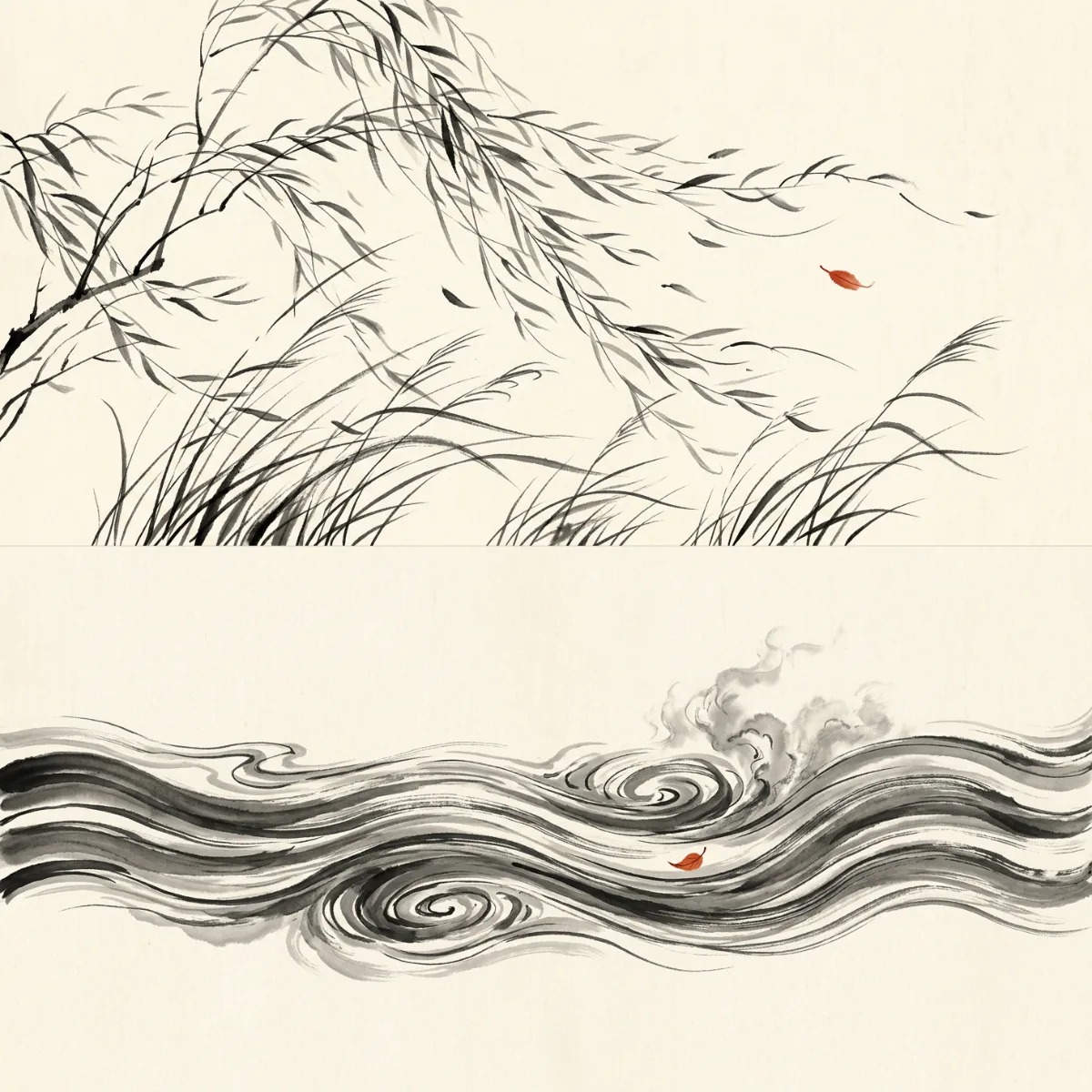 59. Dissolving渙 · HuànSometimes the task is not to build, but to loosen what has clotted together too hard.
Hexagram 59 (Dissolving) often shows up around getting a stuck situation moving again, loosening hardened positions or breaking through an impasse. At its core: Sometimes the task is not to build, but to loosen what has clotted together too hard.
Where this hexagram often fits.
Situations
- getting a stuck situation moving again
- loosening hardened positions
- breaking through an impasse
- feeling distance or wanting to reconnect
- letting something pent-up dissolve
- thinning out a blockage
- afraid to let go of old certainty
- reconciliation after estrangement
Questions people ask
- How do I get a stuck situation flowing again?
- What do I need to release to move again?
- How do I break up a hardened atmosphere?
- What do I hold onto while I let the rest dissolve?
What is often at play
- feeling stuck
- fear of letting go
- rigidity
- longing for movement
What this asks for
- loosening around a holding center
- opening a passage
- allowing relief
- not washing everything away
Also searched as
- Dispersion
- Dissolving
- Scattering
- Loosening
- Thawing
- Softening
- Opening a passage
Core image
This hexagram is about breaking up, dissolving, the loosening of what has hardened into a clot. The image is wind over water: what had gone dense or stiff is set moving again. That is why dispersal can feel freeing and frightening at once. It pries loose fixed shape, but does so to make something passable again.
Tension
The tension lies in the doubleness of dissolving. What was stuck can finally come loose, yet one can feel unsafe without the old density. So this hexagram does not ask for random scattering, but for a loosening that restores the flow.
Distortion
Loosening distorts when, out of fear of what has stiffened, one washes away all shape — or celebrates the loose without knowing what must be gathered again. Then dissolving becomes decay.
Stance
Loosen what has gone fearful, stiff, or clotted, but do it around a center that holds. Good dispersal opens passage, relief, movement again. It does not make everything weightless; it lifts the smothered thing out of its grip.
Closing line
What dissolves the right way does not vanish, but comes back into motion.
Plain-language entrances.
Plain-language entrances to this hexagram. They help with search and recognition, while the reading itself remains rooted in the text and your question.
Hexagram 59 - Dissolving
Hexagram 59 - Dissolving gives language to a recognisable I Ching pattern. Read the linked hexagram as the source, not as a separate interpretation.
Changing lines of hexagram 59
- Line 1. At the start, quick help or a first move is needed so the stiffness does not set deeper. A small opening can do a great deal here. Waiting often hardens the dense thing further.
- Line 2. Here one finds support in a center, a gathering point in the middle of the dispersal. Loosening then does not go rudderless. The line shows that dissolving grows bearable when it is not done alone.
- Line 3. At this point your own self-image, your own cramp, must come loose too. You cannot point only outside yourself for the dense thing. This line asks for dissolving without self-pity.
- Line 4. Here a larger stiffness is broken apart for the good of the whole. That can cut deep, but it makes passage possible again. The line carries the gravity of office.
- Line 5. This line disperses what kept people separated or clenched from each other. It happens not in chaos, but from authority and direction. Through it, something shared can take form again.
- Line 6. Once the danger of smothering has passed, one must not go on living in the loose. Otherwise the dispersal loses its need and turns to emptiness. This line asks you to finish the loosening.
The form beneath hexagram 59
Derived from the structure of the I Ching — not an interpretation, but the shape underneath it. The reading above remains the source.
- Balance. Hexagram 59 is in full balance — 3 yang lines and 3 yin lines.
- Line pattern. From bottom to top: yin, yang, yin, yin, yang, yang.
- Movement. 63 possible paths of change run from this image — every combination of moving lines leads to a different hexagram.
Built from
Hexagram 59 is built from two trigrams, the natural forces of the I Ching.
Related hexagrams
Sources & reading
Our text is our own, ratified reading of the canonical I Ching — source → human → pattern → fitting movement. It is not a reproduction of the translations above, and not prediction, psychology, or new-age. The reference translations serve to calibrate; protected prose is not taken over.
- Richard Wilhelm / Cary F. Baynes — The I Ching or Book of Changes. symbolic-philosophical, with the Ten Wings — the most influential Western edition.
- James Legge — The Yî King (Sacred Books of the East). scholarly-philological (public domain).
Read what is in motion in your situation.
A hexagram only takes on meaning in relation to your own question. Ask one and read what appears.