
56. The Wanderer
The Wanderer is hexagram 56 of the 64 in the I Ching, also known as the Book of Changes (in Chinese Lǚ, 旅).
Whoever has no firm ground must handle their bearing all the more carefully.
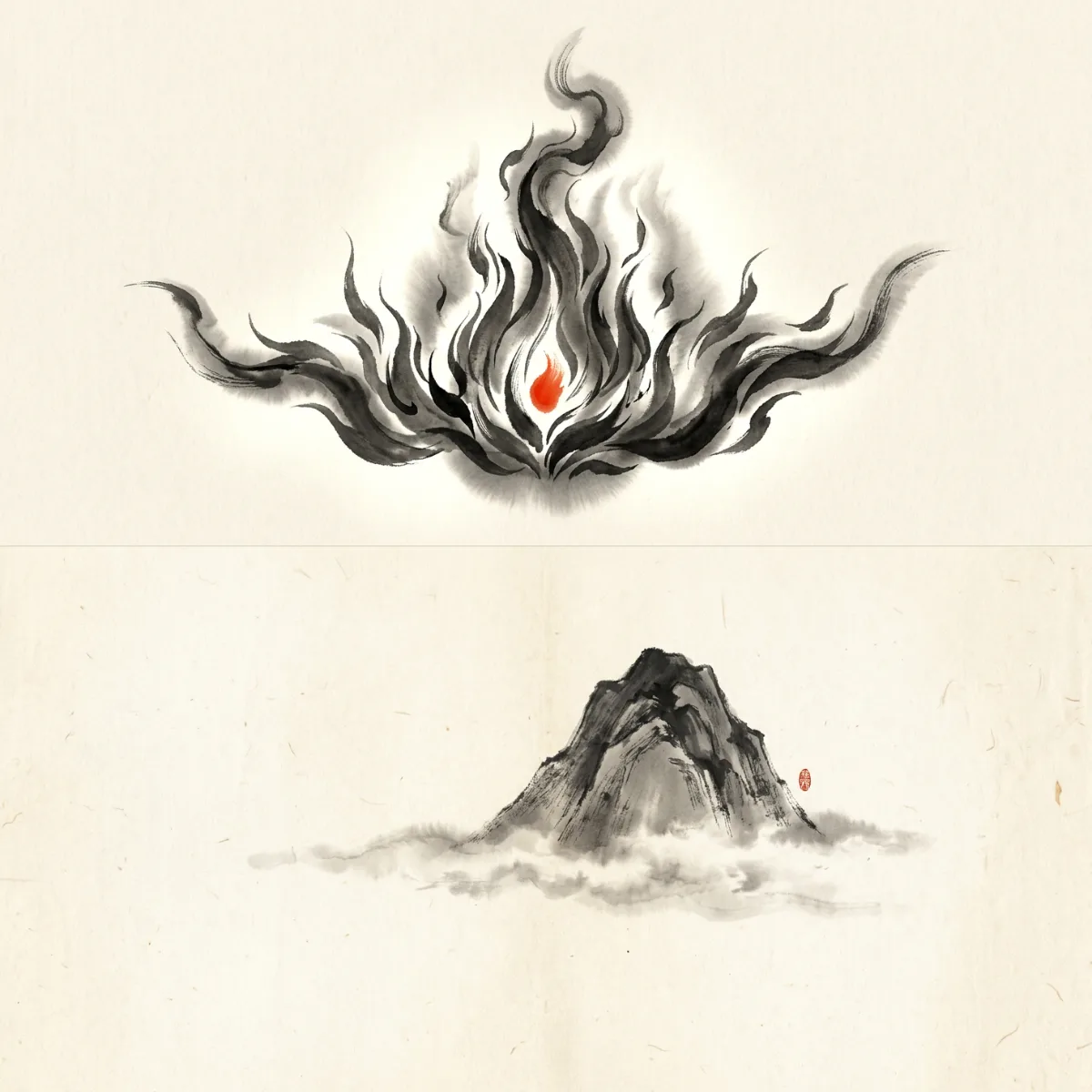 56. The Wanderer旅 · LǚWhoever has no firm ground must handle their bearing all the more carefully.
Hexagram 56 (The Wanderer) often shows up around staying somewhere temporarily, not feeling at home on foreign ground or traveling or living without a fixed base. At its core: Whoever has no firm ground must handle their bearing all the more carefully.
Where this hexagram often fits.
Situations
- staying somewhere temporarily
- not feeling at home on foreign ground
- traveling or living without a fixed base
- a new environment where you're a guest
- having no self-evident place
- moving carefully as an outsider
- a nomadic existence
- keeping your composure far from home
Questions people ask
- How do I behave as a guest on foreign ground?
- How do I keep my bearings without a fixed base?
- What can and can't I allow myself as an outsider?
- How do I stay modest yet dignified far from home?
What is often at play
- detachment
- vulnerability
- freedom
- watchfulness
What this asks for
- staying modest
- respecting the place you pass through
- small enough not to stand out
- dignified without shrinking yourself
Also searched as
- The Wanderer
- The Traveler
- Sojourner
- Temporary stay
- Nomadic life
- Outsider
- Passing through
Core image
This hexagram is about moving through ground that is not yours: traveling, lodging on foreign soil, living without a bed of your own. The wanderer owns no deep claim to any place. So carelessness is a luxury he can't afford. What looks small to the settled can land at once on the one passing through.
Tension
The tension is in being present only for a while. You are here, but not from here. That widens both the freedom and the exposure. So this asks for modesty, attention, and a fair handling of the place you don't command.
Distortion
The wandering goes wrong when detachment curdles into indifference, or when every passing contact gets used to puff yourself up. Then the foreign footing turns impure. Whoever holds no firm ground can in fact afford less, not more.
Stance
Stay small enough not to draw needless notice, and clear enough not to lose yourself in loose impressions. Respect the place you pass through. The right traveling stance is quiet dignity, not self-erasure.
Closing line
On foreign soil it isn't what you own that keeps you safe, but the way you are present.
Plain-language entrances.
Plain-language entrances to this hexagram. They help with search and recognition, while the reading itself remains rooted in the text and your question.
Hexagram 56 - The Wanderer
Hexagram 56 - The Wanderer gives language to a recognisable I Ching pattern. Read the linked hexagram as the source, not as a separate interpretation.
Changing lines of hexagram 56
- Line 1. At the start the wanderer carries himself too small, too sloppy, too dependent, and so invites contempt. The line asks for modesty without self-neglect. Be plain, not absent.
- Line 2. Here the traveler finds a place for now, some means, a measure of rest. That is good as long as he doesn't mistake it for settling down. Grateful plainness is what keeps it sound.
- Line 3. At this point carelessness costs the wanderer his shelter or his support, and the footing turns precarious. The line is severe on heedlessness in strange terrain. What you don't own, you guard more closely.
- Line 4. Here there is a foothold, but no real home harbor. You can hold your ground as long as you don't forget the difference. Keep your dignity without settling into a false security.
- Line 5. This line shows a traveler who carries himself rightly and so finds recognition without pushing for it. That makes the foreign position workable. Good presence opens what property cannot.
- Line 6. When the wanderer treats his temporary footing lightly, he burns down his own lodging and loses even what was left to him. Then wandering becomes self-inflicted harm. The line warns against reckless heedlessness.
The form beneath hexagram 56
Derived from the structure of the I Ching — not an interpretation, but the shape underneath it. The reading above remains the source.
- Balance. Hexagram 56 is in full balance — 3 yang lines and 3 yin lines.
- Line pattern. From bottom to top: yin, yin, yang, yang, yin, yang.
- Movement. 63 possible paths of change run from this image — every combination of moving lines leads to a different hexagram.
Built from
Hexagram 56 is built from two trigrams, the natural forces of the I Ching.
Related hexagrams
Sources & reading
Our text is our own, ratified reading of the canonical I Ching — source → human → pattern → fitting movement. It is not a reproduction of the translations above, and not prediction, psychology, or new-age. The reference translations serve to calibrate; protected prose is not taken over.
- Richard Wilhelm / Cary F. Baynes — The I Ching or Book of Changes. symbolic-philosophical, with the Ten Wings — the most influential Western edition.
- James Legge — The Yî King (Sacred Books of the East). scholarly-philological (public domain).
Read what is in motion in your situation.
A hexagram only takes on meaning in relation to your own question. Ask one and read what appears.