
54. Marrying In
Marrying In is hexagram 54 of the 64 in the I Ching, also known as the Book of Changes (in Chinese Guī Mèi, 歸妹).
Also known as: The Marrying Maiden, Subordination.
Whoever enters without a central place must know all the more sharply what is, and is not, their dignity.
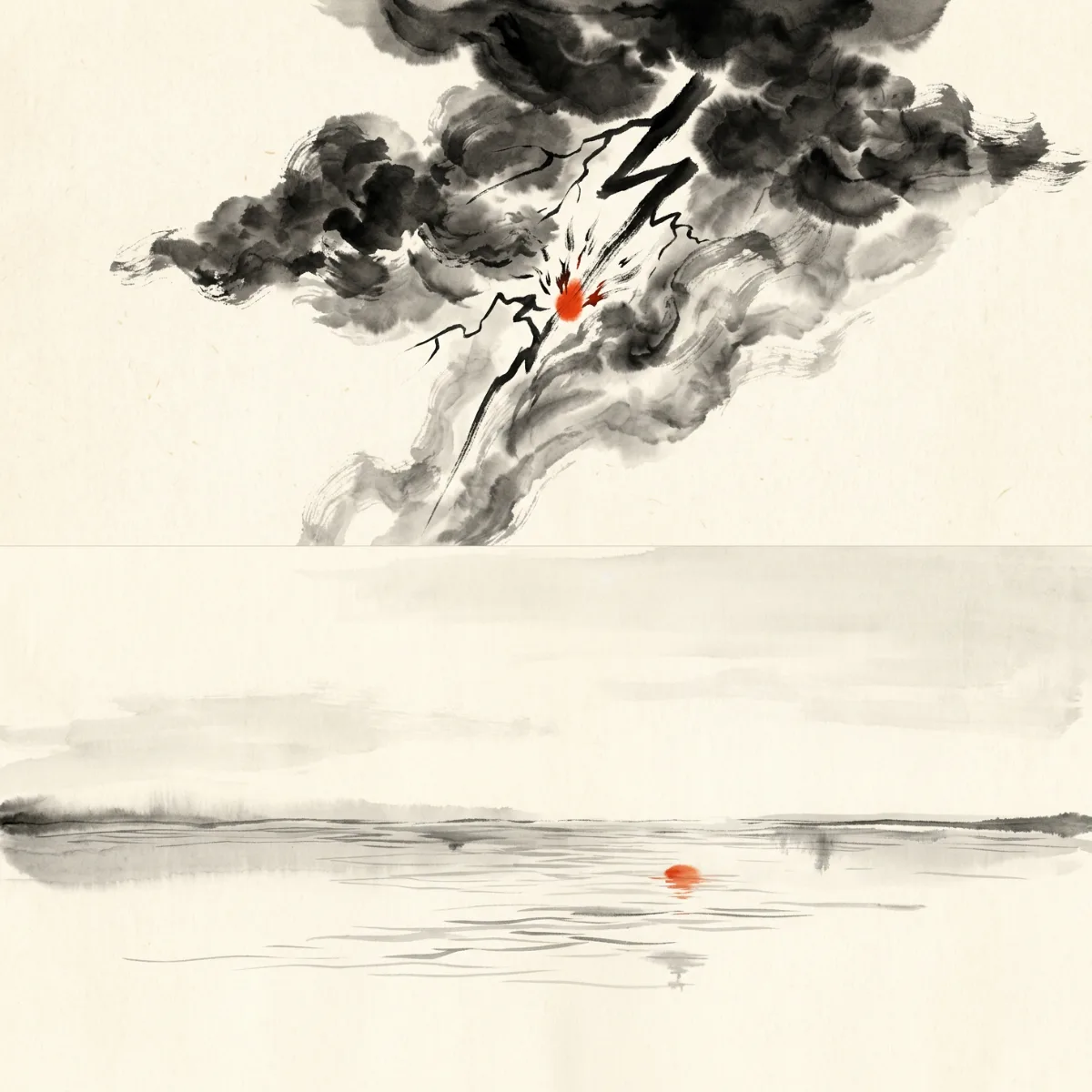 54. Marrying In歸妹 · Guī MèiWhoever enters without a central place must know all the more sharply what is, and is not, their dignity.
Hexagram 54 (Marrying In) often shows up around a role without the lead position, joining something from a dependent place or a lopsided or asymmetric relationship. At its core: Whoever enters without a central place must know all the more sharply what is, and is not, their dignity.
Where this hexagram often fits.
Situations
- a role without the lead position
- joining something from a dependent place
- a lopsided or asymmetric relationship
- knowing your place in a connection
- wanting to take part without being in charge
- not selling yourself too cheaply
- a bond that isn't equal
- stepping in at the wrong moment
Questions people ask
- What is my real place in this relationship?
- Am I selling myself too cheaply?
- How do I stay dignified in a dependent role?
- Am I romanticizing what's actually on offer here?
What is often at play
- longing to belong
- vulnerability
- lack
- uncertainty about your place
What this asks for
- seeing clearly what place you're given
- not romanticizing it
- keeping dignity in a secondary role
- keeping proportion
Also searched as
- The Marrying Maiden
- Subordination
- Joining in
- Asymmetric relationship
- Dependency
- Secondary role
- Timing mistake
Core image
This hexagram is about entering a bond from a place that is not the first or the load-bearing one. It speaks less of romance than of rank, position, and the exposure of a secondary role. The situation asks for discernment, because not every tie carries the same standing or the same staying power.
Tension
The tension is between longing and position. One wants to join, to belong, to take part, but does so from a dependent rather than a leading role. Out of that come the real risks: losing yourself, expecting what was never offered, claiming a place that isn't yours.
Distortion
Subordination goes wrong when lack drives someone to force a head seat anyway, or, the other way, to give themselves away too cheaply to a bond with no firm ground. Then entering turns humiliating, or it throws everything off balance.
Stance
See clearly what place is actually on offer, and don't romanticize it. What is secondary need not be worthless, but it does ask for measure. Dignity here is in a true sense of position, not in pretending every bond stands equal.
Closing line
Not every tie calls for refusal, but every tie calls for plain clarity about its rank.
Plain-language entrances.
Plain-language entrances to this hexagram. They help with search and recognition, while the reading itself remains rooted in the text and your question.
Hexagram 54 - Marrying In
Hexagram 54 - Marrying In gives language to a recognisable I Ching pattern. Read the linked hexagram as the source, not as a separate interpretation.
Changing lines of hexagram 54
- Line 1. At the start the position is narrow but not, in itself, impure. One can come along within a modest place, so long as no false claim is made. This line asks for dignity in the small.
- Line 2. Here inner faithfulness holds despite an outward limit, and that guards against bitterness. Whoever needn't prove everything outward keeps their own line more easily.
- Line 3. At this point one is close to losing themselves to an unworthy or too-loose bond. The line is strict: not every advance deserves your taking part. Sometimes drawing back carries more dignity than joining.
- Line 4. Here entering is held off because the right moment, or the right shape, isn't there yet. That can sting, but it spares a deeper crookedness. Better late and right than now and wrong.
- Line 5. This line shows a secondary place carried with dignity all the same, because it doesn't act out of smallness. There is a sense of rank without humiliation, and that gives the bond a better balance.
- Line 6. When the outward shape of a bond is raised with no real inner substance, only emptiness is left. There is ceremony, but no reality that bears weight. This line exposes the hollow tie.
The form beneath hexagram 54
Derived from the structure of the I Ching — not an interpretation, but the shape underneath it. The reading above remains the source.
- Balance. Hexagram 54 is in full balance — 3 yang lines and 3 yin lines.
- Line pattern. From bottom to top: yang, yang, yin, yang, yin, yin.
- Movement. 63 possible paths of change run from this image — every combination of moving lines leads to a different hexagram.
Built from
Hexagram 54 is built from two trigrams, the natural forces of the I Ching.
Related hexagrams
Sources & reading
Our text is our own, ratified reading of the canonical I Ching — source → human → pattern → fitting movement. It is not a reproduction of the translations above, and not prediction, psychology, or new-age. The reference translations serve to calibrate; protected prose is not taken over.
- Richard Wilhelm / Cary F. Baynes — The I Ching or Book of Changes. symbolic-philosophical, with the Ten Wings — the most influential Western edition.
- James Legge — The Yî King (Sacred Books of the East). scholarly-philological (public domain).
Read what is in motion in your situation.
A hexagram only takes on meaning in relation to your own question. Ask one and read what appears.