
51. Shock
Shock is hexagram 51 of the 64 in the I Ching, also known as the Book of Changes (in Chinese Zhèn, 震).
Also known as: The Arousing (Shock).
Shock breaks the taken-for-granted open and asks what still stands upright after.
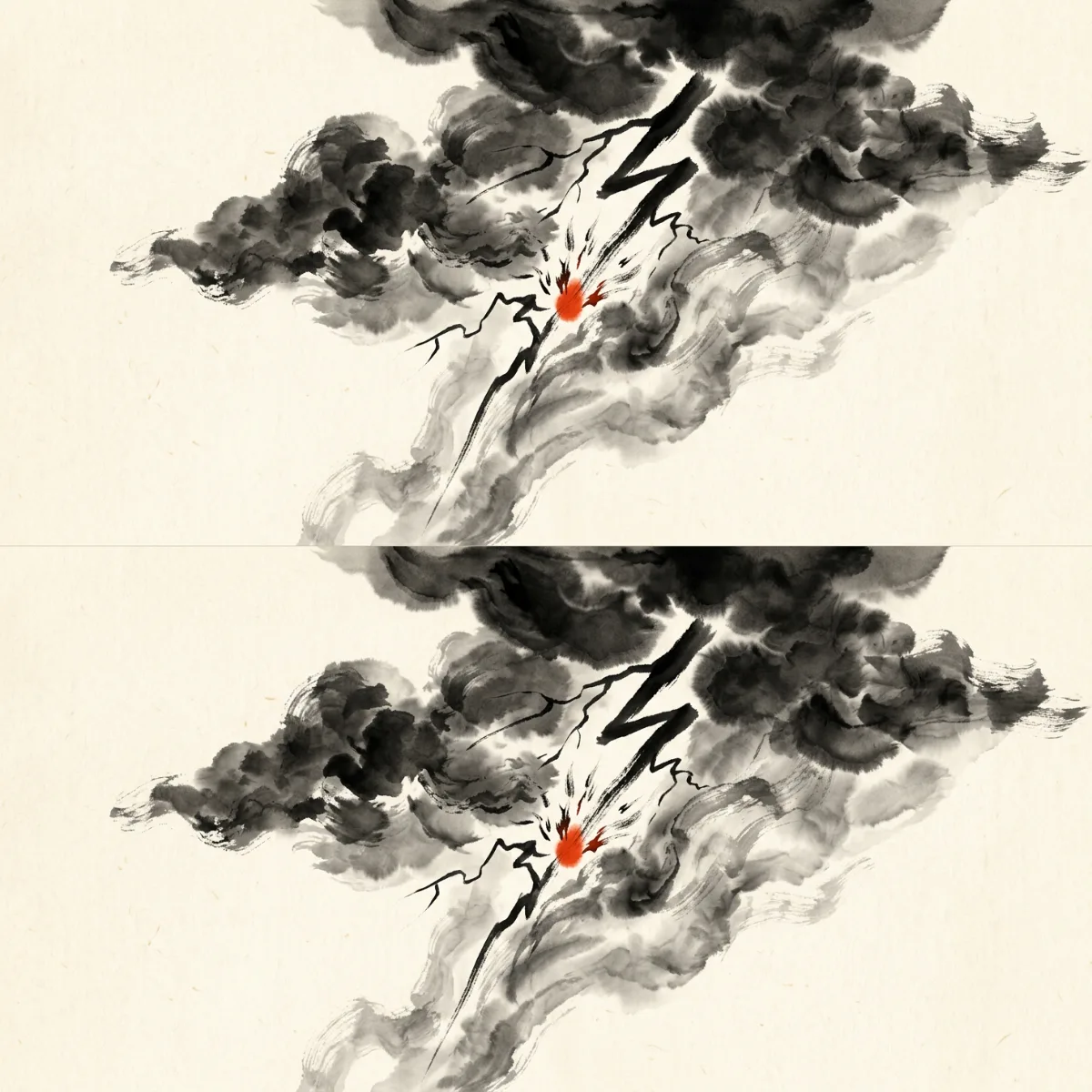 51. Shock震 · ZhènShock breaks the taken-for-granted open and asks what still stands upright after.
Hexagram 51 (Shock) often shows up around being jolted awake, a shock or sudden blow or something that cracks your certainty open. At its core: Shock breaks the taken-for-granted open and asks what still stands upright after.
Where this hexagram often fits.
Situations
- being jolted awake
- a shock or sudden blow
- something that cracks your certainty open
- recovering your footing after a fright
- a disruption that shakes everything up
- processing a sudden event
- finding your composure after the blow
- yanked out of what you took for granted
Questions people ask
- How do I find my calm again after a shock?
- What stays standing when everything wobbles?
- How do I process a sudden blow without staying stuck in it?
- What is this shock trying to show me?
What is often at play
- fright
- rattledness
- panic
- alertness
What this asks for
- returning to right proportion
- keeping your center
- not dramatizing the shock
- regaining seriousness without losing yourself
Also searched as
- Shock
- The Arousing
- Upheaval
- Wake-up jolt
- Disruption
- Thunder
- Sudden event
Core image
This hexagram is thunder upon thunder: a sudden jolt that startles the field awake and unsettles the ordinary sense of safety. Something strikes, and what was assumed quietly true is no longer. The worth of this moment is not in the fright itself, but in what the fright lays bare. Whoever keeps their shape learns something about the firmness of their own center.
Tension
The tension sits between the first jolt and the lasting disarray. The blow is real, but it need not occupy the whole inner room. What this hexagram asks is the recovery of measure once the thunder has fallen — to feel the strike without letting it move in.
Distortion
Shock distorts when someone keeps living inside the panic, or gives the fright theatrical scale. Then the incident hardens into an identity. What was meant to wake you instead just keeps reverberating.
Stance
Let the shock restore your seriousness without losing yourself in it. Take in what was broken open, but stage no drama around your own undoing. Real steadiness here is not the absence of fright, but the return to true measure after it.
Closing line
Whoever stills their hands again after the thunder stands nearer the center than before.
Plain-language entrances.
Plain-language entrances to this hexagram. They help with search and recognition, while the reading itself remains rooted in the text and your question.
Hexagram 51 - Shock
Hexagram 51 - Shock gives language to a recognisable I Ching pattern. Read the linked hexagram as the source, not as a separate interpretation.
Changing lines of hexagram 51
- Line 1. At the start the fright is large and raw. That is not graceful, but it is human. The line turns favorable the moment you stop dwelling in the fright.
- Line 2. Here the shock lands on what's held close — a possession, a position, a nearness. The loss is felt closer to the bone. Even so, the line asks you not to plunder yourself in the aftermath.
- Line 3. At this point the shock works through as confusion and hurried motion. You react too much and see too little. The line asks you to slow your pace only after the unexpected has struck.
- Line 4. Here someone stays stuck in the reverberation and cannot find the center again. The shock grows heavier than it needed to be. This line warns against being tangled in the aftershock.
- Line 5. This line shows real seriousness in the middle of the storm. The situation stays tense, but the center does not come apart. So the shock becomes bearable without being made small.
- Line 6. When the shock spreads into wider unrest and fear infects everyone in turn, you have to withdraw from the panic. Do not join in amplifying every tremor together. Here a sober head saves the field.
The form beneath hexagram 51
Derived from the structure of the I Ching — not an interpretation, but the shape underneath it. The reading above remains the source.
- Balance. Hexagram 51 is predominantly yin — 4 yin lines and 2 yang lines.
- Line pattern. From bottom to top: yang, yin, yin, yang, yin, yin.
- Movement. 63 possible paths of change run from this image — every combination of moving lines leads to a different hexagram.
Built from
Hexagram 51 is built from two trigrams, the natural forces of the I Ching.
Related hexagrams
Sources & reading
Our text is our own, ratified reading of the canonical I Ching — source → human → pattern → fitting movement. It is not a reproduction of the translations above, and not prediction, psychology, or new-age. The reference translations serve to calibrate; protected prose is not taken over.
- Richard Wilhelm / Cary F. Baynes — The I Ching or Book of Changes. symbolic-philosophical, with the Ten Wings — the most influential Western edition.
- James Legge — The Yî King (Sacred Books of the East). scholarly-philological (public domain).
Read what is in motion in your situation.
A hexagram only takes on meaning in relation to your own question. Ask one and read what appears.