
50. The Cauldron
The Cauldron is hexagram 50 of the 64 in the I Ching, also known as the Book of Changes (in Chinese Dǐng, 鼎).
What makes a vessel worthy is not its shine, but what it can hold in the right heat.
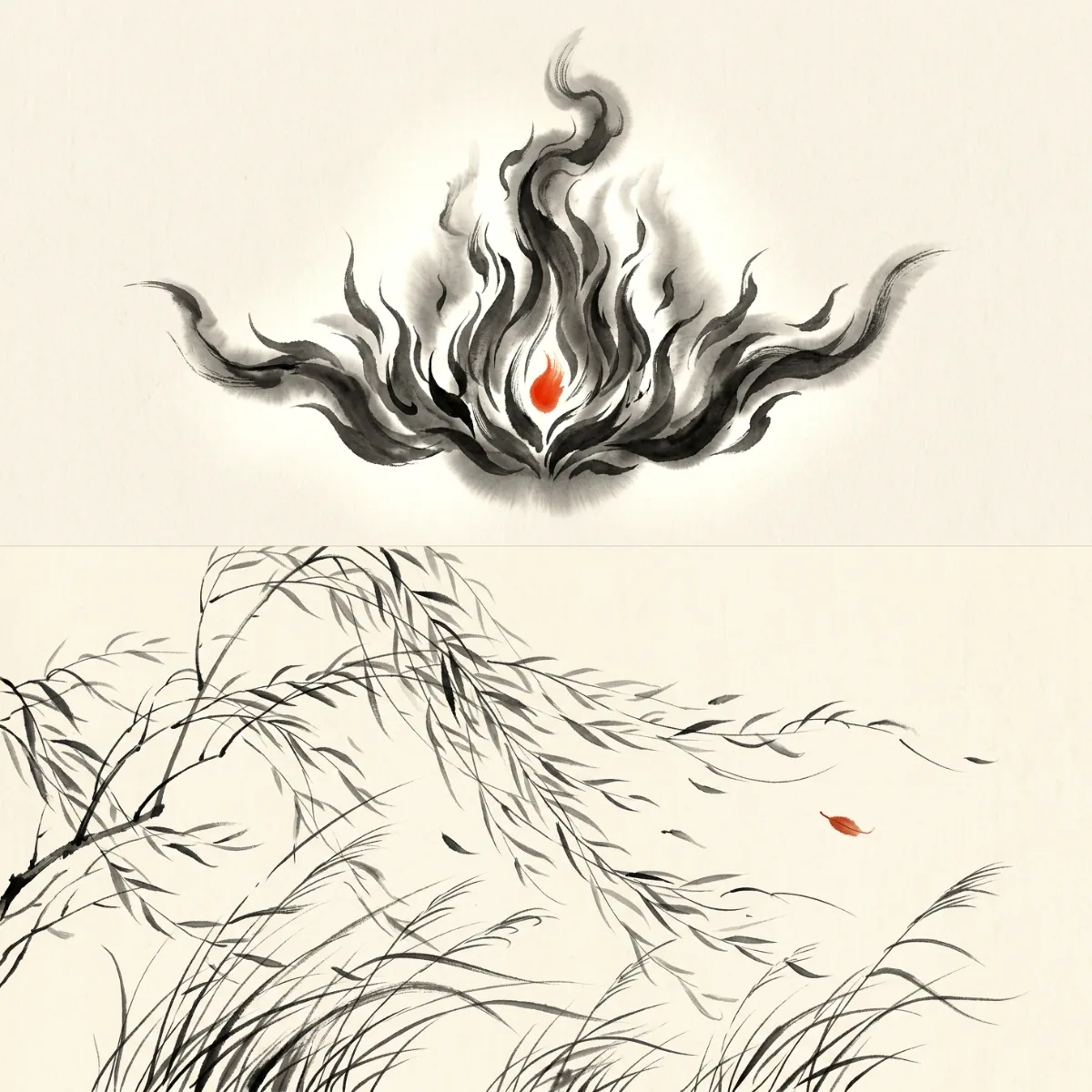 50. The Cauldron鼎 · DǐngWhat makes a vessel worthy is not its shine, but what it can hold in the right heat.
Hexagram 50 (The Cauldron) often shows up around refining something raw into something valuable, giving form to what you carry or passing on culture or meaning. At its core: What makes a vessel worthy is not its shine, but what it can hold in the right heat.
Where this hexagram often fits.
Situations
- refining something raw into something valuable
- giving form to what you carry
- passing on culture or meaning
- turning raw input into nourishment
- being the vessel for something larger
- letting substance matter more than shine
- building something that strengthens others
- tending what needs transforming
Questions people ask
- How do I transform raw material into something of worth?
- Do I care about the substance or only the surface?
- What am I passing on to others?
- How do I become a good vessel for something larger?
What is often at play
- dedication
- craving for status
- responsibility
- care
What this asks for
- putting substance above shine
- maintaining the vessel
- patient refinement
- working quietly but deeply
Also searched as
- The Cauldron
- The Vessel
- Transformation
- Refinement
- Nourishment
- Culture-bearer
- Alchemy
Core image
This hexagram is about the vessel in which raw matter is turned into something nourishing and worthy. The image is ritual and practical at once: a cauldron that is not itself the point, but the bearer of transformation. So this hexagram speaks of refinement, of nourishment, of lifting plain shape into something higher.
Tension
The tension sits in the difference between contents and vessel. One can fix on status, ornament, or function and forget that the cauldron means nothing unless it actually turns something. Without inner heat and the right contents, it stays an empty object.
Distortion
The cauldron distorts when raising the shape matters more than the nourishment. Then one serves up culture without any real change. It gleams, but carries nothing that truly strengthens anyone.
Stance
See that the shape grows fit for what must be prepared higher or more cleanly. Tend the vessel, honor the heat, and do not hold the contents cheap. Real lifting here is no pose, but a refining that makes someone or something more nourishing.
Closing line
A good vessel shows that transformation need not be loud to work deep.
Plain-language entrances.
Plain-language entrances to this hexagram. They help with search and recognition, while the reading itself remains rooted in the text and your question.
Hexagram 50 - The Cauldron
Hexagram 50 - The Cauldron gives language to a recognisable I Ching pattern. Read the linked hexagram as the source, not as a separate interpretation.
Changing lines of hexagram 50
- Line 1. At the start the cauldron must be emptied or tipped over so the old residue can fall out. It looks like a mess, but it is needed. Without this first cleaning, nothing new is cleanly prepared.
- Line 2. Here the contents are good, but there is interference at the edge. The line shows that worth can hold its ground despite the noise around it. Do not let the good be fouled now by petty trouble.
- Line 3. At this point the change stalls, because shape and contents do not yet meet. The potential is there, but it does not come free. This line asks for persistence without cynicism.
- Line 4. Here damage threatens because the cauldron is handled too heavily, too wrongly, or too carelessly. Then worth is lost for want of measure. The line is strict about unworthy handling.
- Line 5. This line shows a cauldron handled with dignity, and so able to truly nourish. The shape is not showy, but fitting. That is what makes refinement reliable.
- Line 6. When the change fully succeeds, the cauldron takes on something noble without growing remote. It carries well because it is ordered down to the detail. This line shows completion in service.
The form beneath hexagram 50
Derived from the structure of the I Ching — not an interpretation, but the shape underneath it. The reading above remains the source.
- Balance. Hexagram 50 is predominantly yang — 4 yang lines and 2 yin lines.
- Line pattern. From bottom to top: yin, yang, yang, yang, yin, yang.
- Movement. 63 possible paths of change run from this image — every combination of moving lines leads to a different hexagram.
Built from
Hexagram 50 is built from two trigrams, the natural forces of the I Ching.
Related hexagrams
Sources & reading
Our text is our own, ratified reading of the canonical I Ching — source → human → pattern → fitting movement. It is not a reproduction of the translations above, and not prediction, psychology, or new-age. The reference translations serve to calibrate; protected prose is not taken over.
- Richard Wilhelm / Cary F. Baynes — The I Ching or Book of Changes. symbolic-philosophical, with the Ten Wings — the most influential Western edition.
- James Legge — The Yî King (Sacred Books of the East). scholarly-philological (public domain).
Read what is in motion in your situation.
A hexagram only takes on meaning in relation to your own question. Ask one and read what appears.