
5. Waiting
Waiting is hexagram 5 of the 64 in the I Ching, also known as the Book of Changes (in Chinese Xū, 需).
Waiting here is not emptiness but faithfulness without possession.
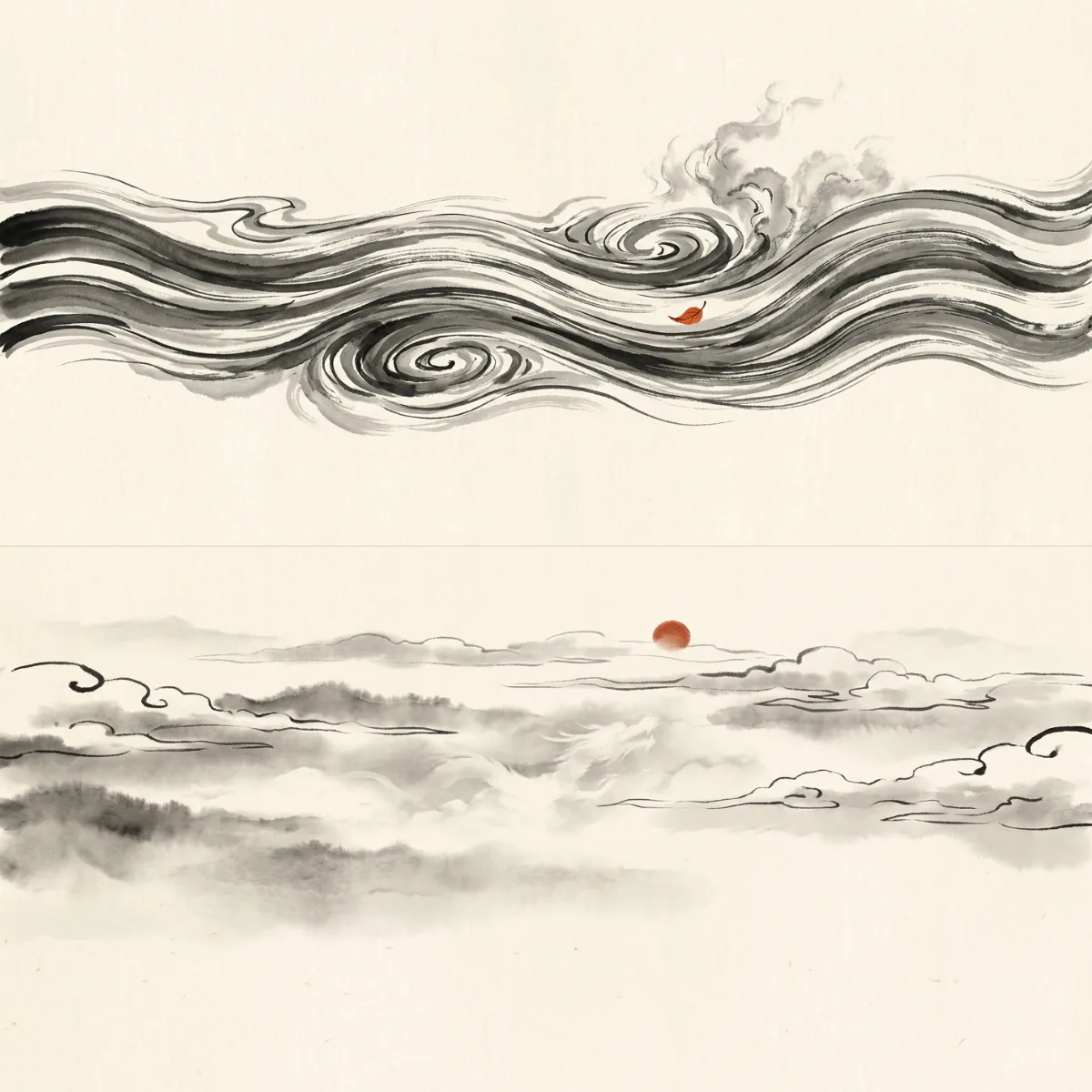 5. Waiting需 · XūWaiting here is not emptiness but faithfulness without possession.
Hexagram 5 (Waiting) often shows up around having to wait, sitting in uncertainty or unable to force anything. At its core: Waiting here is not emptiness but faithfulness without possession.
Where this hexagram often fits.
Situations
- having to wait
- sitting in uncertainty
- unable to force anything
- waiting on a result
- summoning patience
- tension before a decision
- ready but unable to act
- time not in your own hands
Questions people ask
- How do I endure while I can do nothing?
- Is this the right moment or should I wait?
- How do I stay ready without driving myself crazy?
- What does this waiting period ask of me?
What is often at play
- restlessness
- impatience
- tension
- urge to intervene
What this asks for
- staying prepared
- waiting with dignity
- trusting without straining
- not pulling at time
Also searched as
- Waiting
- Timing
- Patience
- Preparation
- Holding off
- Delay
- Pre-decision tension
Core image
This hexagram is like clouds gathering without yet breaking. Something is on its way, but not yet available. The situation asks for preparation without appropriation. Look closely and you see that time is working, even though it delivers nothing yet.
Tension
The ache of waiting is that the will cannot yet reach its object. So the temptation rises to push harder, decide faster, or wall up the emptiness with activity. But something is in fact happening here. The decisive move simply does not yet fall to your hand.
Distortion
Waiting distorts when it goes slack or bitter. Then watchfulness becomes postponement and patience becomes cynicism. The eyes no longer stay open — one merely hangs in time.
Stance
Stay prepared, dignified, and unhurried. Gather what is needed and make yourself ready, but possess nothing in advance. The emptiness need not be filled to be real. Sometimes time tests not your speed, but your ability to keep standing.
Closing line
Only the one who does not pull at time notices when it truly opens.
Plain-language entrances.
Plain-language entrances to this hexagram. They help with search and recognition, while the reading itself remains rooted in the text and your question.
Hexagram 5 - Waiting
Hexagram 5 - Waiting gives language to a recognisable I Ching pattern. Read the linked hexagram as the source, not as a separate interpretation.
Changing lines of hexagram 5
- Line 1. Here the waiting is still clean and simple. There is distance between you and what is to come, and that is no lack. Stay with the ordinary and do not make the emptiness dramatic.
- Line 2. This line brings restlessness into the waiting. There is nearness already, but no fulfillment, and that makes one sensitive to rumor and projection. Do not let noise pass for a sign.
- Line 3. At this point waiting grows dangerous, because the urge to intervene peaks. Whoever wades into the current now pulls themselves out of position. Not everything that seems reachable is yet available.
- Line 4. Here the pressure turns personal. Time presses on body, nerve, and limit. Hold your position, even when the strain presents itself as necessity.
- Line 5. This is waiting at its best. There is trust without torpor, readiness without cramp. What ripens here ripens in dignity.
- Line 6. When the waiting has been long, fulfillment may arrive strange or ill-timed. Just then, recognition is needed. Bitterness often fails to see what has finally arrived.
The form beneath hexagram 5
Derived from the structure of the I Ching — not an interpretation, but the shape underneath it. The reading above remains the source.
- Balance. Hexagram 5 is predominantly yang — 4 yang lines and 2 yin lines.
- Line pattern. From bottom to top: yang, yang, yang, yin, yang, yin.
- Movement. 63 possible paths of change run from this image — every combination of moving lines leads to a different hexagram.
Built from
Hexagram 5 is built from two trigrams, the natural forces of the I Ching.
Related hexagrams
Sources & reading
Our text is our own, ratified reading of the canonical I Ching — source → human → pattern → fitting movement. It is not a reproduction of the translations above, and not prediction, psychology, or new-age. The reference translations serve to calibrate; protected prose is not taken over.
- Richard Wilhelm / Cary F. Baynes — The I Ching or Book of Changes. symbolic-philosophical, with the Ten Wings — the most influential Western edition.
- James Legge — The Yî King (Sacred Books of the East). scholarly-philological (public domain).
Read what is in motion in your situation.
A hexagram only takes on meaning in relation to your own question. Ask one and read what appears.