
4. Inexperience
Inexperience is hexagram 4 of the 64 in the I Ching, also known as the Book of Changes (in Chinese Méng, 蒙).
Also known as: Youthful Folly.
Not every not-knowing is emptiness — sometimes insight still stands before you in rough clothing.
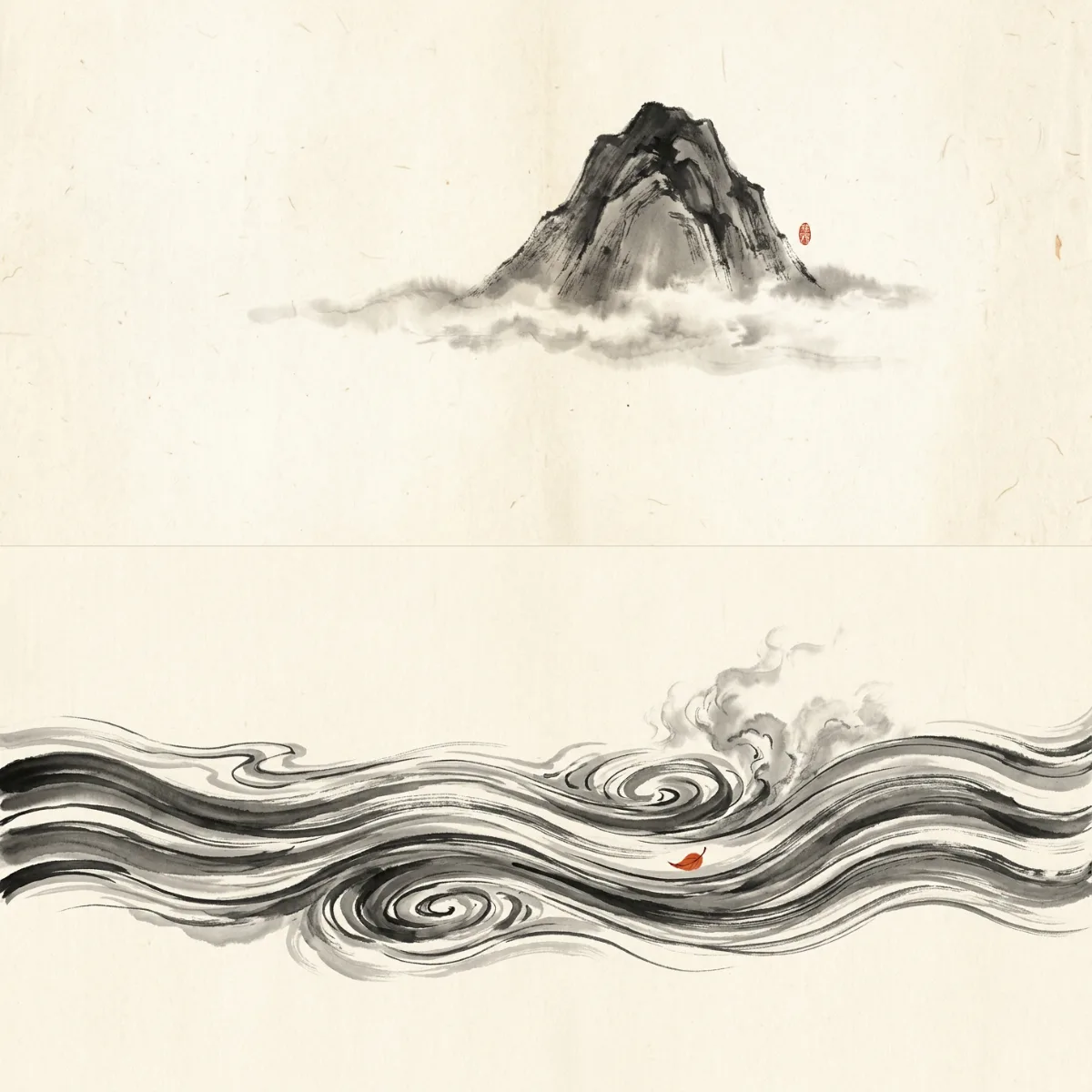 4. Inexperience蒙 · MéngNot every not-knowing is emptiness — sometimes insight still stands before you in rough clothing.
Hexagram 4 (Inexperience) often shows up around having to learn something new, being inexperienced or judging too fast. At its core: Not every not-knowing is emptiness — sometimes insight still stands before you in rough clothing.
Where this hexagram often fits.
Situations
- having to learn something new
- being inexperienced
- judging too fast
- thinking you already know
- needing guidance
- stuck through not knowing
- looking for a mentor
- misunderstandings from inexperience
Questions people ask
- What do I still need to learn here first?
- Am I asking for help or for reassurance?
- Where am I overestimating my own insight?
- How do I let myself be guided without becoming dependent?
What is often at play
- uncertainty
- impatience for answers
- overconfidence
- dependence
What this asks for
- being willing to learn
- accepting form and discipline
- patience with repetition
- simplicity over cleverness
Also searched as
- Youthful Folly
- Inexperience
- Naivety
- Learning
- Beginner phase
- Guidance
- Apprenticeship
Core image
This hexagram belongs to knowing without a bed to lie in. There is life, curiosity, urge, and raw potential, but no measure yet. The young here is not sweet but unpracticed. It wants to answer before it has learned how to look.
Tension
The tension is not a lack of intelligence, but a lack of shape. One asks too early, too often, or in the wrong way — wanting clarity without discipline, insight without an apprenticeship. But whoever fills the unripe too quickly feeds not learning but dependence.
Distortion
Inexperience distorts when it disguises itself as spontaneity, or when guidance disguises itself as control. The result is either loose aimlessness or dead obedience. Either way, real learning is blocked.
Stance
Stay available to what still has to learn, but do not hand it over to ease. Do not answer every cry for clarity. Give shape, limit, and repetition. What wants to grow here needs less explanation than the right discipline.
Closing line
Spare the unripe its friction, and you spare it adulthood.
Plain-language entrances.
Plain-language entrances to this hexagram. They help with search and recognition, while the reading itself remains rooted in the text and your question.
Hexagram 4 - Inexperience
Hexagram 4 - Inexperience gives language to a recognisable I Ching pattern. Read the linked hexagram as the source, not as a separate interpretation.
Changing lines of hexagram 4
- Line 1. At the start, inexperience is still open and workable. That is exactly why early shaping is decisive. What meets no limit now will later learn measure only with difficulty.
- Line 2. Here a fertile relation forms between learning and guidance. The unripe need not be humiliated in order to grow. Patience carries here only when it goes together with clear authority.
- Line 3. This line shows immaturity seduced by glitter. What shines is taken for truth. Here the gaze must be called back from temptation to shape.
- Line 4. At this point folly closes itself off and grows heavy. The problem is no longer lack, but hardening. Whoever no longer wants to learn makes of not-knowing a dwelling place.
- Line 5. Here the unripe stays soft enough to receive. That makes growth possible. In this place, simplicity is stronger than cleverness.
- Line 6. When correction comes too late, the situation asks for a harder limit — not out of spite, but to stop further harm. Here immaturity must finally collide with reality.
The form beneath hexagram 4
Derived from the structure of the I Ching — not an interpretation, but the shape underneath it. The reading above remains the source.
- Balance. Hexagram 4 is predominantly yin — 4 yin lines and 2 yang lines.
- Line pattern. From bottom to top: yin, yang, yin, yin, yin, yang.
- Movement. 63 possible paths of change run from this image — every combination of moving lines leads to a different hexagram.
Built from
Hexagram 4 is built from two trigrams, the natural forces of the I Ching.
Related hexagrams
Sources & reading
Our text is our own, ratified reading of the canonical I Ching — source → human → pattern → fitting movement. It is not a reproduction of the translations above, and not prediction, psychology, or new-age. The reference translations serve to calibrate; protected prose is not taken over.
- Richard Wilhelm / Cary F. Baynes — The I Ching or Book of Changes. symbolic-philosophical, with the Ten Wings — the most influential Western edition.
- James Legge — The Yî King (Sacred Books of the East). scholarly-philological (public domain).
Read what is in motion in your situation.
A hexagram only takes on meaning in relation to your own question. Ask one and read what appears.