
39. Obstacle
Obstacle is hexagram 39 of the 64 in the I Ching, also known as the Book of Changes (in Chinese Jiǎn, 蹇).
Also known as: Obstruction.
Where the road is not open, it is not your speed that proves itself, but your direction.
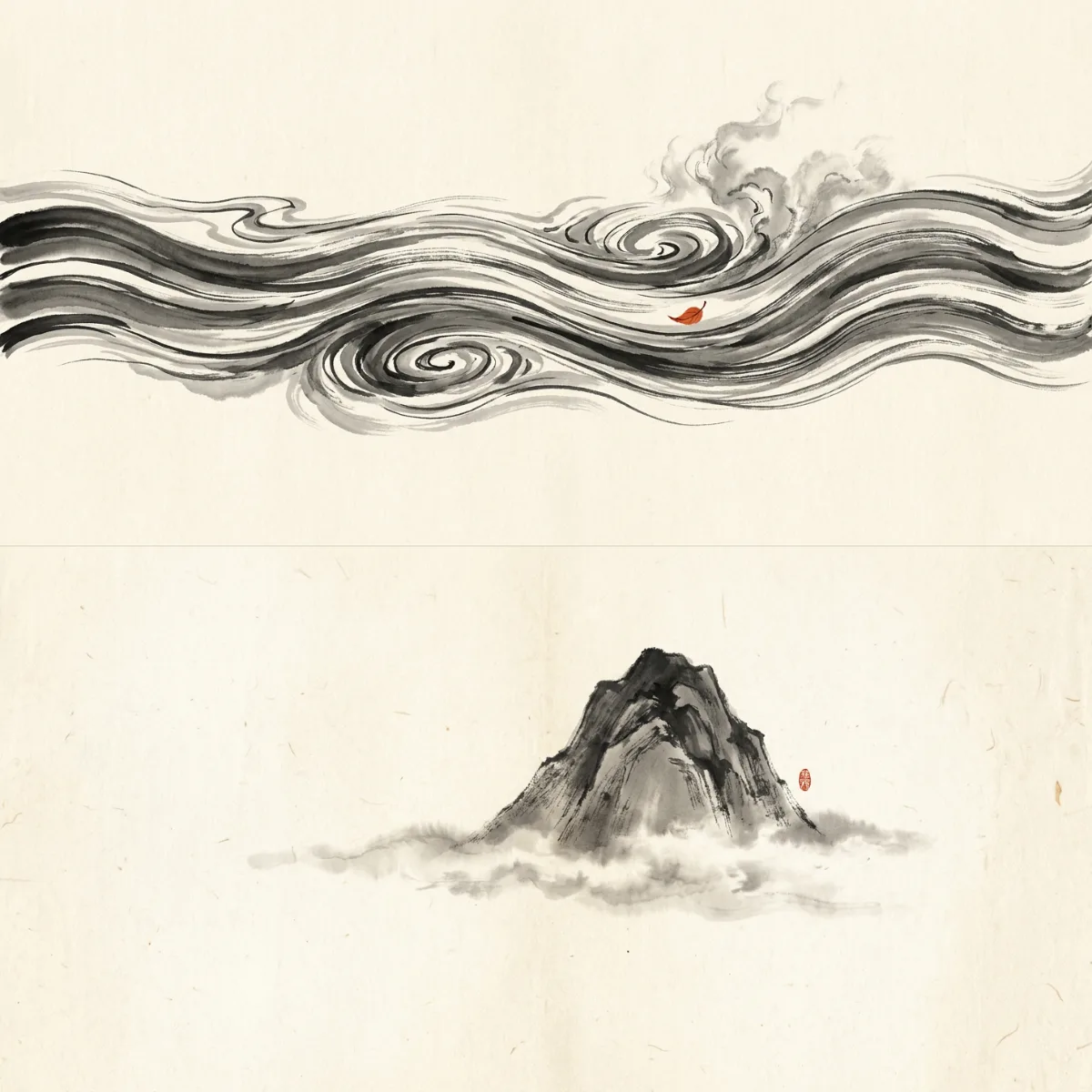 39. Obstacle蹇 · JiǎnWhere the road is not open, it is not your speed that proves itself, but your direction.
Hexagram 39 (Obstacle) often shows up around running into an obstacle, the way forward is blocked or getting stuck on something that won't move. At its core: Where the road is not open, it is not your speed that proves itself, but your direction.
Where this hexagram often fits.
Situations
- running into an obstacle
- the way forward is blocked
- getting stuck on something that won't move
- my progress is being blocked
- facing a hard route ahead
- not being able to go on without damage
- hitting the same wall again
- a delay I can't force through
Questions people ask
- What is this obstacle trying to show me about my direction?
- Do I go through this or around it?
- Why does this obstacle feel like a personal insult?
- Who can help me where I can't get through alone?
What is often at play
- frustration
- stubbornness
- discouragement
- urge to push through
What this asks for
- pausing
- asking for help
- rethinking direction
- finding another route
Also searched as
- Obstruction
- Obstacle
- Blockage
- Hard route
- Stalled progress
- Roadblock
- Stagnation
Core image
The way ahead is blocked. There's height, danger, a passage that won't easily give. You can't simply push through without risking damage. What the moment asks for is a change of direction, a hand from someone else, a way around, or a halt in the right place.
Tension
The sting is in lost momentum. You want to move and you hit something that won't move with you. So you're tempted either to lean harder, or to give up entirely. But a block here isn't only a wall; it's also a way of being pointed somewhere.
Distortion
The obstacle warps when you read it as a personal insult. Then it grows, fed by your own stubbornness. You turn a closed road into a contest between your ego and what's real.
Stance
Stand still long enough to see where the road is truly closed. Look for allies, another track, a better moment. Not every obstacle is meant to be broken through; some are asking you to reconsider where you stand. Right direction weighs more here than a straight line.
Closing line
What stops you sometimes points more precisely than what lets you pass.
Plain-language entrances.
Plain-language entrances to this hexagram. They help with search and recognition, while the reading itself remains rooted in the text and your question.
Hexagram 39 - Obstacle
Hexagram 39 - Obstacle gives language to a recognisable I Ching pattern. Read the linked hexagram as the source, not as a separate interpretation.
Changing lines of hexagram 39
- Line 1. Early on, you already meet resistance. It's frustrating, but it's also clarifying. Stop pushing blindly now and you spare yourself a great deal of needless loss.
- Line 2. Here the obstacle is carried out of duty, out of loyalty to something larger than your own comfort. That makes the weight bearable. Not every burden has to be set down to stay true.
- Line 3. Here you want to move forward where the road won't allow it. The strain between your urge and reality grows. The line asks you to turn back toward support rather than push through alone.
- Line 4. Here you get further precisely by asking for help, by joining with others. What won't work alone need not stay impossible. The obstacle opens sooner to shared strength than to proud force.
- Line 5. This stands in the middle of a real blockage, but without losing its center. From there it can gather others and make the situation something that holds. That gives the obstacle a worthy gravity.
- Line 6. Once the obstacle is fully acknowledged, the way through sometimes lies not forward but in another direction. You find no brute breakthrough, but a higher line. Here the block becomes a turn in understanding.
The form beneath hexagram 39
Derived from the structure of the I Ching — not an interpretation, but the shape underneath it. The reading above remains the source.
- Balance. Hexagram 39 is predominantly yin — 4 yin lines and 2 yang lines.
- Line pattern. From bottom to top: yin, yin, yang, yin, yang, yin.
- Movement. 63 possible paths of change run from this image — every combination of moving lines leads to a different hexagram.
Built from
Hexagram 39 is built from two trigrams, the natural forces of the I Ching.
Related hexagrams
Sources & reading
Our text is our own, ratified reading of the canonical I Ching — source → human → pattern → fitting movement. It is not a reproduction of the translations above, and not prediction, psychology, or new-age. The reference translations serve to calibrate; protected prose is not taken over.
- Richard Wilhelm / Cary F. Baynes — The I Ching or Book of Changes. symbolic-philosophical, with the Ten Wings — the most influential Western edition.
- James Legge — The Yî King (Sacred Books of the East). scholarly-philological (public domain).
Read what is in motion in your situation.
A hexagram only takes on meaning in relation to your own question. Ask one and read what appears.