
36. Darkening
Darkening is hexagram 36 of the 64 in the I Ching, also known as the Book of Changes (in Chinese Míng Yí, 明夷).
Also known as: Darkening of the Light.
When the light keeps burning visibly in the wrong time, it must learn to take cover without going out.
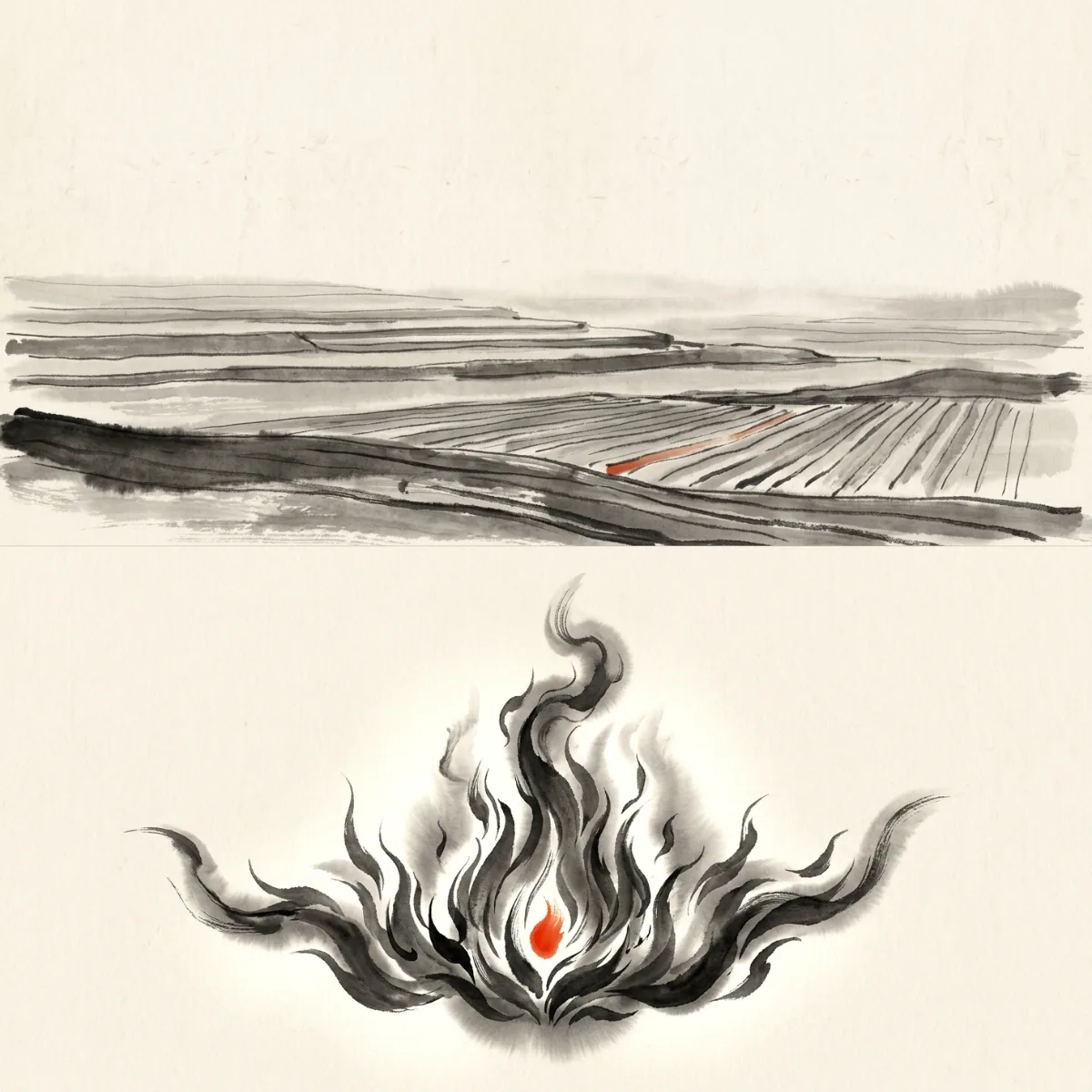 36. Darkening明夷 · Míng YíWhen the light keeps burning visibly in the wrong time, it must learn to take cover without going out.
Hexagram 36 (Darkening) often shows up around having to keep myself small in a hostile place, not being able to show my light or holding back so I don't get hurt. At its core: When the light keeps burning visibly in the wrong time, it must learn to take cover without going out.
Where this hexagram often fits.
Situations
- having to keep myself small in a hostile place
- not being able to show my light
- holding back so I don't get hurt
- being in a place that doesn't get me
- staying quiet while I'm more than that
- protecting my inner fire
- not being recognized for what I can do
- surviving in the wrong environment
Questions people ask
- How do I stay true to myself in a place that can't bear me?
- When is holding back protection, and when is it self-betrayal?
- How do I keep my fire alive without burning out?
- What do I do when I'm not seen for who I am?
What is often at play
- feeling unseen
- bitterness
- fatigue from holding back
- loneliness
What this asks for
- staying true inside
- patient sheltering
- guarding the fire
- plainness on the outside
Also searched as
- Darkening of the Light
- Dimming the light
- Sheltering
- Guarding the inner fire
- Holding back
- Surviving
- Keeping low
Core image
This hexagram is clarity under pressure. The light is not gone, but it lives in surroundings that cannot bear it, or that turn it to the wrong use. So it is not radiated openly but kept covered. This is not the light's defeat — it is how the light survives in dark conditions.
Tension
The tension sits in the gap between taking cover and disowning. You have to draw the light back without handing the inner flame over to the dark. That is hard. Whoever insists on staying visible burns out; whoever adapts all the way betrays the fire.
Distortion
Darkening goes wrong when bitterness sets in over the lack of recognition, or when, to save your own skin, you give the inside away entirely. Then hiddenness turns either hard or hollow.
Stance
Keep the light, but do not let it strike out recklessly at the wrong moment. Be plain enough on the outside not to be shattered, and true enough on the inside not to disappear. This time asks not for triumph, but for faithful shelter.
Closing line
Sometimes the light stays real only by dropping, for a while, out of full sight.
Plain-language entrances.
Plain-language entrances to this hexagram. They help with search and recognition, while the reading itself remains rooted in the text and your question.
Hexagram 36 - Darkening
Hexagram 36 - Darkening gives language to a recognisable I Ching pattern. Read the linked hexagram as the source, not as a separate interpretation.
Changing lines of hexagram 36
- Line 1. At the start the light is already struck and must pull back fast. It hurts, but it spares worse. Not every leaving is betrayal.
- Line 2. Here the wounded light is still helped, still shielded. Because of that, something is kept that would otherwise fall away. This line carries a quiet rescue.
- Line 3. At this point the dark can be seen and struck from within. That is dangerous, but sometimes necessary. It asks for courage with no pull toward joining in.
- Line 4. This line sees how deep the darkening really reaches. After that you can no longer pretend it is only a small discomfort. The seeing itself turns heavy here.
- Line 5. Here the light is kept small in a way that holds its dignity. You stay upright within without laying yourself open. That makes this line a model of hidden clarity.
- Line 6. When the dark is at its height, how far it has gone becomes plain. Then its own excess finally turns against it. This line marks the far edge of darkening.
The form beneath hexagram 36
Derived from the structure of the I Ching — not an interpretation, but the shape underneath it. The reading above remains the source.
- Balance. Hexagram 36 is predominantly yin — 4 yin lines and 2 yang lines.
- Line pattern. From bottom to top: yang, yin, yang, yin, yin, yin.
- Movement. 63 possible paths of change run from this image — every combination of moving lines leads to a different hexagram.
Built from
Hexagram 36 is built from two trigrams, the natural forces of the I Ching.
Related hexagrams
Sources & reading
Our text is our own, ratified reading of the canonical I Ching — source → human → pattern → fitting movement. It is not a reproduction of the translations above, and not prediction, psychology, or new-age. The reference translations serve to calibrate; protected prose is not taken over.
- Richard Wilhelm / Cary F. Baynes — The I Ching or Book of Changes. symbolic-philosophical, with the Ten Wings — the most influential Western edition.
- James Legge — The Yî King (Sacred Books of the East). scholarly-philological (public domain).
Read what is in motion in your situation.
A hexagram only takes on meaning in relation to your own question. Ask one and read what appears.