
35. Rising
Rising is hexagram 35 of the 64 in the I Ching, also known as the Book of Changes (in Chinese Jìn, 晉).
Also known as: Progress.
What truly advances does not only rise, but comes into the light to be seen.
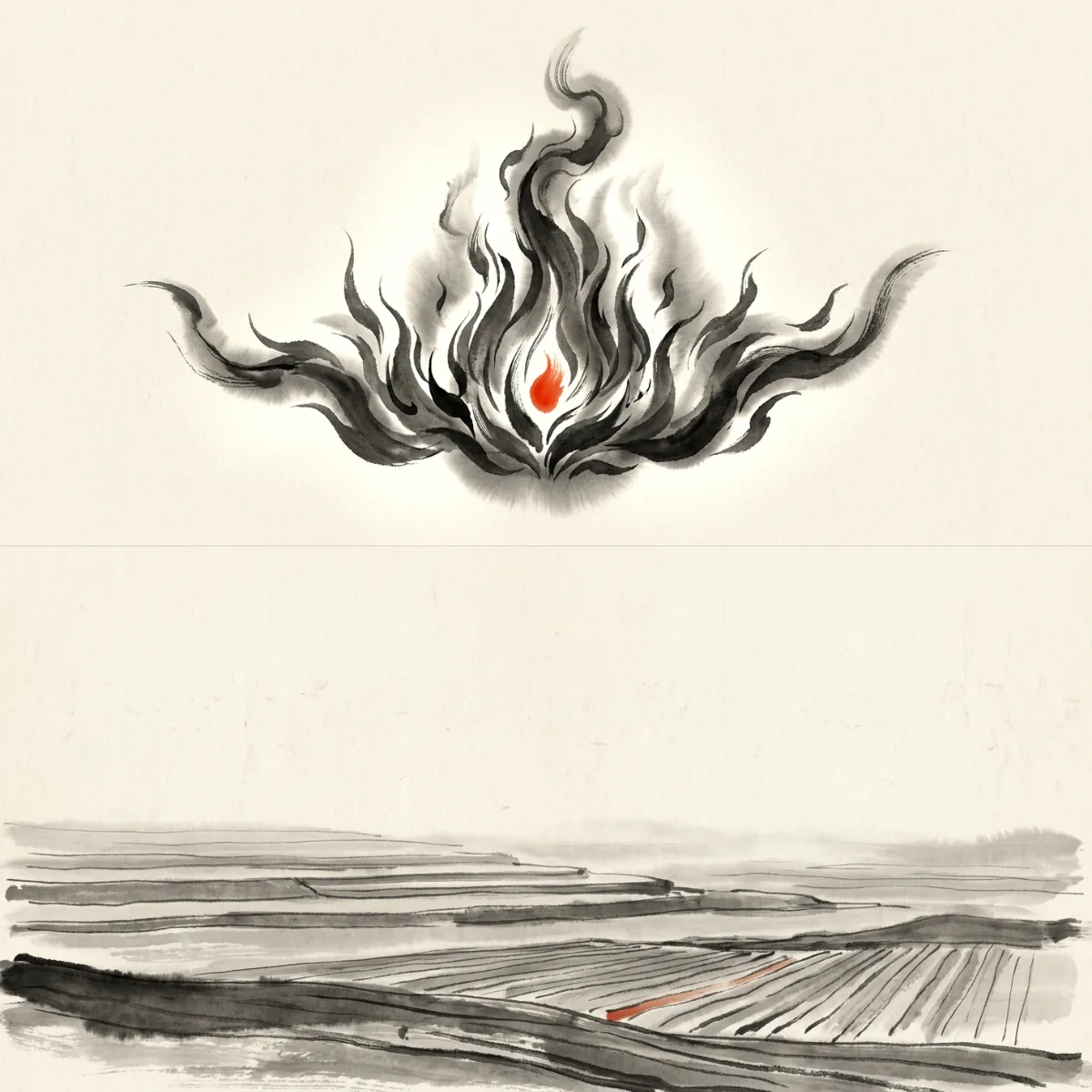 35. Rising晉 · JìnWhat truly advances does not only rise, but comes into the light to be seen.
Hexagram 35 (Rising) often shows up around making a breakthrough, getting a promotion or finally being seen. At its core: What truly advances does not only rise, but comes into the light to be seen.
Where this hexagram often fits.
Situations
- making a breakthrough
- getting a promotion
- finally being seen
- moving forward and getting recognition
- stepping into the spotlight
- my work is being noticed
- climbing up
- success that becomes visible
Questions people ask
- How do I stay myself now that I'm being seen?
- What do I want this progress to serve beyond myself?
- What does recognition do to me?
- How do I rise without getting lost in the attention?
What is often at play
- pride
- fear of losing it again
- vanity
- excitement
What this asks for
- humility in success
- being visible to serve
- staying measured
- staying grounded
Also searched as
- Progress
- Advancement
- Rising
- Recognition
- Promotion
- Visibility
- Breakthrough
Core image
This hexagram is the sun above the earth: what once lay low or hidden now gains reach and shine. Something comes forward, takes ground, and is seen and acknowledged. Progress here is not just speed — it is a visible unfolding. The light does not only lift; it reveals.
Tension
The tension is in what being seen does to a person. Whoever rises is not only confirmed but tested. You can lose yourself in the light's favor, or in the fear of losing it again. Progress here asks for movement, but it asks for character just as much.
Distortion
Rising goes wrong when it gets mistaken for personal greatness. Then success quickly becomes a backdrop for vanity. What once rose in order to serve begins to rise only to be seen.
Stance
Go forward without letting the light dazzle you. Use being seen to clarify something, not to inflate yourself. Progress stays credible here when it keeps its measure even on a good day. What rises has to be able to carry what it draws toward it.
Closing line
Not every light lifts; some shine only shows, faster, what was already weak.
Plain-language entrances.
Plain-language entrances to this hexagram. They help with search and recognition, while the reading itself remains rooted in the text and your question.
Hexagram 35 - Rising
Hexagram 35 - Rising gives language to a recognisable I Ching pattern. Read the linked hexagram as the source, not as a separate interpretation.
Changing lines of hexagram 35
- Line 1. At the start the progress is still uncertain, not yet recognized by everyone. That need not be a problem. The rising should not lean on confirmation too early.
- Line 2. Here progress is carried in spite of reluctance or grief. That is what makes this line human, and strong. Not every rising begins in gladness.
- Line 3. At this point the progress is more widely acknowledged. That opens room, but adds weight too. What merely grew before now draws a public after it.
- Line 4. This line climbs in a way that is too eager, not entirely clean. The rising takes on something restless. What climbs fast without a straight root soon draws suspicion.
- Line 5. Here progress is carried at the center, with dignity. You need not hold everything in hand for the rising to work. That is what makes this line strong in its openness.
- Line 6. When progress crosses its limit, it wants to light too far and conquer too much. Then the light turns into exhaustion, or attack. This line warns against over-reaching at the peak.
The form beneath hexagram 35
Derived from the structure of the I Ching — not an interpretation, but the shape underneath it. The reading above remains the source.
- Balance. Hexagram 35 is predominantly yin — 4 yin lines and 2 yang lines.
- Line pattern. From bottom to top: yin, yin, yin, yang, yin, yang.
- Movement. 63 possible paths of change run from this image — every combination of moving lines leads to a different hexagram.
Built from
Hexagram 35 is built from two trigrams, the natural forces of the I Ching.
Related hexagrams
Sources & reading
Our text is our own, ratified reading of the canonical I Ching — source → human → pattern → fitting movement. It is not a reproduction of the translations above, and not prediction, psychology, or new-age. The reference translations serve to calibrate; protected prose is not taken over.
- Richard Wilhelm / Cary F. Baynes — The I Ching or Book of Changes. symbolic-philosophical, with the Ten Wings — the most influential Western edition.
- James Legge — The Yî King (Sacred Books of the East). scholarly-philological (public domain).
Read what is in motion in your situation.
A hexagram only takes on meaning in relation to your own question. Ask one and read what appears.