
34. Great Power
Great Power is hexagram 34 of the 64 in the I Ching, also known as the Book of Changes (in Chinese Dà Zhuàng, 大壯).
Also known as: Power of the Great.
Great power is only great when it holds more measure than urge.
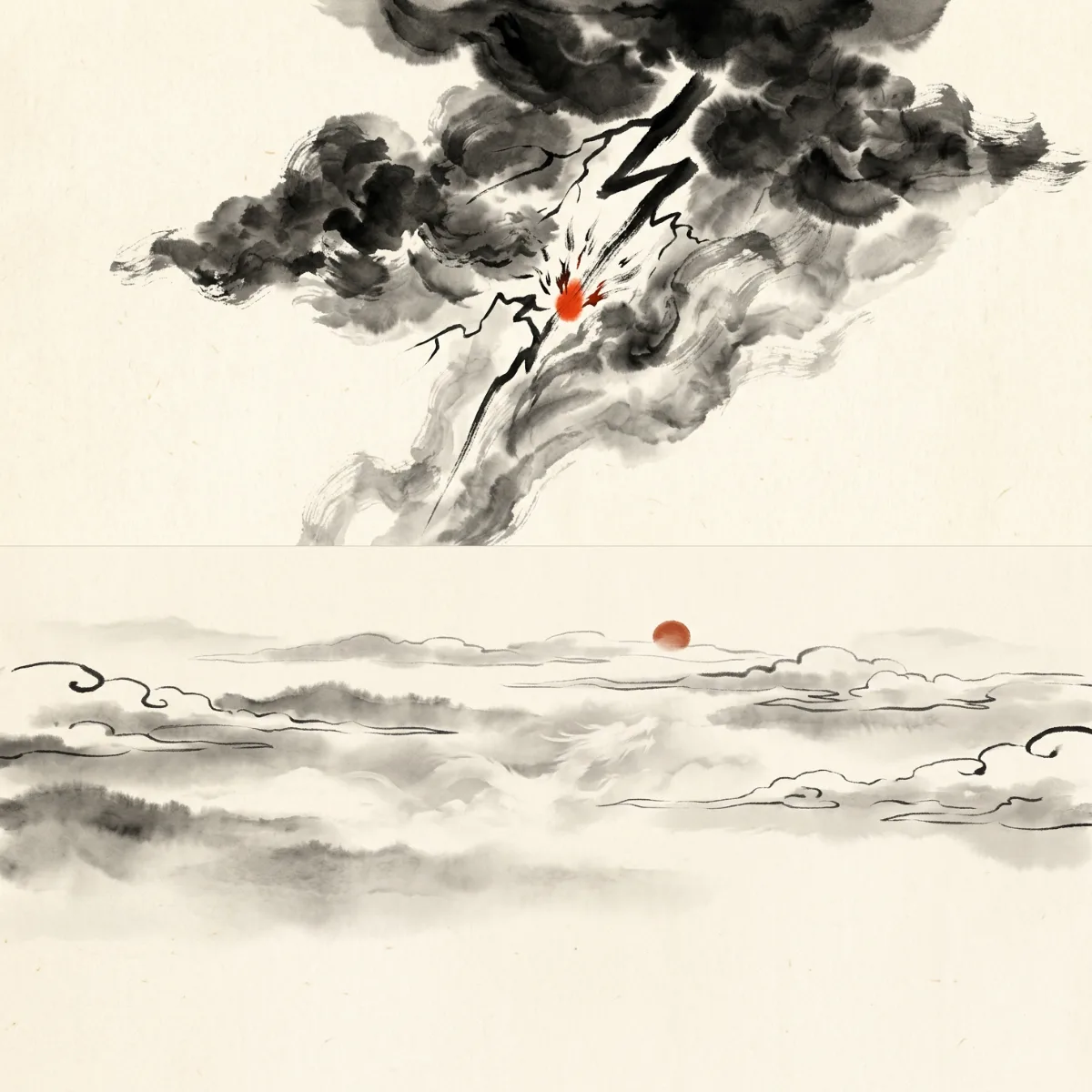 34. Great Power大壯 · Dà ZhuàngGreat power is only great when it holds more measure than urge.
Hexagram 34 (Great Power) often shows up around having power and not knowing how to use it, wanting to push too hard or feeling my strength build. At its core: Great power is only great when it holds more measure than urge.
Where this hexagram often fits.
Situations
- having power and not knowing how to use it
- wanting to push too hard
- feeling my strength build
- the urge to force everything
- standing strong but impatient
- wanting to make an impact
- proving myself through force
- raw energy that wants out
Questions people ask
- How do I use my strength rightly instead of just unleashing it?
- Why does my impatience push harder than needed?
- What does this strong position ask of my self-control?
- When does forcing through do harm rather than good?
What is often at play
- impatience
- urge to prove
- pent-up energy
- overconfidence
What this asks for
- self-control
- giving direction
- restraint
- calm beneath the strength
Also searched as
- Power of the Great
- Great power
- Strength
- Assertion
- Drive
- Power with restraint
- Impact
Core image
This hexagram shows strong, visible force standing ready to make itself felt. The field is charged; the capacity is there and wants out. There is no shortage of power here. The only question is whether that force is also rightly used.
Tension
The tension sits in the pull to take great capacity at once for a right. But this hexagram glorifies no brute expansion. Great power can break much open, and damage much too, when measure does not guide it. Not every possibility deserves discharge.
Distortion
Great power distorts the moment it comes to love itself. Then capacity turns into an argument all on its own. One pushes not because it is right, but because one can.
Stance
Carry the force upright, but keep it under discipline. Great power asks not for shame, but for direction. Do not let capacity spill into collision where it would work better in steady measure. Real strength has no need of needless proof.
Closing line
The greater the force, the smaller its right to be impatient.
Plain-language entrances.
Plain-language entrances to this hexagram. They help with search and recognition, while the reading itself remains rooted in the text and your question.
Hexagram 34 - Great Power
Hexagram 34 - Great Power gives language to a recognisable I Ching pattern. Read the linked hexagram as the source, not as a separate interpretation.
Changing lines of hexagram 34
- Line 1. At the start the force shoots into the limbs too fast. There is plenty of will, but little of the right place yet. Whoever cuts loose now works against themselves sooner than forward.
- Line 2. Here the force grows straighter and easier to carry. The movement still holds its capacity, but loses its raw haste. That is what makes this line strong.
- Line 3. At this point the force shows itself too gladly. One uses capacity to make oneself visible. By that, power tips over into crudeness.
- Line 4. This line finds a passage for great force without a rough collision. That is the art of this hexagram. The strong need not always break in order to get through.
- Line 5. Here the force tames itself in the midst of its full availability. That asks for much. For that very reason this line holds more power than one who only erupts.
- Line 6. When great force jams itself in the wrong place, it grows clumsy and painful. Then one sits wedged in one's own capacity. This line asks for a return to measure before the force presses itself stuck.
The form beneath hexagram 34
Derived from the structure of the I Ching — not an interpretation, but the shape underneath it. The reading above remains the source.
- Balance. Hexagram 34 is predominantly yang — 4 yang lines and 2 yin lines.
- Line pattern. From bottom to top: yang, yang, yang, yang, yin, yin.
- Movement. 63 possible paths of change run from this image — every combination of moving lines leads to a different hexagram.
Built from
Hexagram 34 is built from two trigrams, the natural forces of the I Ching.
Related hexagrams
Sources & reading
Our text is our own, ratified reading of the canonical I Ching — source → human → pattern → fitting movement. It is not a reproduction of the translations above, and not prediction, psychology, or new-age. The reference translations serve to calibrate; protected prose is not taken over.
- Richard Wilhelm / Cary F. Baynes — The I Ching or Book of Changes. symbolic-philosophical, with the Ten Wings — the most influential Western edition.
- James Legge — The Yî King (Sacred Books of the East). scholarly-philological (public domain).
Read what is in motion in your situation.
A hexagram only takes on meaning in relation to your own question. Ask one and read what appears.