
32. Endurance
Endurance is hexagram 32 of the 64 in the I Ching, also known as the Book of Changes (in Chinese Héng, 恆).
Also known as: Duration.
Endurance lives not on hardness, but on a rhythm that can keep carrying itself.
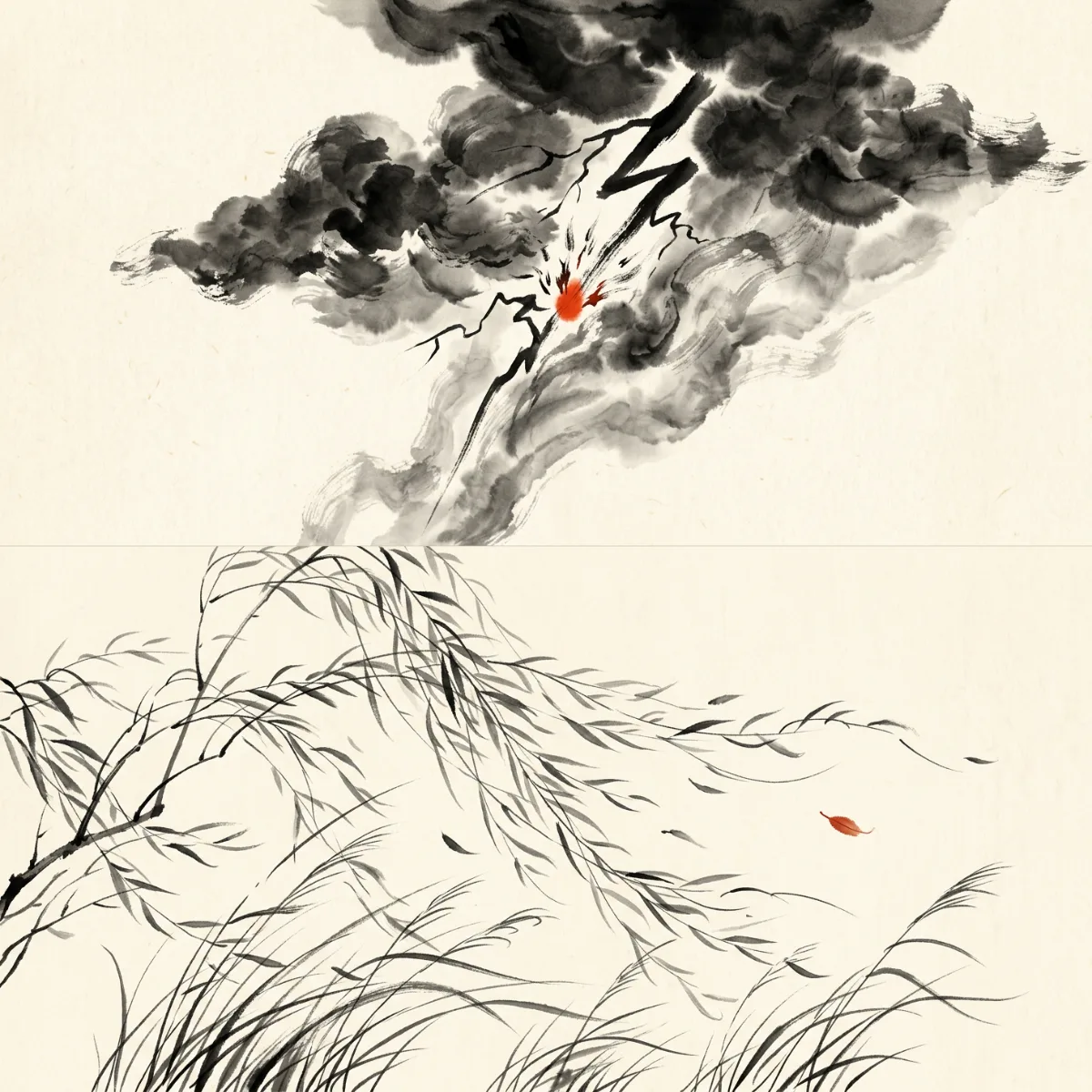 32. Endurance恆 · HéngEndurance lives not on hardness, but on a rhythm that can keep carrying itself.
Hexagram 32 (Endurance) often shows up around wanting to keep something going, making a relationship or project last or looking for rhythm instead of peaks. At its core: Endurance lives not on hardness, but on a rhythm that can keep carrying itself.
Where this hexagram often fits.
Situations
- wanting to keep something going
- making a relationship or project last
- looking for rhythm instead of peaks
- doubting whether loyalty still makes sense
- going through the motions
- wanting long-term stability
- holding on without going rigid
- noticing something has gone stale
Questions people ask
- How do I keep this going without going rigid?
- Is this still loyalty or just inertia?
- What gives something the strength to last?
- Is the source under this habit still alive?
What is often at play
- fatigue from holding on
- stubbornness
- longing for stability
- going through the motions
What this asks for
- maintain the rhythm
- test whether the source is still alive
- regularity over heroics
- release what lost its truth
Also searched as
- Duration
- Endurance
- Continuity
- Constancy
- Perseverance
- Steadiness
- Lasting
Core image
This hexagram is about staying, continuing, holding on without going stiff. The image is not standstill, but a movement that has found its measure. What becomes lasting need not be invented over and over. It gains strength by returning, again and again, in a true rhythm.
Tension
The tension sits in the difference between endurance and stubbornness. People often call something lasting when it has only grown heavy and rigid. But this hexagram asks for no stiffened loyalty. It asks for a continuity that feeds on living rightness.
Distortion
Endurance distorts when one keeps going out of habit with something that has lost its truth. Then loyalty becomes a burden and rhythm a cage. What once carried now only presses through its own duration.
Stance
Stay with what truly proves itself over time. Keep the rhythm, but test whether the source still lives. Good endurance asks less heroics than regularity. What genuinely lasts has no need to keep rescuing itself by force.
Closing line
Only what is rightly grounded can stay long enough to truly give shape.
Plain-language entrances.
Plain-language entrances to this hexagram. They help with search and recognition, while the reading itself remains rooted in the text and your question.
Hexagram 32 - Endurance
Hexagram 32 - Endurance gives language to a recognisable I Ching pattern. Read the linked hexagram as the source, not as a separate interpretation.
Changing lines of hexagram 32
- Line 1. At the start, endurance is reached for too soon. One wants to make permanent what has barely begun. That makes the ground too heavy for what still needed to stay light.
- Line 2. Here an earlier restlessness is left behind and a truer center forms. That gives duration a reliable floor. Not everything meant to last has to begin grandly.
- Line 3. At this point holding on goes impure. One stays, but without an upright stance. Then duration no longer builds — it wears.
- Line 4. This line shows persistence in the wrong place. Loyalty is asked toward something no longer fruitful there. Not every long effort is valuable for being long.
- Line 5. Here duration is carried from a centered rightness. That makes loyalty not heavy, but orderly. What stays here need not be shouted.
- Line 6. When endurance is mistaken for endless continuation, it tips over into exhaustion. What is needed now is not more holding on, but an end to the wrong continuity.
The form beneath hexagram 32
Derived from the structure of the I Ching — not an interpretation, but the shape underneath it. The reading above remains the source.
- Balance. Hexagram 32 is in full balance — 3 yang lines and 3 yin lines.
- Line pattern. From bottom to top: yin, yang, yang, yang, yin, yin.
- Movement. 63 possible paths of change run from this image — every combination of moving lines leads to a different hexagram.
Built from
Hexagram 32 is built from two trigrams, the natural forces of the I Ching.
Related hexagrams
Sources & reading
Our text is our own, ratified reading of the canonical I Ching — source → human → pattern → fitting movement. It is not a reproduction of the translations above, and not prediction, psychology, or new-age. The reference translations serve to calibrate; protected prose is not taken over.
- Richard Wilhelm / Cary F. Baynes — The I Ching or Book of Changes. symbolic-philosophical, with the Ten Wings — the most influential Western edition.
- James Legge — The Yî King (Sacred Books of the East). scholarly-philological (public domain).
Read what is in motion in your situation.
A hexagram only takes on meaning in relation to your own question. Ask one and read what appears.