
30. Radiance
Radiance is hexagram 30 of the 64 in the I Ching, also known as the Book of Changes (in Chinese Lí, 離).
Also known as: The Clinging (Fire).
Clarity burns well only when it can cling to something that keeps bearing it.
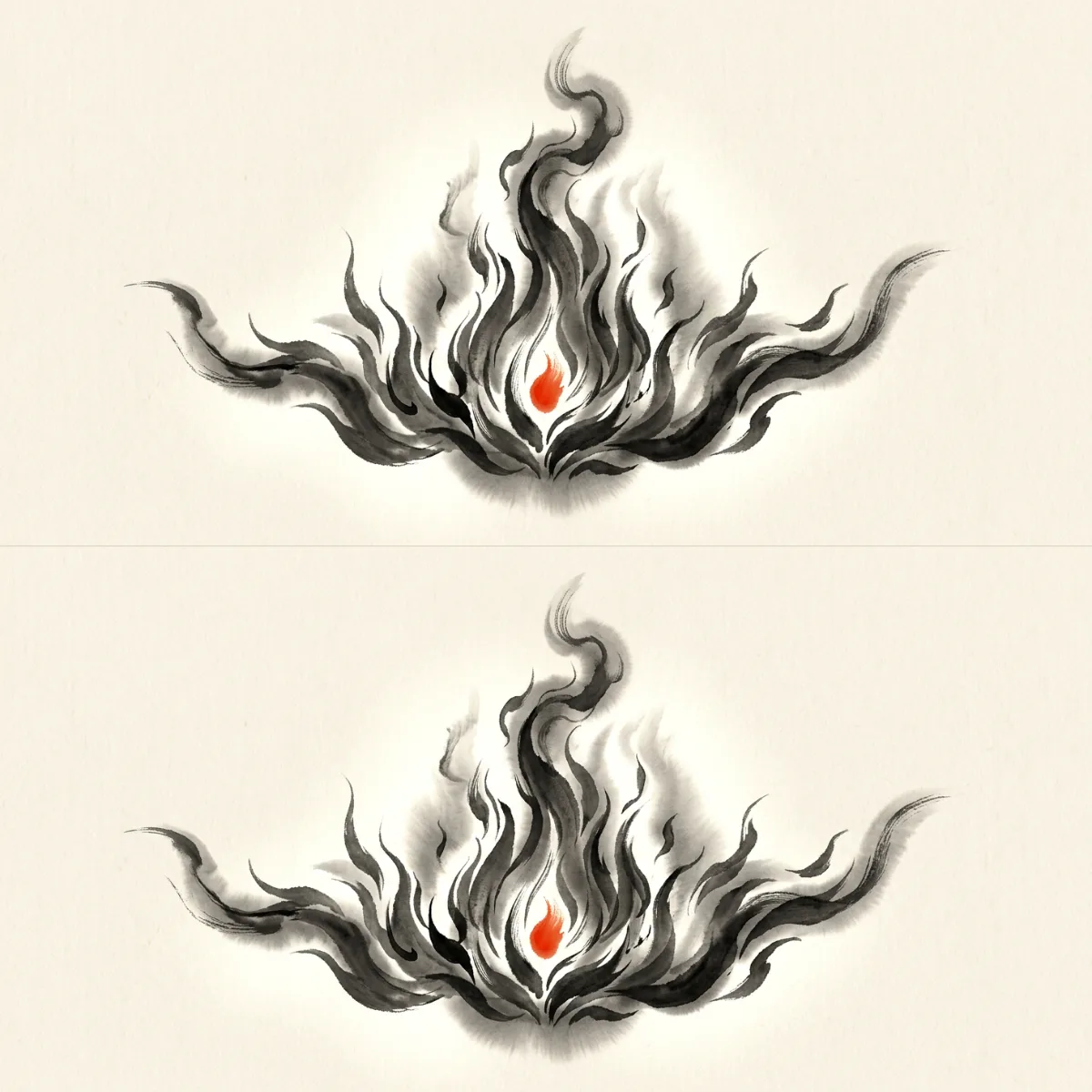 30. Radiance離 · LíClarity burns well only when it can cling to something that keeps bearing it.
Hexagram 30 (Radiance) often shows up around wanting to see clearly, being visible but afraid of burning out or burning too hot and depleting. At its core: Clarity burns well only when it can cling to something that keeps bearing it.
Where this hexagram often fits.
Situations
- wanting to see clearly
- being visible but afraid of burning out
- burning too hot and depleting
- insight with nothing to hold onto
- wanting to shine without a foundation
- depending on what I attach myself to
- seeing sharply but also the loss
- carrying attention and visibility
Questions people ask
- What do I anchor my clarity to?
- How do I keep burning without consuming myself?
- How do I make insight last instead of flaring briefly?
- What holds my visibility when the shine fades?
What is often at play
- intensity
- nervousness
- longing to be seen
- fear of going out
What this asks for
- tend the thing that holds the flame
- feed your clarity
- see cleanly
- stay connected
Also searched as
- The Clinging
- Fire
- Radiance
- Clarity
- Visibility
- Attachment
- Attention
Core image
This hexagram is fire upon fire: light, visibility, awareness, the power to tell apart. But fire never lives on its own; it clings. So this is not only about seeing clearly, but about what that light binds itself to. Clarity with nothing to hold flares up and goes out.
Tension
The tension lies in mistaking light for self-sufficiency. One assumes that insight is enough in itself. But fire has to be fed, held, and rightly placed. Otherwise clarity turns into nervousness, exposure, or burning through.
Distortion
Clinging distorts when one loves only the gleam of insight. Then one wants to illuminate without bearing, to show without feeding. The fire grows sharp, but thin.
Stance
Tend the light by not neglecting what carries it. Seek clarity, but also the discipline that makes it last. See sharply, speak cleanly, and stay tied to what your seeing can hold. Real light does not consume everything it touches.
Closing line
Not every fire is guidance; some flames live on exposure alone.
Plain-language entrances.
Plain-language entrances to this hexagram. They help with search and recognition, while the reading itself remains rooted in the text and your question.
Hexagram 30 - Radiance
Hexagram 30 - Radiance gives language to a recognisable I Ching pattern. Read the linked hexagram as the source, not as a separate interpretation.
Changing lines of hexagram 30
- Line 1. At the start the light still flickers, unsteady. That is no cause for alarm. The question is whether it finds good fuel and a right place in time.
- Line 2. Here the fire burns clear and true. Not too high, not too low, but warm enough to light the room. This is a strong place: measure made visible.
- Line 3. At this point the light meets ending and decline. One sees sharply, but also the shadow of loss. This line asks for dignity in waning light.
- Line 4. Here the fire flares up too fast and nearly burns through. The clarity is intense, but not yet built to last. That calls for careful limit.
- Line 5. This line shows a light that stays clean through tears and gravity. Not all clarity is cheerful. Sometimes the truest light is the one that does not deny its loss.
- Line 6. When clarity fully ripens, it can also cut hard. What can no longer stand in the light becomes plain. This line asks for strict purity without cruelty.
The form beneath hexagram 30
Derived from the structure of the I Ching — not an interpretation, but the shape underneath it. The reading above remains the source.
- Balance. Hexagram 30 is predominantly yang — 4 yang lines and 2 yin lines.
- Line pattern. From bottom to top: yang, yin, yang, yang, yin, yang.
- Movement. 63 possible paths of change run from this image — every combination of moving lines leads to a different hexagram.
Built from
Hexagram 30 is built from two trigrams, the natural forces of the I Ching.
Related hexagrams
Sources & reading
Our text is our own, ratified reading of the canonical I Ching — source → human → pattern → fitting movement. It is not a reproduction of the translations above, and not prediction, psychology, or new-age. The reference translations serve to calibrate; protected prose is not taken over.
- Richard Wilhelm / Cary F. Baynes — The I Ching or Book of Changes. symbolic-philosophical, with the Ten Wings — the most influential Western edition.
- James Legge — The Yî King (Sacred Books of the East). scholarly-philological (public domain).
Read what is in motion in your situation.
A hexagram only takes on meaning in relation to your own question. Ask one and read what appears.