
3. Rough Start
Rough Start is hexagram 3 of the 64 in the I Ching, also known as the Book of Changes (in Chinese Zhūn, 屯).
Also known as: Difficulty at the Beginning.
The beginning is already alive, but has no dry ground beneath it yet.
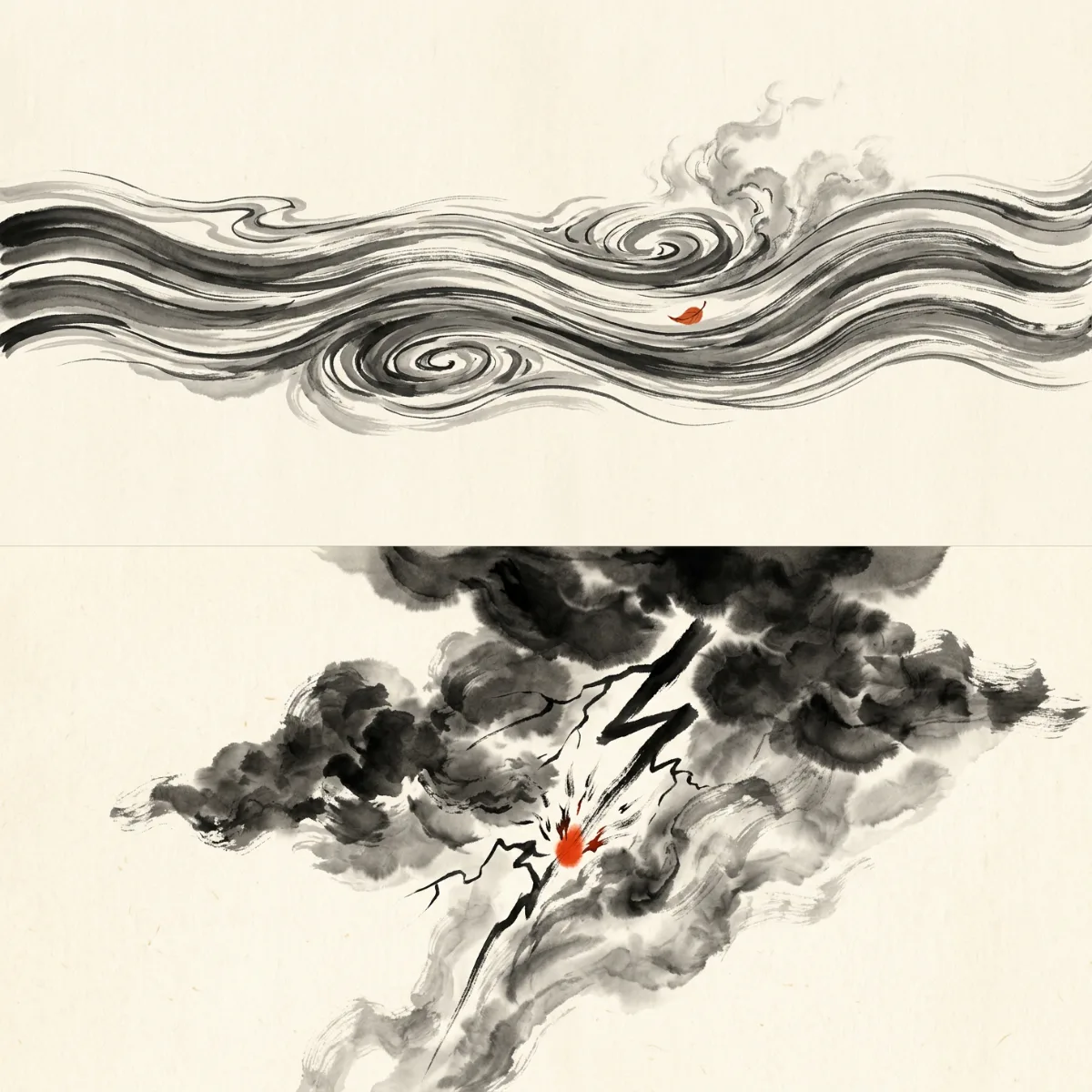 3. Rough Start屯 · ZhūnThe beginning is already alive, but has no dry ground beneath it yet.
Hexagram 3 (Rough Start) often shows up around a rocky start, a chaotic early phase or teething problems. At its core: The beginning is already alive, but has no dry ground beneath it yet.
Where this hexagram often fits.
Situations
- a rocky start
- a chaotic early phase
- teething problems
- everything still feels stuck
- no overview yet
- structuring too soon
- a fledgling venture
- confusion while building something up
Questions people ask
- Why does this beginning feel so chaotic?
- Should I impose structure now or not yet?
- How do I protect something fragile without forcing it?
- What does this early phase really need from me?
What is often at play
- confusion
- impatience
- pressure to have it figured out
- doubt
What this asks for
- protecting the beginning
- persevering modestly
- finding allies
- keeping a light hand
Also searched as
- Difficulty at the Beginning
- Rough Start
- Chaotic launch
- Teething problems
- Startup phase
- Initial friction
- Early chaos
Core image
This hexagram belongs to a beginning that draws no clean line. There is life, but no order yet. Hope, confusion, pressure, and misunderstanding still sit in the same water. It is a first sprout in muddy ground: real, fragile, and not yet load-bearing.
Tension
The difficulty here is not a wrong beginning, but the demand that a beginning already be clear. People want proof, a line, confirmation. That very demand overwrites what is still tender with haste. Disorder at the start is no fault; it is often the price of something genuinely coming into being.
Distortion
A rough start distorts the moment you over-organize it or assign it meaning too soon. Then you turn something tender straight into a system, a story, or a decision. What still has to be born is fixed in place before it has limbs of its own.
Stance
Stay awake, modest, and persistent. Protect the beginning, but do not perfect it too early. Look for allies, rhythm, and a simple shape, but keep your hand light. What is alive here needs guarding more than ambition.
Closing line
Force a beginning, and you get shape without life.
Plain-language entrances.
Plain-language entrances to this hexagram. They help with search and recognition, while the reading itself remains rooted in the text and your question.
Hexagram 3 - Rough Start
Hexagram 3 - Rough Start gives language to a recognisable I Ching pattern. Read the linked hexagram as the source, not as a separate interpretation.
Changing lines of hexagram 3
- Line 1. On the first line everything is still too tender for large moves. The urge to decide at once is understandable, but impure. First ground, then direction.
- Line 2. Here the beginning asks for loyalty to what is small and real. Help may be near, but not yet in the shape you hoped for. Let the start stay modest; too much promise makes it fragile.
- Line 3. This line shows a search without a guide. To drift alone among possibilities now spends time and strength. Not every opening is a path.
- Line 4. At this point connection comes into view, but still with hesitation. You can receive support, as long as you do not present yourself as larger than you are. A modest alliance carries further than a heroic solo.
- Line 5. Here central pressure builds: everything wants to be going somewhere. For that very reason, measured leadership is needed. Give direction, but do not close the story yet.
- Line 6. When a hard beginning stays locked too long, tension turns into exhaustion. Then holding on becomes a kind of petrifying. Protect what is still alive, and stop letting the rest pass for a future.
The form beneath hexagram 3
Derived from the structure of the I Ching — not an interpretation, but the shape underneath it. The reading above remains the source.
- Balance. Hexagram 3 is predominantly yin — 4 yin lines and 2 yang lines.
- Line pattern. From bottom to top: yang, yin, yin, yin, yang, yin.
- Movement. 63 possible paths of change run from this image — every combination of moving lines leads to a different hexagram.
Built from
Hexagram 3 is built from two trigrams, the natural forces of the I Ching.
Related hexagrams
Sources & reading
Our text is our own, ratified reading of the canonical I Ching — source → human → pattern → fitting movement. It is not a reproduction of the translations above, and not prediction, psychology, or new-age. The reference translations serve to calibrate; protected prose is not taken over.
- Richard Wilhelm / Cary F. Baynes — The I Ching or Book of Changes. symbolic-philosophical, with the Ten Wings — the most influential Western edition.
- James Legge — The Yî King (Sacred Books of the East). scholarly-philological (public domain).
Read what is in motion in your situation.
A hexagram only takes on meaning in relation to your own question. Ask one and read what appears.