
27. Nourishment
Nourishment is hexagram 27 of the 64 in the I Ching, also known as the Book of Changes (in Chinese Yí, 頤).
What you feed shapes you; what you take in later speaks back out of your own mouth.
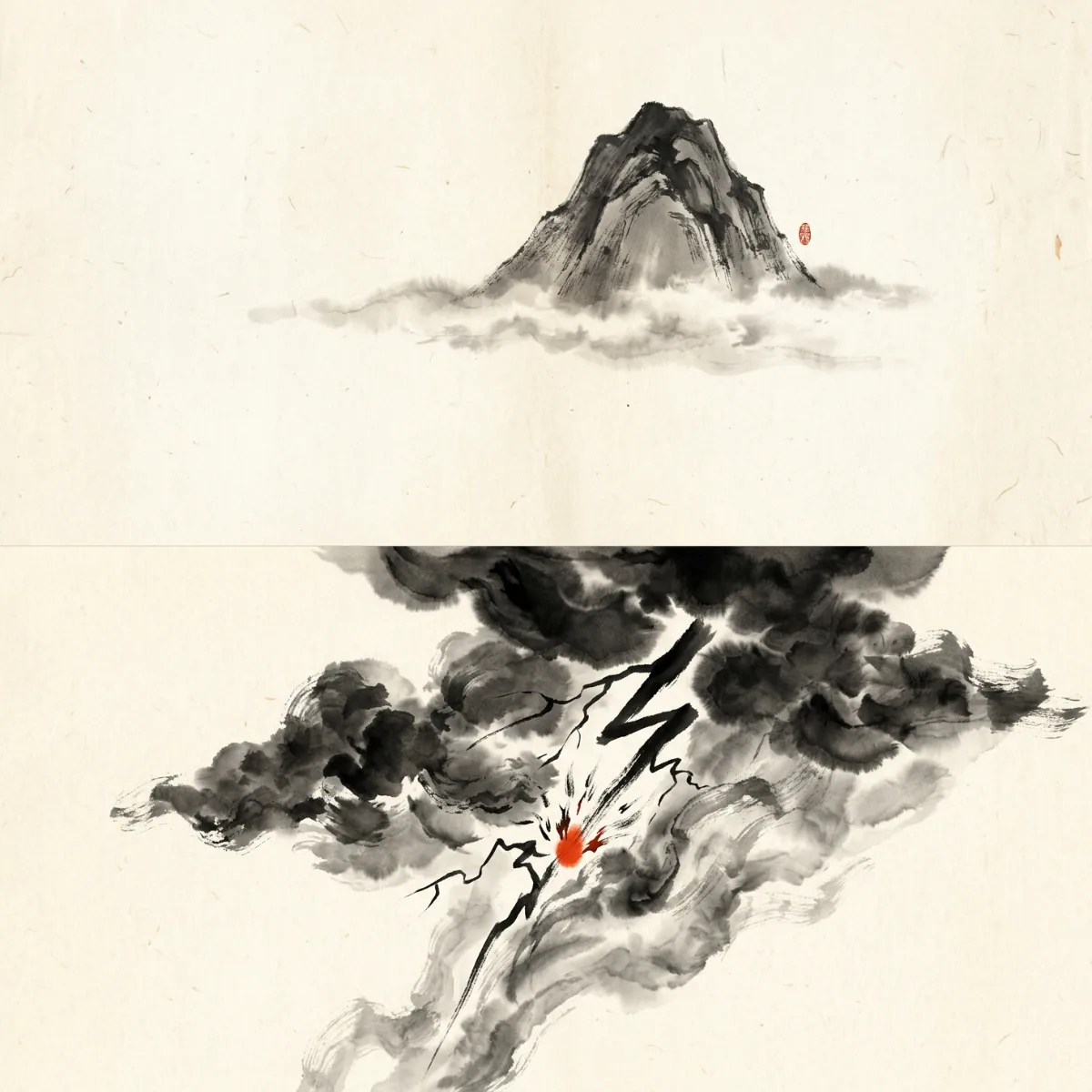 27. Nourishment頤 · YíWhat you feed shapes you; what you take in later speaks back out of your own mouth.
Hexagram 27 (Nourishment) often shows up around watching what I take in, feeding on the wrong input or doom-scrolling and overconsuming. At its core: What you feed shapes you; what you take in later speaks back out of your own mouth.
Where this hexagram often fits.
Situations
- watching what I take in
- feeding on the wrong input
- doom-scrolling and overconsuming
- nourishing what actually fuels me
- guarding my words
- caring for something that makes me dependent
- craving what doesn't nourish
- responsible for feeding others
Questions people ask
- Does this actually nourish me or just fill me?
- What am I letting in day after day?
- How do I care well for myself and for others?
- Which input makes me stronger and which makes me dependent?
What is often at play
- hunger
- dependency
- restlessness
- craving for gratification
What this asks for
- test what you take in
- discernment
- feed yourself consciously
- build rhythm and ground
Also searched as
- Nourishment
- The Corners of the Mouth
- Sustenance
- Mental Input
- Providing
- Feeding
- Attention
Core image
This hexagram is about nourishment in the widest sense: food, words, attention, the influences a person takes in and gives back out. The image is the mouth and jaw: taking in, sending out. What becomes clear here is that a life turns not on what you have, but on what you let in and what you bring forth.
Tension
The tension lies in how easily we take in without testing. We feed ourselves and others without looking at what it actually does. So care can turn into weakening, and scarcity into restless hunger. Not everything that fills you feeds you.
Distortion
Nourishment goes wrong when the mouth matters more than the source. Then we chase satisfaction, approval, sheer consumption. What comes in no longer strengthens the life, only the dependence.
Stance
Test what you feed, and what feeds you. Don't take in everything within reach, and don't say everything that rises in you. Good nourishment builds ground, rhythm, and dignity. Character is eaten slowly here.
Closing line
Much of the damage starts not with what we do, but with what we let in, day after day.
Plain-language entrances.
Plain-language entrances to this hexagram. They help with search and recognition, while the reading itself remains rooted in the text and your question.
Hexagram 27 - Nourishment
Hexagram 27 - Nourishment gives language to a recognisable I Ching pattern. Read the linked hexagram as the source, not as a separate interpretation.
Changing lines of hexagram 27
- Line 1. At the start, nourishment is sought in the wrong place. The eye goes to what glitters rather than what sustains. This line warns against hunger that cannot tell one thing from another.
- Line 2. Here nourishment is sought outside its proper order. From that comes dependence, or a kind of humbling. What you need does not justify just any source.
- Line 3. At this point the wrong feeding turns stubborn. You already know something isn't truly nourishing, yet you keep returning to it. This line shows how hunger can deceive itself.
- Line 4. Here feeding others becomes a task that can be carried well. The mouth is no longer used for oneself alone. That is what makes this line fruitful.
- Line 5. This line knows the responsibility of nourishment but cannot take it on lightly. Support or direction is still needed from elsewhere. That is no disgrace, as long as you hold the weight of it seriously.
- Line 6. When nourishment is at its best, it becomes a source rather than a consuming. Then not only your own life is fed, but the lives of others. This line carries great responsibility and great blessing at once.
The form beneath hexagram 27
Derived from the structure of the I Ching — not an interpretation, but the shape underneath it. The reading above remains the source.
- Balance. Hexagram 27 is predominantly yin — 4 yin lines and 2 yang lines.
- Line pattern. From bottom to top: yang, yin, yin, yin, yin, yang.
- Movement. 63 possible paths of change run from this image — every combination of moving lines leads to a different hexagram.
Built from
Hexagram 27 is built from two trigrams, the natural forces of the I Ching.
Related hexagrams
Sources & reading
Our text is our own, ratified reading of the canonical I Ching — source → human → pattern → fitting movement. It is not a reproduction of the translations above, and not prediction, psychology, or new-age. The reference translations serve to calibrate; protected prose is not taken over.
- Richard Wilhelm / Cary F. Baynes — The I Ching or Book of Changes. symbolic-philosophical, with the Ten Wings — the most influential Western edition.
- James Legge — The Yî King (Sacred Books of the East). scholarly-philological (public domain).
Read what is in motion in your situation.
A hexagram only takes on meaning in relation to your own question. Ask one and read what appears.