
21. Biting Through
Biting Through is hexagram 21 of the 64 in the I Ching, also known as the Book of Changes (in Chinese Shì Kè, 噬嗑).
What is stuck in the passage asks not for discussion, but for one clean bite.
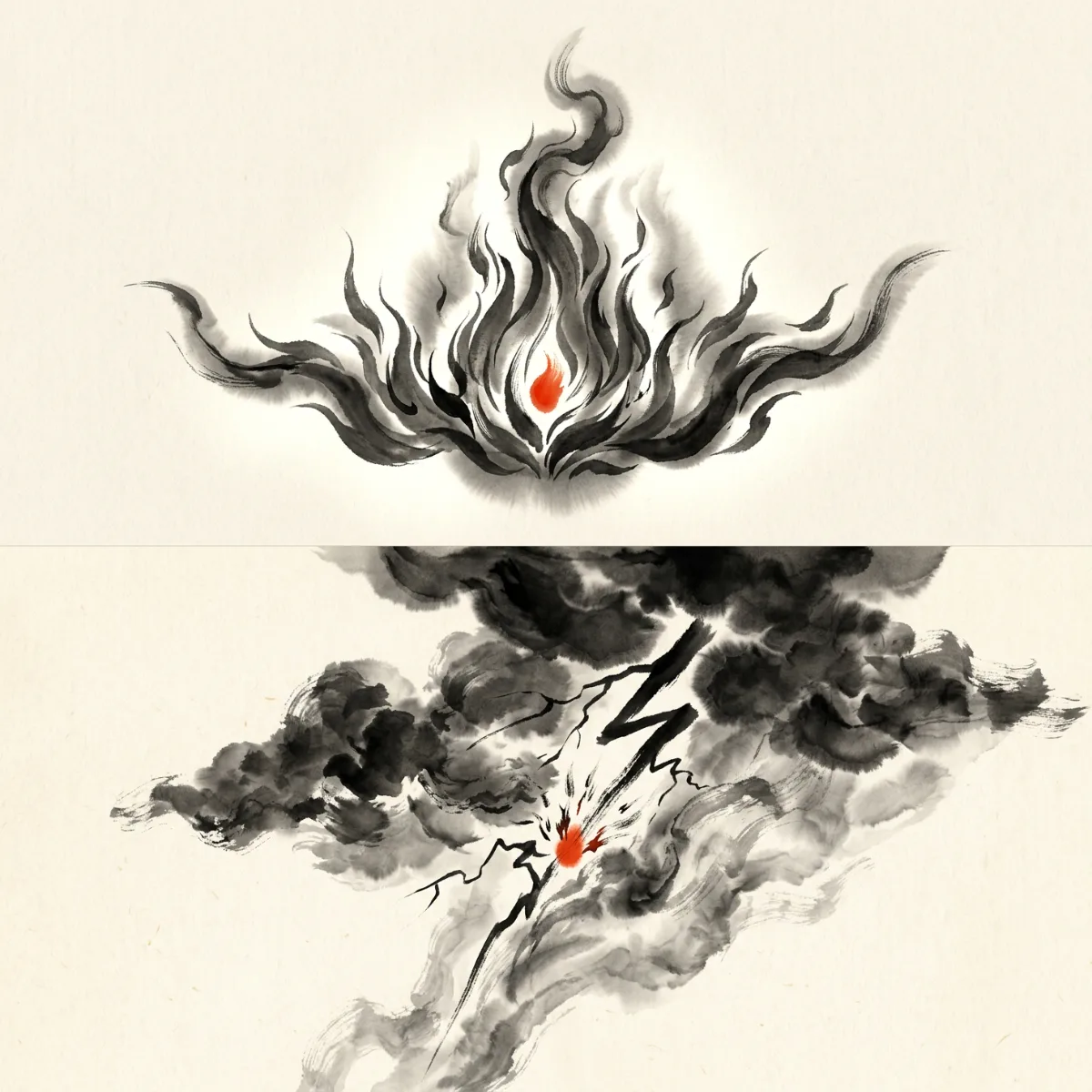 21. Biting Through噬嗑 · Shì KèWhat is stuck in the passage asks not for discussion, but for one clean bite.
Hexagram 21 (Biting Through) often shows up around tackling a problem decisively, setting right something that can't stay or clearing a blockage. At its core: What is stuck in the passage asks not for discussion, but for one clean bite.
Where this hexagram often fits.
Situations
- tackling a problem decisively
- setting right something that can't stay
- clearing a blockage
- cutting through the knot
- drawing a hard line
- putting an end to procrastination
- untangling a conflict
- pushing through where it's stuck
Questions people ask
- How do I tackle this stubborn problem?
- When do I push through instead of negotiate?
- How do I correct sharply without becoming needlessly harsh?
- What happens if I keep letting this slide?
What is often at play
- irritation
- resolve
- hesitation to be hard
- tension
What this asks for
- grip exactly what blocks
- sharp without cruel
- correct clearly
- stop postponing
Also searched as
- Biting through
- Pushing through
- Setting right
- Cutting through
- Correcting
- Forcing the passage
- Resolving
Core image
This hexagram shows a blockage that cannot stay where it is. Something sits between the teeth of the system: a disturbance, a transgression, a hard piece that obstructs the flow. What is needed here is not softness first, but decisive setting-right. What closes the passage must be seized.
Tension
Biting through is dangerous work, because correction can quickly turn into hardness. Yet too much softness is just as wrong here. The situation asks for a sharpness that does not grow cruel, and for a penalty that does not enjoy itself. Doing justice here is something other than acting out your drive.
Distortion
Biting through distorts when one either hesitates until the damage grows, or identifies too eagerly with the sanction. Then the correction is either too slack or too heavy. In both cases the passage stays damaged.
Stance
Seize exactly what blocks the passage, no more and no less. Let the correction be clear and free of theater. What is set right here must restore the flow, not only assign blame. A good bite breaks the hard piece, not the whole mouth.
Closing line
Whoever does not dare to correct often, unnoticed, chooses longer decay.
Plain-language entrances.
Plain-language entrances to this hexagram. They help with search and recognition, while the reading itself remains rooted in the text and your question.
Hexagram 21 - Biting Through
Hexagram 21 - Biting Through gives language to a recognisable I Ching pattern. Read the linked hexagram as the source, not as a separate interpretation.
Changing lines of hexagram 21
- Line 1. At the start the disturbance is still small enough for light correction. That is favorable. What is set right early need not be tackled heavily.
- Line 2. Here the bite grows firmer. The obstacle already sits deeper and asks for more force. Yet measure can still be kept.
- Line 3. At this point the correction chafes against something difficult and stubborn. That breeds irritation and the risk of excess. This line asks for perseverance without a hardening of heart.
- Line 4. Here a hard piece is finally truly gripped. It costs effort, but it is right. The passage only begins to heal when one stops working around the obstacle.
- Line 5. This line corrects from central measure. The hardness here is not blind, but justified. Because of that the sanction can bear weight without becoming contaminated.
- Line 6. When correction comes too late, the rigidity grows so great that the repair too turns out hard. Then there is less room for nuance. This line is a warning against prolonged neglect.
The form beneath hexagram 21
Derived from the structure of the I Ching — not an interpretation, but the shape underneath it. The reading above remains the source.
- Balance. Hexagram 21 is in full balance — 3 yang lines and 3 yin lines.
- Line pattern. From bottom to top: yang, yin, yin, yang, yin, yang.
- Movement. 63 possible paths of change run from this image — every combination of moving lines leads to a different hexagram.
Built from
Hexagram 21 is built from two trigrams, the natural forces of the I Ching.
Related hexagrams
Sources & reading
Our text is our own, ratified reading of the canonical I Ching — source → human → pattern → fitting movement. It is not a reproduction of the translations above, and not prediction, psychology, or new-age. The reference translations serve to calibrate; protected prose is not taken over.
- Richard Wilhelm / Cary F. Baynes — The I Ching or Book of Changes. symbolic-philosophical, with the Ten Wings — the most influential Western edition.
- James Legge — The Yî King (Sacred Books of the East). scholarly-philological (public domain).
Read what is in motion in your situation.
A hexagram only takes on meaning in relation to your own question. Ask one and read what appears.