
20. Contemplation
Contemplation is hexagram 20 of the 64 in the I Ching, also known as the Book of Changes (in Chinese Guān, 觀).
Before a thing can be seen rightly, it must first be looked at quietly enough.
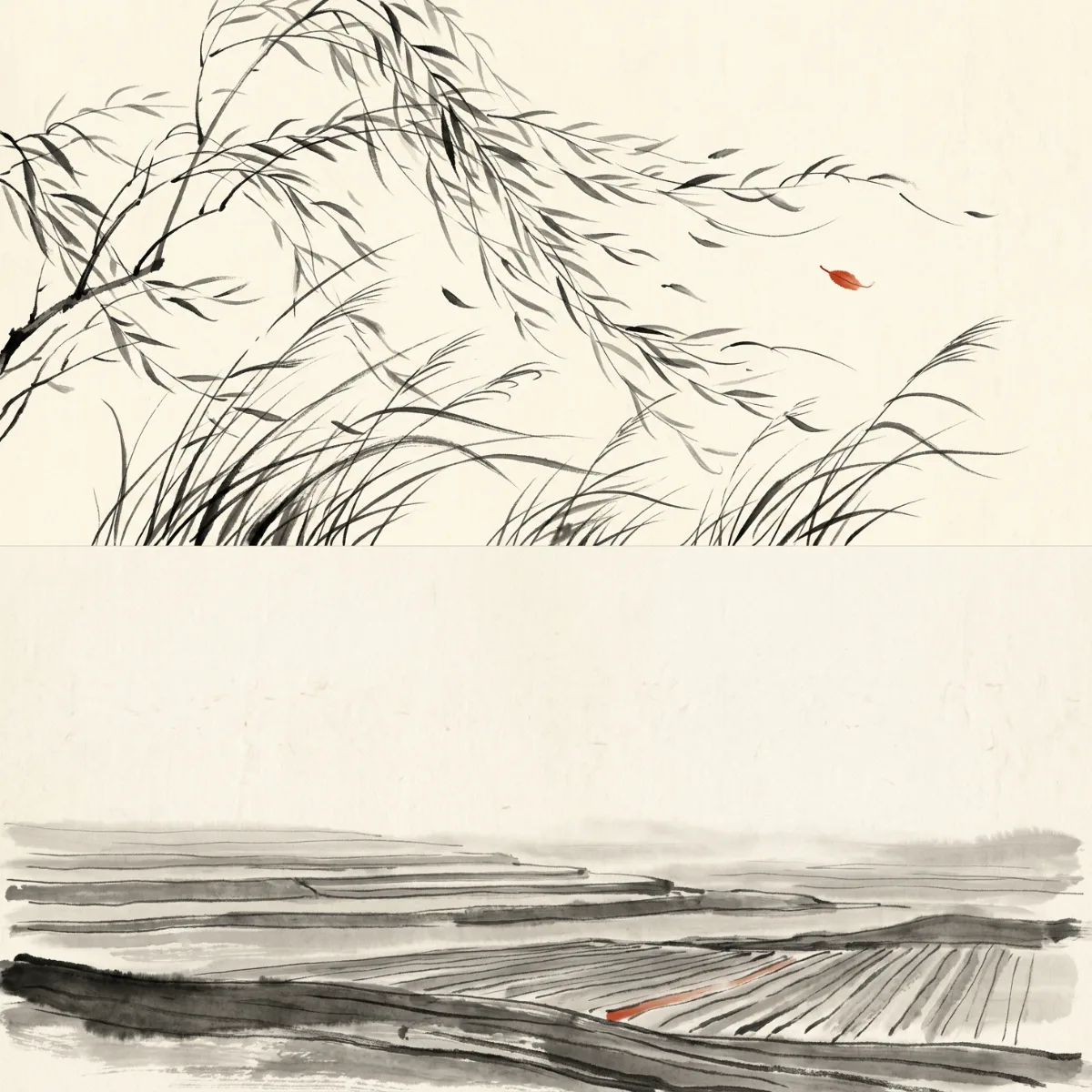 20. Contemplation觀 · GuānBefore a thing can be seen rightly, it must first be looked at quietly enough.
Hexagram 20 (Contemplation) often shows up around stepping back for a moment, looking before you act or taking in the whole situation. At its core: Before a thing can be seen rightly, it must first be looked at quietly enough.
Where this hexagram often fits.
Situations
- stepping back for a moment
- looking before you act
- taking in the whole situation
- unsure whether to intervene
- trying to see the meaning
- calmly observing what's going on
- seeing your own life from outside
- not reacting right away
Questions people ask
- Should I act now or watch first?
- What do I actually see if I look longer?
- How do I get enough distance to see this clearly?
- What does this situation also say about me?
What is often at play
- restlessness to act
- detachment
- attention
- uncertainty
What this asks for
- look longer than your reflex
- let the field reveal itself
- dare to look at yourself too
- patience before you judge
Also searched as
- Contemplation
- Observation
- Reflection
- Overview
- Perspective
- Attention
- Looking on
Core image
This hexagram is about looking from a distance, about seeing without intervening at once. The image is high and open: one surveys, contemplates, and is also seen oneself. What counts here is not quick action, but the quality of attention. What is seen perhaps gets a movement only later.
Tension
Contemplation looks passive to whoever values only outcome. But this hexagram asks for a kind of looking that is already at work. The tension lies in the urge to act too early, or instead to let the looking go empty. Real contemplation is no postponement, but preparation of right measure.
Distortion
Contemplation distorts when looking comes loose from truth. Then it becomes pose, aesthetics, or distance without responsibility. One sees much, but binds oneself to nothing real.
Stance
Look longer than your reflex is used to. Let the field show itself before you lay meaning over it. Stand so that your gaze can also reach back to you. Contemplation here is no luxury, but a discipline of attention.
Closing line
Whoever acts too quickly often sees only afterward what could first have become visible.
Plain-language entrances.
Plain-language entrances to this hexagram. They help with search and recognition, while the reading itself remains rooted in the text and your question.
Hexagram 20 - Contemplation
Hexagram 20 - Contemplation gives language to a recognisable I Ching pattern. Read the linked hexagram as the source, not as a separate interpretation.
Changing lines of hexagram 20
- Line 1. At the start, the seeing is still small and limited. That is not wrong, as long as one knows the limit. A narrow gaze that imagines itself wide is the real danger here.
- Line 2. This line looks from within a limited opening. There is feeling for the field, but little width yet. That may be enough for the small, but not for the great.
- Line 3. At this point the looking itself is examined. One views not only the world, but also one's own life within that world. That makes this line fruitful and uncomfortable.
- Line 4. Here contemplation gains sight of public form, power, and order. One sees how the larger bond works. That asks for seriousness, for looking at this height obliges.
- Line 5. This line shows someone who can contemplate themselves without drowning in it. That makes pure leadership possible. Whoever cannot see themselves ends up seeing the world askew too.
- Line 6. When contemplation ripens fully, it becomes impersonally clear. One then looks without vanity, but also without evasion. This line carries a wide and sober gaze.
The form beneath hexagram 20
Derived from the structure of the I Ching — not an interpretation, but the shape underneath it. The reading above remains the source.
- Balance. Hexagram 20 is predominantly yin — 4 yin lines and 2 yang lines.
- Line pattern. From bottom to top: yin, yin, yin, yin, yang, yang.
- Movement. 63 possible paths of change run from this image — every combination of moving lines leads to a different hexagram.
Built from
Hexagram 20 is built from two trigrams, the natural forces of the I Ching.
Related hexagrams
Sources & reading
Our text is our own, ratified reading of the canonical I Ching — source → human → pattern → fitting movement. It is not a reproduction of the translations above, and not prediction, psychology, or new-age. The reference translations serve to calibrate; protected prose is not taken over.
- Richard Wilhelm / Cary F. Baynes — The I Ching or Book of Changes. symbolic-philosophical, with the Ten Wings — the most influential Western edition.
- James Legge — The Yî King (Sacred Books of the East). scholarly-philological (public domain).
Read what is in motion in your situation.
A hexagram only takes on meaning in relation to your own question. Ask one and read what appears.