
2. Bearing Strength
Bearing Strength is hexagram 2 of the 64 in the I Ching, also known as the Book of Changes (in Chinese Kūn, 坤).
Also known as: The Receptive, Bearing power.
What carries does not need to steer to be decisive.
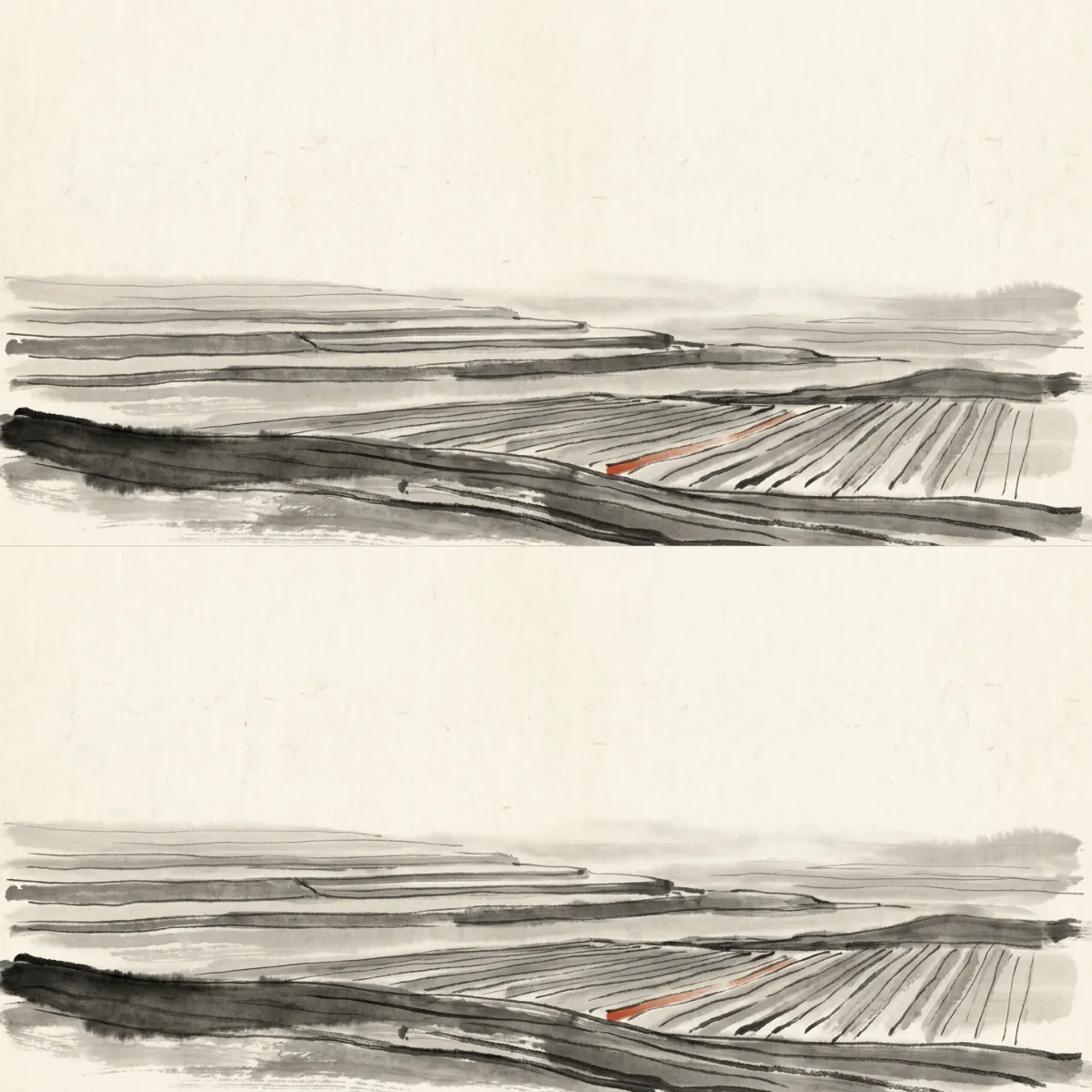 2. Bearing Strength坤 · KūnWhat carries does not need to steer to be decisive.
Hexagram 2 (Bearing Strength) often shows up around a supporting role, working behind the scenes or carrying too much. At its core: What carries does not need to steer to be decisive.
Where this hexagram often fits.
Situations
- a supporting role
- working behind the scenes
- carrying too much
- always holding it together
- afraid to take a stance
- going along with others
- making room for someone
- putting yourself last
Questions people ask
- How do I support without losing myself?
- What is truly mine to carry?
- Can I stay in the background or must I step forward?
- How do I set a boundary without hardening?
What is often at play
- devotion
- overload
- doubt about your place
- resistance to the spotlight
What this asks for
- being available with limits
- staying calmly in place
- carrying without overflowing
- seeing softness as strength
Also searched as
- The Receptive
- Bearing Strength
- Carrying
- Receiving
- Following
- Grounding
- Availability
Core image
This hexagram is earth: wide, quiet, and ready to carry. It pushes nothing forward, yet it makes arising possible. There is no weakness here, but a power that does not begin with steering. What comes in is taken up, held, and fed.
Tension
The mistake is easily made: from the outside, receptivity looks like passivity. But this hexagram does not ask you to disappear. It asks you not to need to be the center. For many that is harder than acting, because the self would rather begin than carry.
Distortion
Bearing strength distorts the moment it becomes formless. Then going along becomes an excuse to take no position. Whoever carries everything ends up carrying what is not theirs as well.
Stance
Be available and bounded at once. Let things land, but do not let yourself be flooded. Carry what is entrusted to you, not everything that asks for attention. Receiving here is a form of precision.
Closing line
What is truly fertile makes room without losing itself.
Plain-language entrances.
Plain-language entrances to this hexagram. They help with search and recognition, while the reading itself remains rooted in the text and your question.
Hexagram 2 - Bearing Strength
Hexagram 2 - Bearing Strength gives language to a recognisable I Ching pattern. Read the linked hexagram as the source, not as a separate interpretation.
Changing lines of hexagram 2
- Line 1. At the start, receptivity still feels cold and bare. There is little to lean on but the refusal to force. So hold your ground without demanding fruit yet.
- Line 2. Here what carries shows itself in simplicity. Nothing needs to be added to act rightly. What is honestly available creates a reliable ground of its own.
- Line 3. At this level the temptation creeps in to turn your carrying into moral credit. Then service goes impure. Carry the work, but build no identity on it.
- Line 4. This line knows the worth of being closed. Not everything needs to be spoken or shown now. Here protection can be wiser than openness.
- Line 5. This is receptivity with dignity. Not submissive, not merely waiting, but quietly in its place. Whoever stands here need not prove that softness is strong.
- Line 6. When receptivity sets no limit for too long, it becomes a field where others park their will. Then the ground is no longer fertile but ground down. Here formless availability must end.
The form beneath hexagram 2
Derived from the structure of the I Ching — not an interpretation, but the shape underneath it. The reading above remains the source.
- Balance. Hexagram 2 is predominantly yin — 6 yin lines and 0 yang lines.
- Line pattern. From bottom to top: yin, yin, yin, yin, yin, yin.
- Movement. 63 possible paths of change run from this image — every combination of moving lines leads to a different hexagram.
Built from
Hexagram 2 is built from two trigrams, the natural forces of the I Ching.
Related hexagrams
Sources & reading
Our text is our own, ratified reading of the canonical I Ching — source → human → pattern → fitting movement. It is not a reproduction of the translations above, and not prediction, psychology, or new-age. The reference translations serve to calibrate; protected prose is not taken over.
- Richard Wilhelm / Cary F. Baynes — The I Ching or Book of Changes. symbolic-philosophical, with the Ten Wings — the most influential Western edition.
- James Legge — The Yî King (Sacred Books of the East). scholarly-philological (public domain).
Read what is in motion in your situation.
A hexagram only takes on meaning in relation to your own question. Ask one and read what appears.