
19. Approach
Approach is hexagram 19 of the 64 in the I Ching, also known as the Book of Changes (in Chinese Lín, 臨).
What approaches brings opening with it, and with it the duty not to grow careless in good fortune.
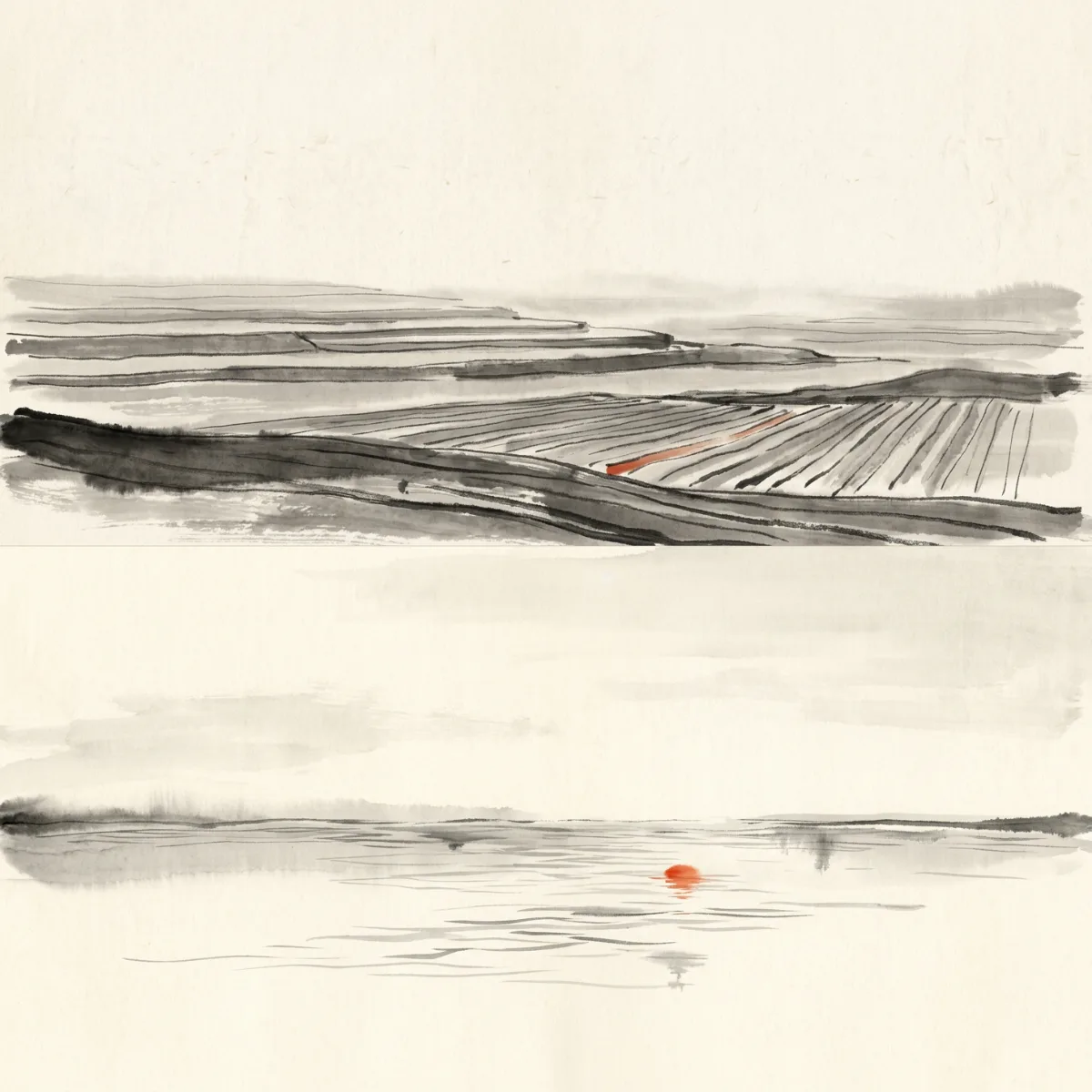 19. Approach臨 · LínWhat approaches brings opening with it, and with it the duty not to grow careless in good fortune.
Hexagram 19 (Approach) often shows up around an opportunity is opening up, something good is drawing closer or a favorable stretch. At its core: What approaches brings opening with it, and with it the duty not to grow careless in good fortune.
Where this hexagram often fits.
Situations
- an opportunity is opening up
- something good is drawing closer
- a favorable stretch
- a new collaboration is growing
- responsibility coming toward you
- success you don't want to squander
- letting someone into your life
- staying alert in good times
Questions people ask
- How do I handle an opportunity that's coming my way?
- How do I avoid getting sloppy when things are going well?
- What does this favorable time ask of me?
- How do I carry growing responsibility?
What is often at play
- openness
- optimism
- ease
- trust
What this asks for
- stay careful
- carry the chance rather than claim it
- stay alert in leadership
- don't get too familiar too fast
Also searched as
- Approach
- Drawing near
- Approaching
- Arrival
- Opening
- Closeness
- Onset
Core image
This hexagram shows a movement of coming near. Something opens, something descends, something comes within reach. The atmosphere is favorable: there is access, contact, growing nearness. The field grows richer and more receptive. But for that very reason this time asks for measure.
Tension
Approach tempts one to ease. The moment something comes closer, people begin to think it is already theirs. But this hexagram points out that favorable movement is no possession. What approaches still has to be received, guided, and carried.
Distortion
Approach distorts when one nests early in the good fortune. Then openness becomes self-evident and care disappears. One already lives in the harvest while the work of carrying has yet to begin.
Stance
Receive the near widely and without cramp, but not carelessly. What comes closer also lays more bare. A favorable time especially asks for wakeful leadership. Whoever carries approach well spares it from decay.
Closing line
Good fortune often spoils not through enmity, but through too quick a familiarity.
Plain-language entrances.
Plain-language entrances to this hexagram. They help with search and recognition, while the reading itself remains rooted in the text and your question.
Hexagram 19 - Approach
Hexagram 19 - Approach gives language to a recognisable I Ching pattern. Read the linked hexagram as the source, not as a separate interpretation.
Changing lines of hexagram 19
- Line 1. At the start, approach shows itself in a pure first opening. That is a good sign, but no resting place yet. The first step especially must stay simple and clear.
- Line 2. Here the approach becomes truly favorable. What comes can be received honestly. That gives room for broad effect.
- Line 3. At this point one goes soft in enjoying the openness. One lets measure slacken because everything already seems favorable. This line warns against cozy carelessness.
- Line 4. Here approach can take concrete and right form. What was opened is now brought into shape. The favor takes on a body.
- Line 5. This line shows dignified approach from a central position. Not everything has to be done oneself; receiving well is the great art here. The strength lies in right relation, not in takeover.
- Line 6. When approach reaches its end, the shadow of later distance already appears. That does not make this line bad, but it does make it sober. Carry the favorable time in such a way that you do not summon its end ahead of time.
The form beneath hexagram 19
Derived from the structure of the I Ching — not an interpretation, but the shape underneath it. The reading above remains the source.
- Balance. Hexagram 19 is predominantly yin — 4 yin lines and 2 yang lines.
- Line pattern. From bottom to top: yang, yang, yin, yin, yin, yin.
- Movement. 63 possible paths of change run from this image — every combination of moving lines leads to a different hexagram.
Built from
Hexagram 19 is built from two trigrams, the natural forces of the I Ching.
Related hexagrams
Sources & reading
Our text is our own, ratified reading of the canonical I Ching — source → human → pattern → fitting movement. It is not a reproduction of the translations above, and not prediction, psychology, or new-age. The reference translations serve to calibrate; protected prose is not taken over.
- Richard Wilhelm / Cary F. Baynes — The I Ching or Book of Changes. symbolic-philosophical, with the Ten Wings — the most influential Western edition.
- James Legge — The Yî King (Sacred Books of the East). scholarly-philological (public domain).
Read what is in motion in your situation.
A hexagram only takes on meaning in relation to your own question. Ask one and read what appears.