
15. Modesty
Modesty is hexagram 15 of the 64 in the I Ching, also known as the Book of Changes (in Chinese Qiān, 謙).
What truly has height has no need to display it.
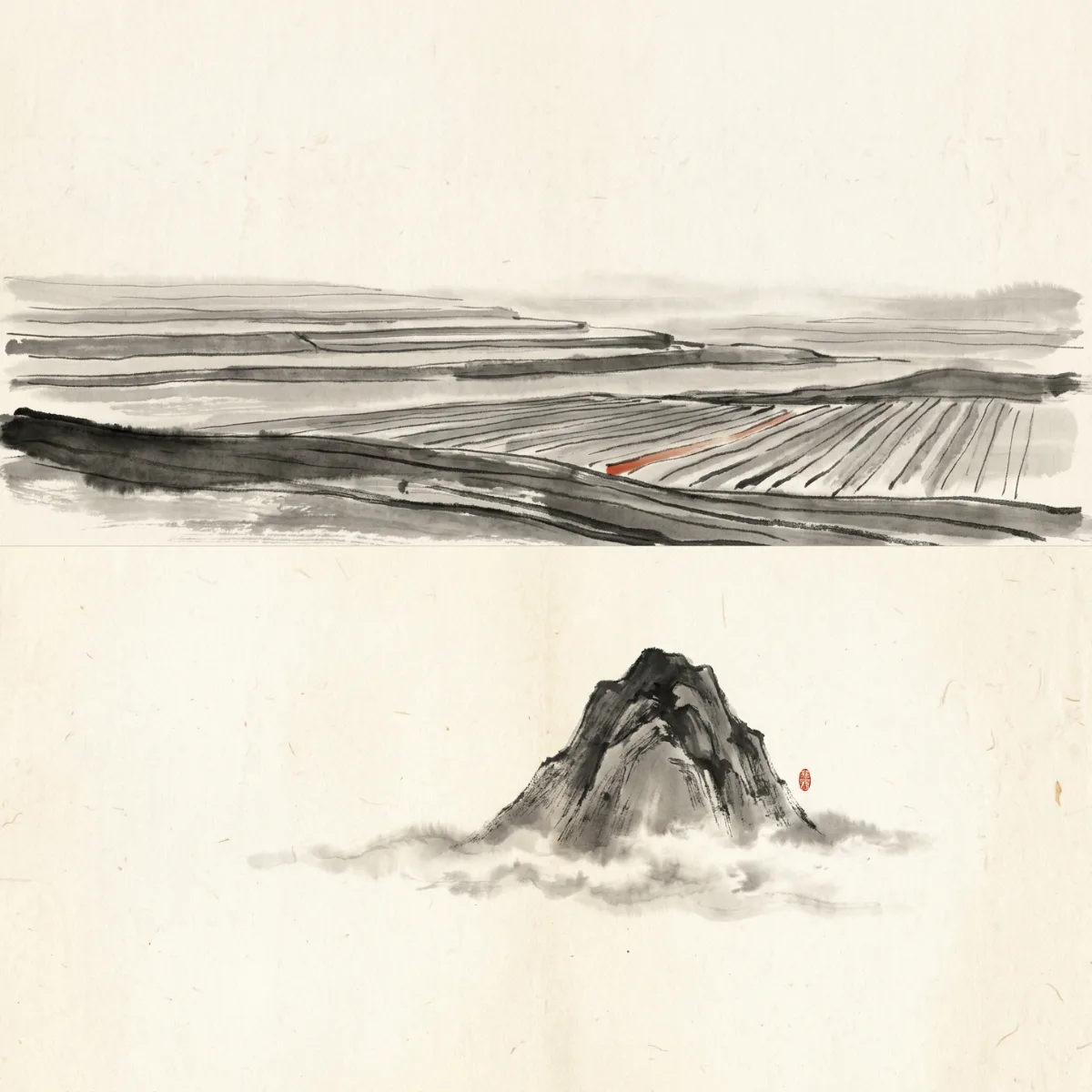 15. Modesty謙 · QiānWhat truly has height has no need to display it.
Hexagram 15 (Modesty) often shows up around staying grounded amid success, not bragging or not needing to flaunt your weight. At its core: What truly has height has no need to display it.
Where this hexagram often fits.
Situations
- staying grounded amid success
- not bragging
- not needing to flaunt your weight
- smoothing out differences
- finding the right measure
- standing modest but solid
- taking no more room than needed
- strength without display
Questions people ask
- How do I stay grounded without erasing myself?
- What is the right measure here?
- How do I let my weight show without display?
- When is modesty real and when is it a pose?
What is often at play
- composure
- doubt about asserting yourself
- calm
- resistance to showing off
What this asks for
- staying in proportion
- showing capacity, not claims
- authenticity
- not making yourself smaller than true
Also searched as
- Modesty
- Humility
- Groundedness
- Restraint
- Understatement
- Inner measure
- Sobriety
Core image
This hexagram shows strength that does not push itself to the foreground. The low and the high find a right relation here because nothing inflates itself. Modesty is not self-diminishment, but precise measure. What truly has weight need not lean on display.
Tension
The difficulty is that many mistake modesty for weakness, or for social decorum. But this hexagram does not ask you to become smaller than is true. It asks that greatness not need its own volume. What has to prove itself already stands here at a loss.
Distortion
Modesty distorts when it is performed. Then humility becomes a fine form of vanity. One makes oneself small in order to seem morally larger by it.
Stance
Stay in measure. Take no more room than the matter asks, but no less than the task requires. Let weight show through load-bearing, not through claim. Real modesty makes the relations lighter without losing the seriousness.
Closing line
Whoever keeps measure rarely has to fight for a place.
Plain-language entrances.
Plain-language entrances to this hexagram. They help with search and recognition, while the reading itself remains rooted in the text and your question.
Hexagram 15 - Modesty
Hexagram 15 - Modesty gives language to a recognisable I Ching pattern. Read the linked hexagram as the source, not as a separate interpretation.
Changing lines of hexagram 15
- Line 1. At the start, modesty shows itself in simple, unadorned effort. Nothing is won here by making yourself larger. It is the quiet step that opens the way.
- Line 2. This line shows that real modesty need not stay hidden. What is in measure works through without much noise. That is exactly why it is believed.
- Line 3. Here someone carries much, but without display. That makes influence possible. Whoever keeps bearing the load without hoisting themselves on it keeps the center clean.
- Line 4. At this point modesty may also become active — not as self-promotion, but as right effort. What is in measure may show itself when the situation asks for it.
- Line 5. Here it becomes clear that modesty is no slackness. One can still intervene, correct, and set limits. It is only done without an inflated sense of self.
- Line 6. When modesty has done its work, it can even grow stern without losing its nature. Then the necessary is no longer postponed. Whoever truly stays low can sometimes correct the hardest.
The form beneath hexagram 15
Derived from the structure of the I Ching — not an interpretation, but the shape underneath it. The reading above remains the source.
- Balance. Hexagram 15 is predominantly yin — 5 yin lines and 1 yang lines.
- Line pattern. From bottom to top: yin, yin, yang, yin, yin, yin.
- Movement. 63 possible paths of change run from this image — every combination of moving lines leads to a different hexagram.
Built from
Hexagram 15 is built from two trigrams, the natural forces of the I Ching.
Related hexagrams
Sources & reading
Our text is our own, ratified reading of the canonical I Ching — source → human → pattern → fitting movement. It is not a reproduction of the translations above, and not prediction, psychology, or new-age. The reference translations serve to calibrate; protected prose is not taken over.
- Richard Wilhelm / Cary F. Baynes — The I Ching or Book of Changes. symbolic-philosophical, with the Ten Wings — the most influential Western edition.
- James Legge — The Yî King (Sacred Books of the East). scholarly-philological (public domain).
Read what is in motion in your situation.
A hexagram only takes on meaning in relation to your own question. Ask one and read what appears.