
11. Peace
Peace is hexagram 11 of the 64 in the I Ching, also known as the Book of Changes (in Chinese Tài, 泰).
When the high and the low find each other again, the world starts to breathe.
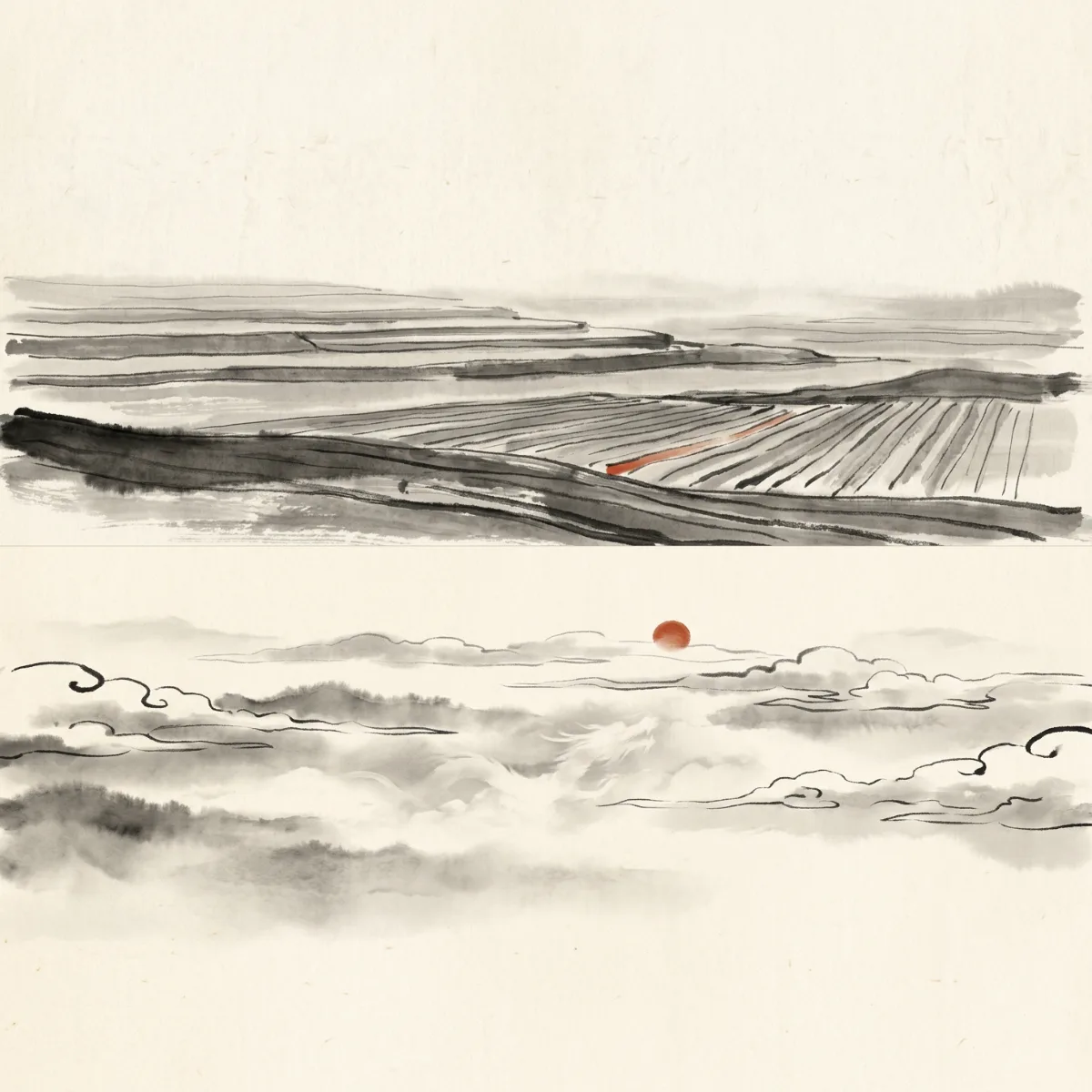 11. Peace泰 · TàiWhen the high and the low find each other again, the world starts to breathe.
Hexagram 11 (Peace) often shows up around everything is flowing, good collaboration or an open connection. At its core: When the high and the low find each other again, the world starts to breathe.
Where this hexagram often fits.
Situations
- everything is flowing
- good collaboration
- an open connection
- things just click
- mutual trust
- a fruitful period
- things falling into place
- harmony in a relationship
Questions people ask
- How do I hold on to what's going well now?
- What does a fruitful period ask of me?
- How do I keep tending openness instead of taking it for granted?
- What keeps the connection alive?
What is often at play
- relief
- trust
- gratitude
- ease
What this asks for
- maintaining what works
- staying open
- not getting complacent
- keeping the exchange going
Also searched as
- Peace
- Harmony
- Flow
- Attunement
- Open channel
- Connection
- Equilibrium
Core image
This hexagram describes a state of through-flow. What sits above descends; what lives below rises. Force and receptivity do not close themselves off from each other, but find traffic. Peace here is no resting plate, but a living order.
Tension
A favorable time itself breeds carelessness. When things flow, one quickly assumes that order is self-evident. But peace does not keep itself. The moment relations are no longer tended, the form stays standing a while as the traffic thins.
Distortion
Peace distorts when prosperity grows complacent. Then the forms stay intact a while longer, but the exchange is already impoverishing. One lives in the peace but no longer maintains it.
Stance
Stay grateful, precise, and not triumphant. Tend the passages that make this openness possible. Let what is high come down and what is low rise. Where the traffic stalls, peace stops being a living form.
Closing line
True harmony is not smooth, but permeable.
Plain-language entrances.
Plain-language entrances to this hexagram. They help with search and recognition, while the reading itself remains rooted in the text and your question.
Hexagram 11 - Peace
Hexagram 11 - Peace gives language to a recognisable I Ching pattern. Read the linked hexagram as the source, not as a separate interpretation.
Changing lines of hexagram 11
- Line 1. At the base, peace shows itself in small, healthy ties. When the roots are well entangled, more comes up with you than you could have carried alone. Here order begins underground.
- Line 2. This line brings generosity into the center. Not everything has to be made fitting first in order to be taken in. Great order arises here from inner breadth, not from narrow purity.
- Line 3. Even in a favorable time the world chafes. This line recalls that alternation is no contradiction of peace, but its condition. Whoever tolerates only the rising line understands nothing of order.
- Line 4. At this point it becomes visible who truly takes part in the flow and who merely rides along. Openness here asks for genuineness, not decorum. What wants to seem light but carries nothing is found out.
- Line 5. Here peace stands at its most dignified point. There is authority without distance and connection without loss of form. Do not possess this state; serve it.
- Line 6. When peace comes to completion, its vulnerability also begins. Whoever thinks this is the final stop invites the turn. This line asks for sobriety at the summit.
The form beneath hexagram 11
Derived from the structure of the I Ching — not an interpretation, but the shape underneath it. The reading above remains the source.
- Balance. Hexagram 11 is in full balance — 3 yang lines and 3 yin lines.
- Line pattern. From bottom to top: yang, yang, yang, yin, yin, yin.
- Movement. 63 possible paths of change run from this image — every combination of moving lines leads to a different hexagram.
Built from
Hexagram 11 is built from two trigrams, the natural forces of the I Ching.
Related hexagrams
Sources & reading
Our text is our own, ratified reading of the canonical I Ching — source → human → pattern → fitting movement. It is not a reproduction of the translations above, and not prediction, psychology, or new-age. The reference translations serve to calibrate; protected prose is not taken over.
- Richard Wilhelm / Cary F. Baynes — The I Ching or Book of Changes. symbolic-philosophical, with the Ten Wings — the most influential Western edition.
- James Legge — The Yî King (Sacred Books of the East). scholarly-philological (public domain).
Read what is in motion in your situation.
A hexagram only takes on meaning in relation to your own question. Ask one and read what appears.